Buying sand for a sandbox, paver project, or drainage fix? Order too little and you're making a second trip to the supplier. Order too much and you're paying for sand that sits in your driveway for months.
The good news: calculating how much sand you need is straightforward once you know the formula. This guide walks you through the math, breaks down the three main sand types, shows you exactly how much each covers, and links to a free calculator that does all the work for you.
How to Calculate Sand Needed
The formula works the same way for any project — playground sandbox, paver base, or fill sand for leveling:
| Step | Formula | Example (10 x 10 ft, 3 in deep) |
|---|---|---|
| 1. Find area | Length × Width | 10 × 10 = 100 ft² |
| 2. Convert depth | Depth (in) ÷ 12 | 3 ÷ 12 = 0.25 ft |
| 3. Calculate volume | Area × Depth (ft) | 100 × 0.25 = 25 ft³ |
| 4. Convert to yards | Cubic feet ÷ 27 | 25 ÷ 27 = 0.93 yd³ |
| 5. Convert to tons | Cubic yards × 1.4 | 0.93 × 1.4 = 1.30 tons |
Sand Coverage Chart
Different sand types have slightly different densities, which affects how many tons you need for the same area. Here's the complete coverage chart:
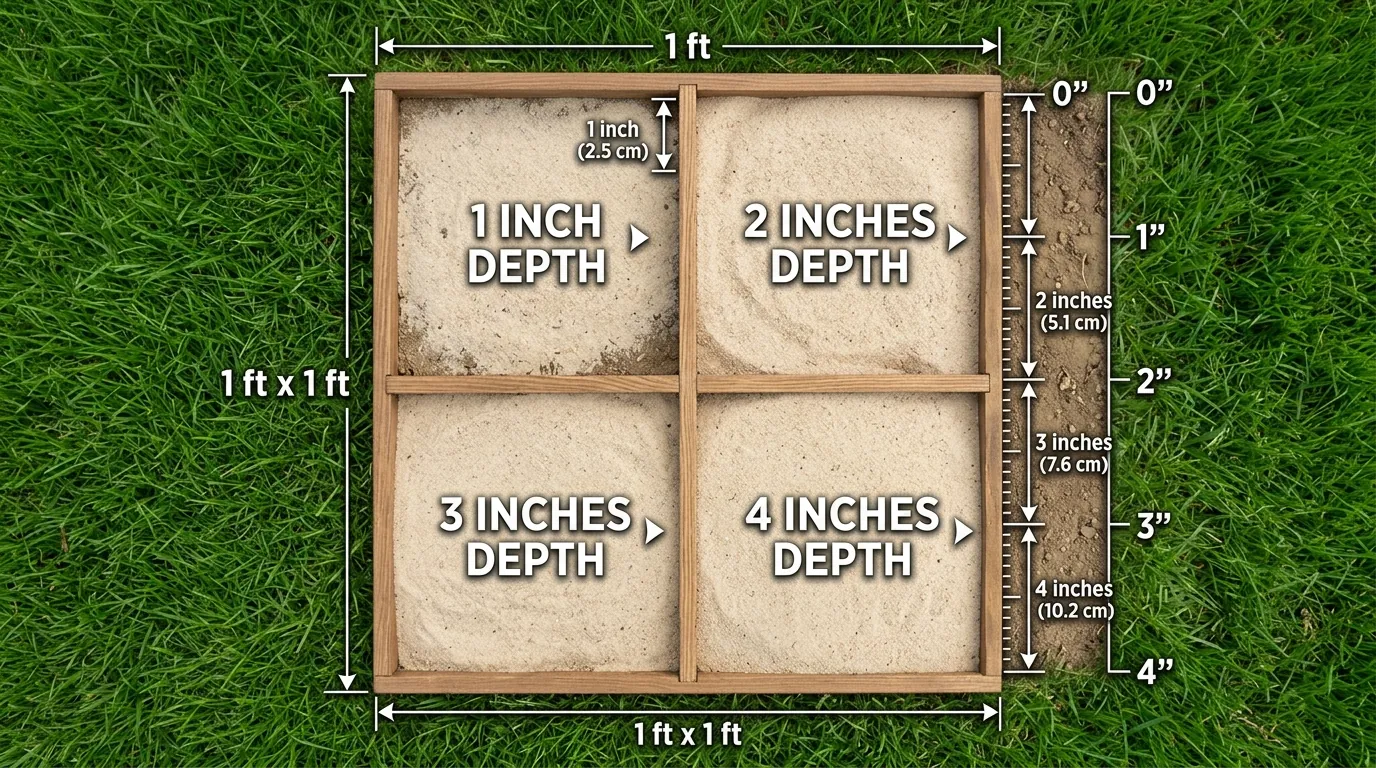
| Sand Type | Density (lb/ft³) | 1 Ton @ 2 in | 1 Ton @ 3 in | 1 Ton @ 4 in | Best For |
|---|---|---|---|---|---|
| Play Sand | 100 | 120 ft² | 80 ft² | 60 ft² | Sandboxes, children's play areas |
| Mason Sand | 105 | 114 ft² | 76 ft² | 57 ft² | Paver bases, concrete mixing, leveling |
| Concrete Sand | 110 | 109 ft² | 73 ft² | 55 ft² | Concrete mixing, driveways |
| Fill Sand | 100 | 120 ft² | 80 ft² | 60 ft² | Grading, leveling, drainage |
| Pool Sand | 105 | 114 ft² | 76 ft² | 57 ft² | Pool bases, under-liner fill |
Sand Depth Recommendations
Depth is the number most people get wrong. Too thin and the sand shifts. Too deep and you waste money on material you don't need. Here's what most projects require:
| Project Type | Recommended Depth | Sand Type | Notes |
|---|---|---|---|
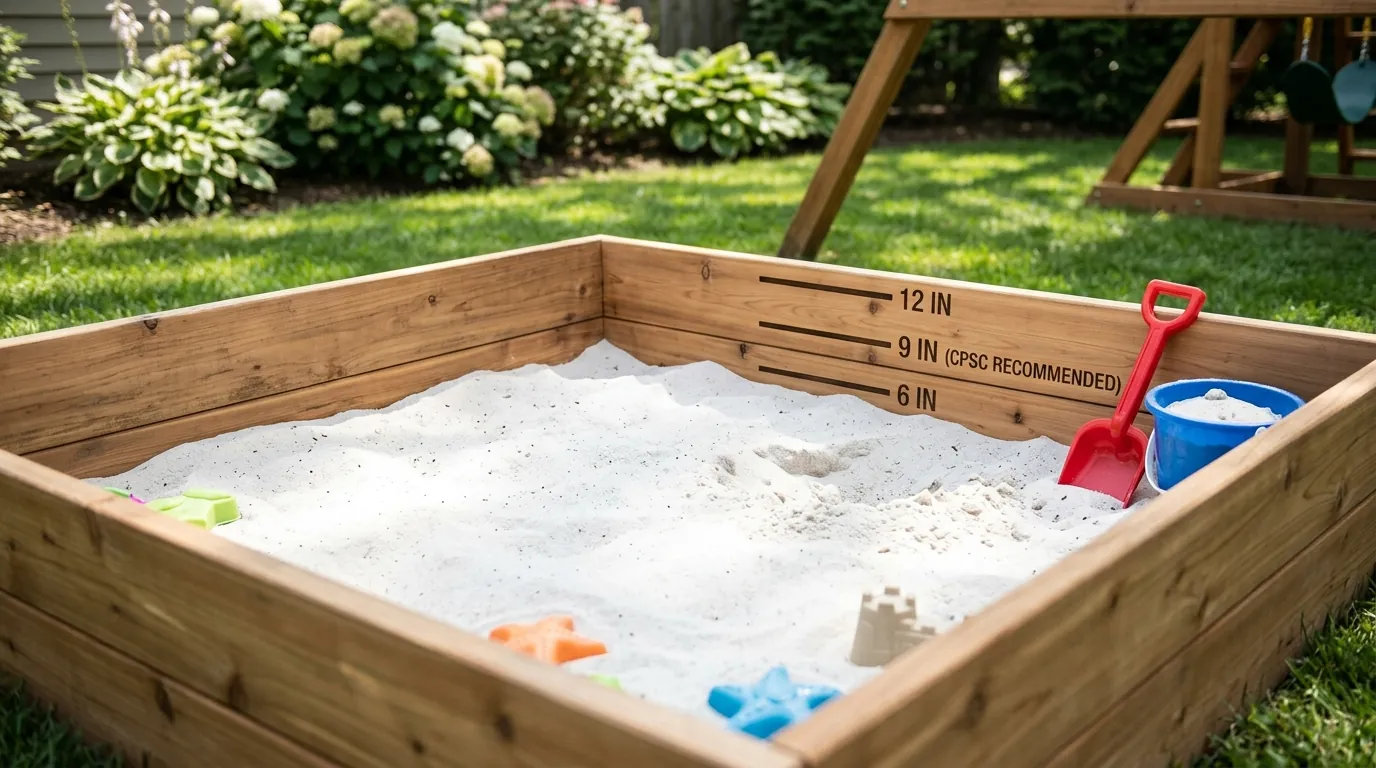
| Children's sandbox | 8–12 inches | Play sand | Deeper is safer and more fun for kids |
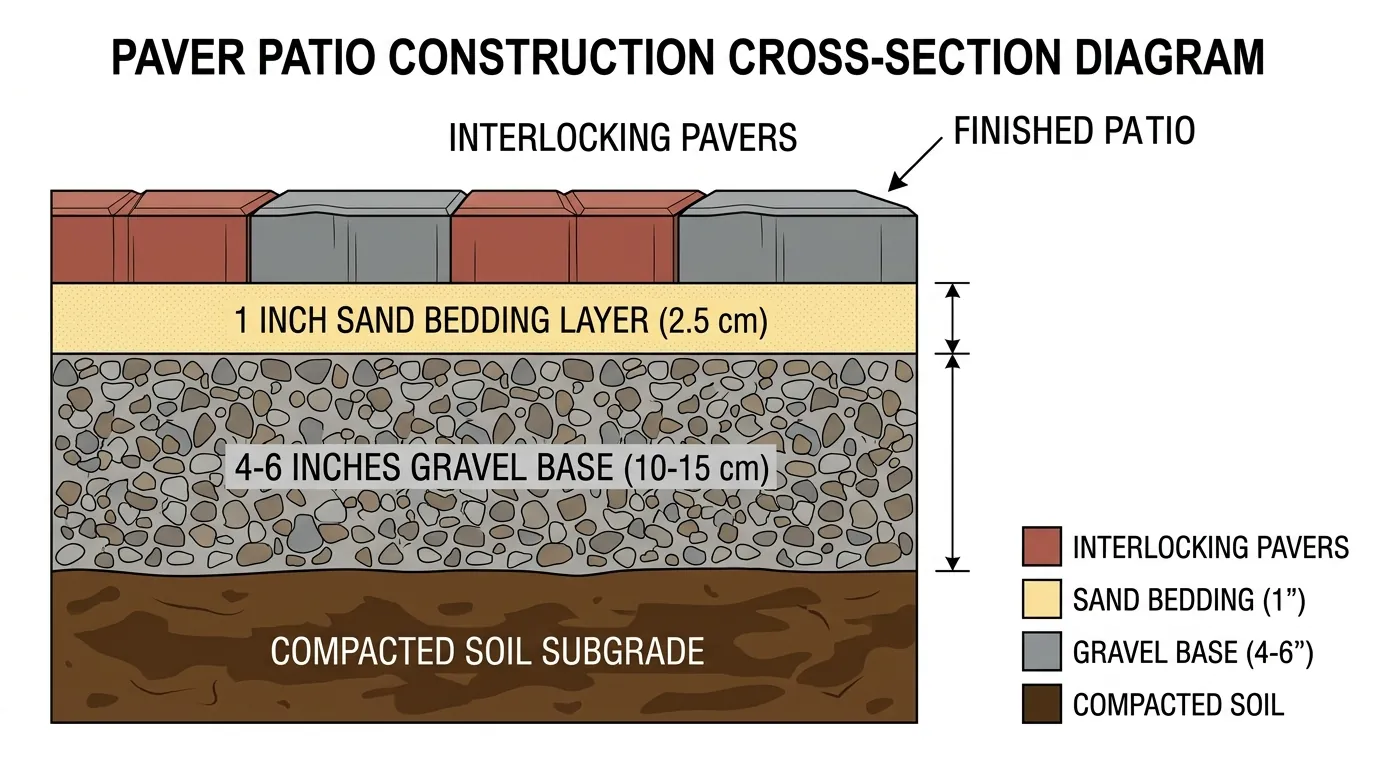
| Paver bedding layer | 1 inch | Mason sand | Thin layer on top of compacted gravel base |
| Walkway base | 4–6 inches | Concrete sand | Compact in 2-inch lifts |
| Driveway base | 6–8 inches | Concrete sand | Use geotextile fabric on soft soil |
| Leveling / grading | 1–3 inches | Fill sand | Use to fill low spots before turf or pavers |
| Drainage fill | 6–12 inches | Fill sand | Around French drains, septic systems |
| Pool base | 2–4 inches | Pool sand | Smooth, compacted layer under liner |
Use Our Free Sand Calculator
Enter your project dimensions, choose a sand type, and get instant estimates for cubic yards, tons, and cost.
Sand CalculatorSand Types Explained
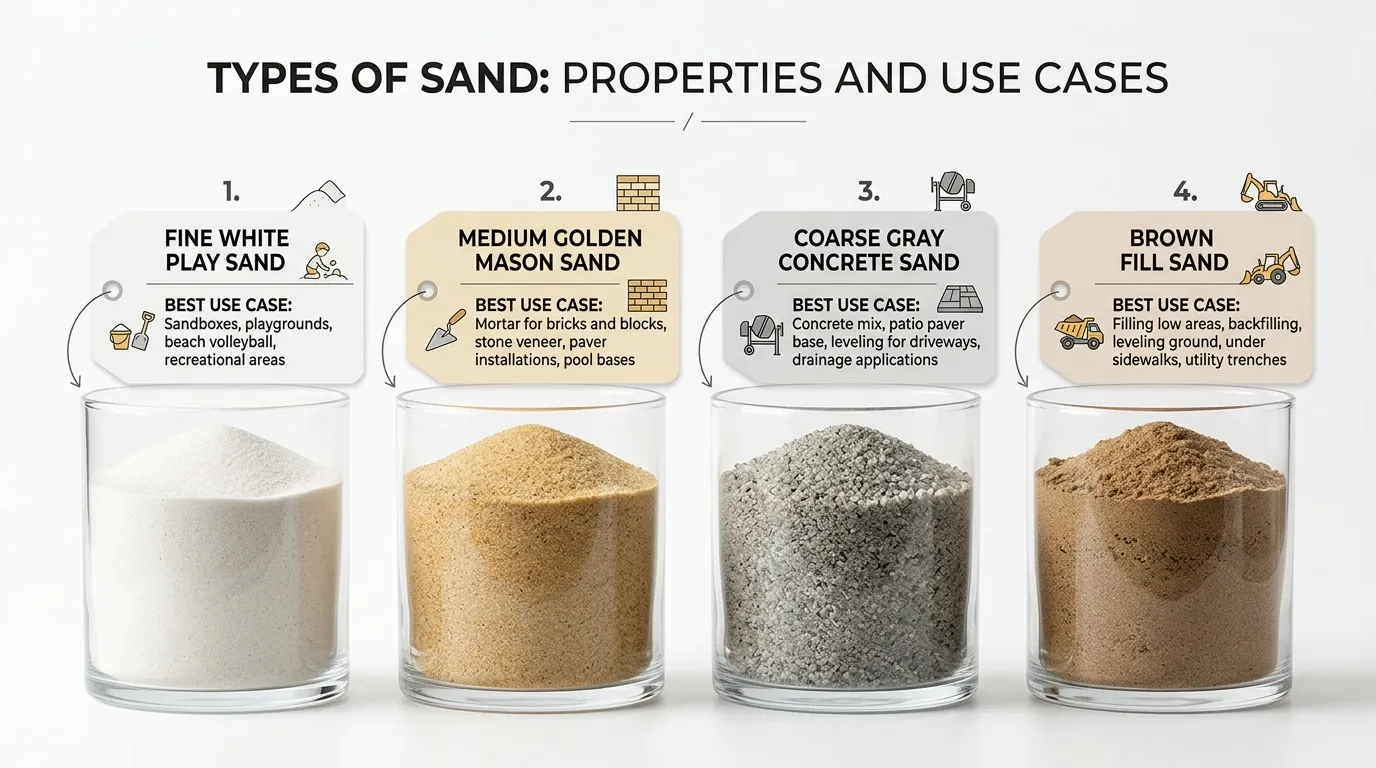
Not all sand is the same. Using the wrong type can ruin a project. Here's what each type is designed for:
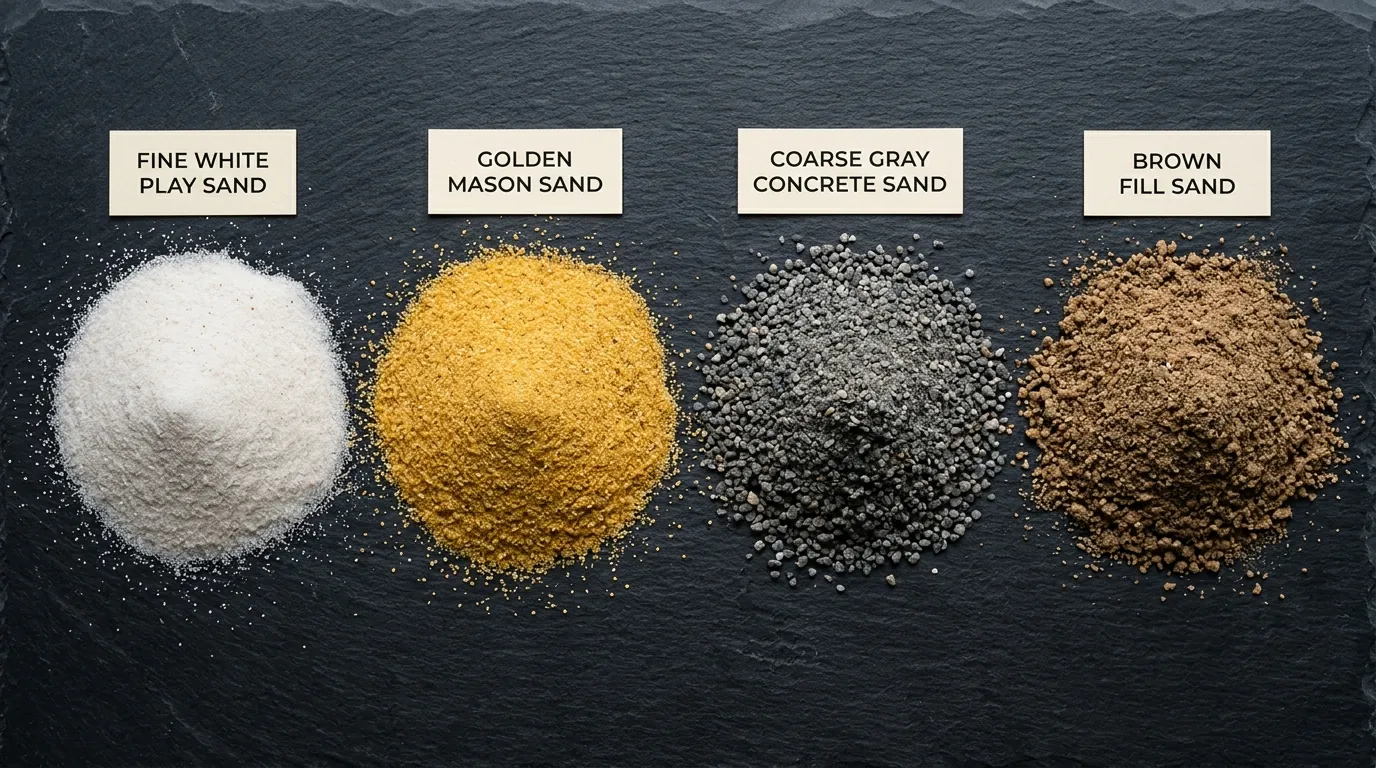
Play Sand
Play sand is fine-grained, washed, and rounded — specifically processed to be safe for children. It's free of sharp edges and harmful minerals. At 90 lb/ft³, it's the lightest sand type, which means one ton covers more area (89 sq ft at 3 inches). Play sand is ideal for sandboxes, play areas, and sensory tables. It costs $30-$60 per cubic yard due to the extensive washing and safety processing required. Never use construction sand in a children's sandbox — it can contain silica dust and sharp particles. The Consumer Product Safety Commission (CPSC) recommends at least 9 inches of play sand under and around play equipment for fall protection.
Mason Sand
Mason sand is coarser and angular, making it ideal for construction applications. At 100 lb/ft³, it compacts firmly and provides a stable base. Use it for paver bedding layers, concrete mixing, and leveling. Mason sand costs $35-$50 per cubic yard. It's the most versatile sand type for residential projects — most contractors keep it in stock. The fine texture allows it to fill small gaps between pavers and create a smooth, level surface. When used as a paver bedding layer, mason sand should be exactly 1 inch thick on top of compacted gravel base.
Concrete Sand
Concrete sand is coarse, angular, and specifically graded for mixing with cement and aggregate. At 105 lb/ft³, it's the densest option. Use it for concrete projects, driveway bases, and large-scale construction. It costs $25-$45 per cubic yard. The angular shape creates strong interlock when compacted, making it ideal for load-bearing applications. Concrete sand meets strict specifications for particle size and cleanliness, which is why it costs more than fill sand. For residential concrete projects, this is the sand type your contractor will use.
Fill Sand
Fill sand is a general-purpose sand used for grading, leveling, and filling low spots. At 95 lb/ft³, it's slightly lighter than mason sand. It's the most affordable option at $15-$35 per cubic yard. Fill sand works well for drainage projects, backfilling, and preparing subgrade before turf installation. It's not suitable for visible applications because it may contain more fines and organic material. Fill sand compacts well and provides excellent drainage, making it the go-to choice for utility trenches and septic system backfill.
Sand Weight & Cost
Sand is sold by the cubic yard or by the ton. Here's what to expect:
| Sand Type | Cost per Cubic Yard | Cost per Ton | Weight per Cubic Yard |
|---|---|---|---|
| Play Sand | $30 – $60 | $40 – $75 | ~2,700 lbs |
| Mason Sand | $35 – $50 | $40 – $65 | ~2,835 lbs |
| Concrete Sand | $25 – $45 | $30 – $55 | ~2,970 lbs |
| Fill Sand | $15 – $35 | $20 – $45 | ~2,700 lbs |
| Pool Sand | $30 – $50 | $35 – $60 | ~2,835 lbs |
Bulk Sand vs Bagged Sand
Most suppliers offer sand in two forms: bulk delivery by the cubic yard, and pre-packaged bags (usually 50-60 lbs each). The right choice depends on your project size:
| Feature | Bulk Sand | Bagged Sand |
|---|---|---|
| Cost per cubic yard | $10 – $45 | $150 – $300 (equivalent) |
| Delivery | Supplier delivers (truck load) | DIY transport from store |
| Best for | Projects over 1 cubic yard | Projects under 0.5 cubic yard |
| Minimum order | Usually 1–2 cubic yards | No minimum |
| Convenience | Requires space for pile | Store-bought, carry home |
A 100 sq ft sandbox at 12 inches deep needs about 3.7 cubic yards. That's about 60 bags at 50 lbs each, or one bulk delivery. Bulk sand is dramatically cheaper for any project over about 0.5 cubic yard.
Common Mistakes When Ordering Sand
Play sand in a paver base will shift and collapse. Mason sand in a sandbox is too coarse for kids. Always match the sand type to the project.
Sand compacts 10-15% when wet and compacted. If you need 6 inches of finished depth, order enough for 7 inches to account for settling.
Most suppliers have a 1-2 cubic yard minimum for delivery. Ordering less means paying the same delivery fee for a smaller load. Combine projects or split an order with a neighbor.
Running short mid-project means a second delivery trip, which doubles your delivery cost. Order 10% extra — it's almost always cheaper than a second trip.
How to Order Sand
Ordering sand seems simple, but a few smart moves can save you significant money. Here's the process most experienced contractors follow:
Use the formula above or our free calculator to determine exactly how many cubic yards you need. Never guess — ordering too much wastes money, ordering too little means a second delivery.
Call local landscape yards, quarry operators, and building supply stores. Prices can vary 30-50% between suppliers for the same sand type. Ask for the price per cubic yard delivered, not just the material price.
Most suppliers have a 1-2 cubic yard minimum for delivery. Delivery fees range from $50-$200 depending on distance. Many suppliers offer free delivery on orders over 5 cubic yards — always ask.
Make sure you're getting the right sand for your project. Say "I need play sand for a children's sandbox" or "I need mason sand for a paver patio" — don't just say "sand." The wrong type can ruin your project.
Ensure the delivery truck can reach your project area. Dump trucks need about 12 feet of width and 20 feet of height clearance. If the truck can't get close, you'll need to wheelbarrow the sand to your project — which adds hours of labor.
Regional Price Differences
Sand prices vary significantly across the United States. Your location affects both the material cost and delivery fees:
| Region | Material Cost (per yd³) | Delivery Cost | Notes |
|---|---|---|---|
| Northeast | $25 – $50 | $60 – $150 | Higher delivery fees due to urban logistics |
| Midwest | $20 – $40 | $40 – $90 | Lower material costs, moderate delivery |
| South | $20 – $45 | $35 – $80 | Sand is more available, lower transport costs |
| West Coast | $30 – $55 | $60 – $180 | Coastal supply constraints push prices higher |
| Mountain West | $25 – $50 | $50 – $120 | Longer haul distances increase delivery costs |
These are 2026 national averages. Your actual price depends on proximity to sand quarries, local demand, and seasonal factors. Spring and summer are peak seasons — prices tend to be 10-15% higher than winter.
Worked Examples
Example 1: Children's Sandbox
A 5 × 5 ft sandbox with 10 inches of play sand:
| Step | Calculation | Result |
|---|---|---|
| Area | 5 × 5 | 25 ft² |
| Volume | 25 × (10/12) | 20.83 ft³ = 0.77 yd³ |
| Tons (play sand) | 0.77 × 1.4 | 1.08 tons |
| With 10% waste | 1.08 × 1.10 | 1.19 tons |
| Estimated Cost ($45/yd³) | 0.77 × $45 | $34.65 |
| Bags (50 lb each) | 1,652 lbs ÷ 50 | 34 bags |
| Bag Cost ($6/bag) | 34 × $6 | $204 |
Example 2: Paver Patio Base
A 12 × 16 ft patio with 1 inch mason sand bedding on top of gravel base:
| Step | Calculation | Result |
|---|---|---|
| Area | 12 × 16 | 192 ft² |
| Volume | 192 × (1/12) | 16 ft³ = 0.59 yd³ |
| Tons (mason sand) | 0.59 × 1.4 | 0.83 tons |
| With 10% waste | 0.83 × 1.10 | 0.91 tons |
| Estimated Cost ($42/yd³) | 0.59 × $42 | $24.78 |
Note: This is just the sand bedding layer. The gravel base (4-6 inches) is calculated separately using a gravel calculator.
Example 3: Driveway Base
An 80 × 12 ft driveway with 6 inches of concrete sand base:
| Step | Calculation | Result |
|---|---|---|
| Area | 80 × 12 | 960 ft² |
| Volume | 960 × (6/12) | 480 ft³ = 17.78 yd³ |
| Tons (concrete sand) | 17.78 × 1.4 | 24.89 tons |
| With 10% waste | 24.89 × 1.10 | 27.38 tons |
| Estimated Cost ($35/yd³) | 17.78 × $35 | $622.30 |
| Delivery (often free at 5+ yd³) | — | $0 – $100 |
Example 4: Garden Leveling
A 20 × 30 ft garden area with 2 inches of fill sand to fix low spots:
| Step | Calculation | Result |
|---|---|---|
| Area | 20 × 30 | 600 ft² |
| Volume | 600 × (2/12) | 100 ft³ = 3.70 yd³ |
| Tons (fill sand) | 3.70 × 1.35 | 5.00 tons |
| With 10% waste | 5.00 × 1.10 | 5.50 tons |
| Estimated Cost ($25/yd³) | 3.70 × $25 | $92.50 |
Frequently Asked Questions
How many cubic yards of sand do I need for a sandbox?
For a 4×4 ft sandbox with 12 inches of depth, you need about 0.5 cubic yards. For a 6×6 ft sandbox at 12 inches, you need about 1.1 cubic yards. For a standard 5×5 ft sandbox at 10 inches, you need about 0.77 cubic yards.
How much does a cubic yard of sand weigh?
Dry sand weighs approximately 2,700 pounds per cubic yard (100 lbs per cubic foot). Wet sand can weigh up to 3,240 pounds per cubic yard (120 lbs per cubic foot). A cubic yard of sand covers about 80 square feet at 3 inches deep.
What is the difference between play sand and mason sand?
Play sand is fine-grained, washed, and rounded — safe for children's sandboxes. Mason sand is coarser, angular, and used for paver bases, concrete mixing, and leveling. Play sand costs $30-$60 per cubic yard; mason sand costs $35-$50.
How deep should sand be under pavers?
Use 1 inch of concrete sand as a bedding layer on top of 4-6 inches of compacted gravel base. For walkways, 4 inches of gravel base is sufficient. For driveways, use 6-8 inches of compacted gravel with 1 inch of sand.
How much does sand delivery cost?
Delivery typically costs $50-$200 per load depending on distance and quantity. Ordering 5+ cubic yards usually gets free delivery from most suppliers. Small orders may have a minimum delivery charge of $50-$100.
How many bags of sand equal a cubic yard?
One cubic yard equals 27 cubic feet. A standard 50 lb bag is about 0.5 cubic feet — so 54 bags per cubic yard. A 60 lb bag is about 0.67 cubic feet — about 40 bags per cubic yard. At $5-$8 per bag, that's $270-$432 per cubic yard in bags vs $25-$60 for bulk delivery.
Can I use play sand for pavers?
No. Play sand is too fine and rounded — it won't compact properly and will shift under pavers. Use mason sand or concrete sand for paver bedding layers. These angular grains lock together when compacted, providing a stable base.
How far in advance can I order sand?
Most suppliers can deliver within 1-3 business days. For large projects, order 1-2 weeks in advance to ensure availability. During peak season (spring and summer), lead times can extend to 5-7 days.
How much is a yard of sand?
A cubic yard of sand costs $15 to $60 depending on the type. Fill sand is cheapest at $15-$35 per yard. Play sand is most expensive at $30-$60 per yard. Delivery adds $50-$150 on top of the material cost.
Is sand sold by the ton or by the cubic yard?
Both. Most landscape suppliers sell by the cubic yard for bulk orders. Quarries and large commercial orders often sell by the ton. One cubic yard of dry sand weighs approximately 1.3-1.5 tons, so you can convert between the two.
Data Sources
- The Home Depot – Sand Calculator & Buying Guide
- Lowe's – How to Calculate Sand for Your Project
- Family Handyman – Sand for Pavers and Concrete
- The Spruce – Types of Sand for Gardening and Construction
Related Calculators & Tools
- Sand Calculator — Get exact cubic yards, tons, and cost for your project
- Landscape Rock Calculator — Compare sand vs rock for your project
- Concrete Slab Calculator — Estimate concrete with sand base
- Pea Gravel Calculator — Compare gravel vs sand for pathways