Buying landscape rock is one of the most common outdoor projects — and one of the easiest to miscalculate. Order too little and you are making a second trip to the supplier mid-project. Order too much and you are stuck with a pile of expensive rock sitting in your driveway.
The good news: calculating how much landscape rock you need is straightforward once you know the formula. This guide walks you through the math, shows you exactly how much area each rock type covers, breaks down costs by material, and links to a free calculator that does all the work for you.
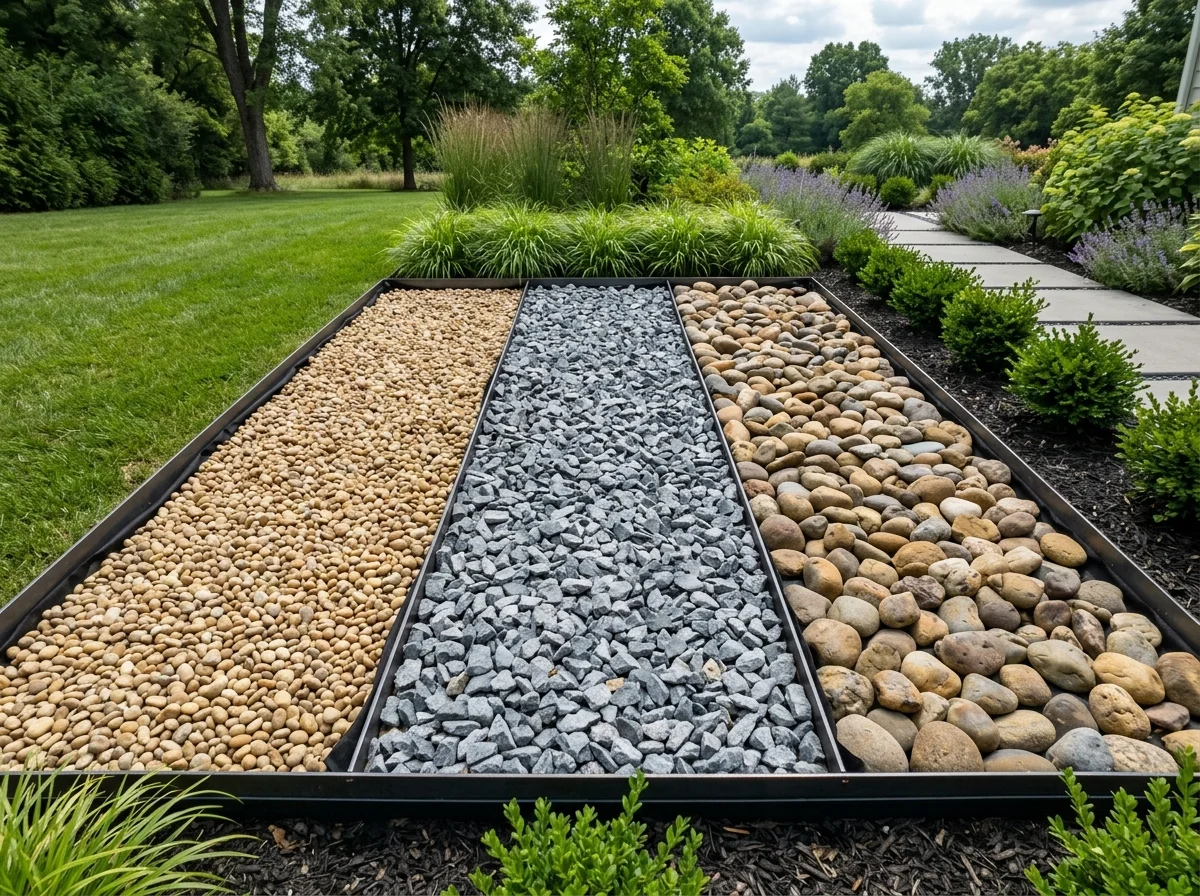
How to Calculate Landscape Rock Needed
The formula for landscape rock volume is the same one professionals use. It works for any rectangular area, any rock type, and any depth:
| Step | Formula | Example (10 × 10 ft, 2 in deep) |
|---|---|---|
| 1. Find area | Length × Width | 10 × 10 = 100 ft² |
| 2. Convert depth | Depth (in) ÷ 12 | 2 ÷ 12 = 0.167 ft |
| 3. Calculate volume | Area × Depth (ft) | 100 × 0.167 = 16.67 ft³ |
| 4. Convert to yards | Cubic feet ÷ 27 | 16.67 ÷ 27 = 0.62 yd³ |
| 5. Convert to tons | Cubic feet × density ÷ 2000 | 16.67 × 100 ÷ 2000 = 0.83 tons |
Landscape Rock Depth Chart
Depth is the number most people get wrong. Too thin and the rock shifts, exposes soil, or washes away. Too deep and you waste money on material you do not need. Here is what most landscaping professionals recommend:
| Project Type | Recommended Depth | Material | Notes |
|---|---|---|---|
| Decorative ground cover | 2–3 inches | Pea gravel, river rock, lava rock | 2 inches on landscape fabric is enough for most garden beds |
| Garden path / walkway | 3 inches | Pea gravel, decomposed granite | 2 inches for light foot traffic, 3 inches for heavy use |
| Patio under pavers | 4 in base + 1 in sand | CA6, concrete sand | Compact the base thoroughly before laying pavers |
| Residential driveway | 4–6 inches | Crushed stone #57, crusher run | 4 inches minimum; 6 inches for daily vehicle traffic |
| Heavy vehicle / RV pad | 6–8 inches | #57 over CA6 base | Use geotextile fabric on soft soil |
| French drain | 12–36 inches | Washed #57 stone | Depth varies based on drain design and water volume |
| Dry creek bed | 6–12 inches | River rock, large stone | Vary depth for natural appearance |
| Playground surface | 6 inches | Pea gravel, rubber mulch | Follow local safety requirements for depth based on equipment height |
For most garden beds and decorative areas, 2–3 inches is the sweet spot. It suppresses weeds effectively, retains moisture, and does not waste material. Only go deeper for driveways, drainage, or heavy-traffic areas.
Landscape Rock Coverage Chart
One of the most useful numbers in landscaping is how many square feet one ton of rock covers at a given depth. This depends on the rock's density. Here is the complete coverage chart for the six most common landscape rocks:
| Rock Type | Density (lb/ft³) | 1 Ton @ 2 in | 1 Ton @ 3 in | 1 Ton @ 4 in | 1 Ton @ 6 in |
|---|---|---|---|---|---|
| Pea Gravel | 100 | 120 ft² | 80 ft² | 60 ft² | 40 ft² |
| Crushed Stone | 110 | 109 ft² | 73 ft² | 55 ft² | 36 ft² |
| River Rock | 105 | 114 ft² | 76 ft² | 57 ft² | 38 ft² |
| Decomposed Granite | 95 | 126 ft² | 84 ft² | 63 ft² | 42 ft² |
| Lava Rock | 55 | 218 ft² | 145 ft² | 109 ft² | 73 ft² |
| Limestone | 100 | 120 ft² | 80 ft² | 60 ft² | 40 ft² |
The coverage chart shows why choosing the right rock type matters. Lava rock is the lightest option — one ton covers 218 sq ft at 2 inches, nearly double what pea gravel covers. On the other hand, crushed stone is denser, so one ton covers less area but provides a more stable, durable surface for driveways and high-traffic areas.
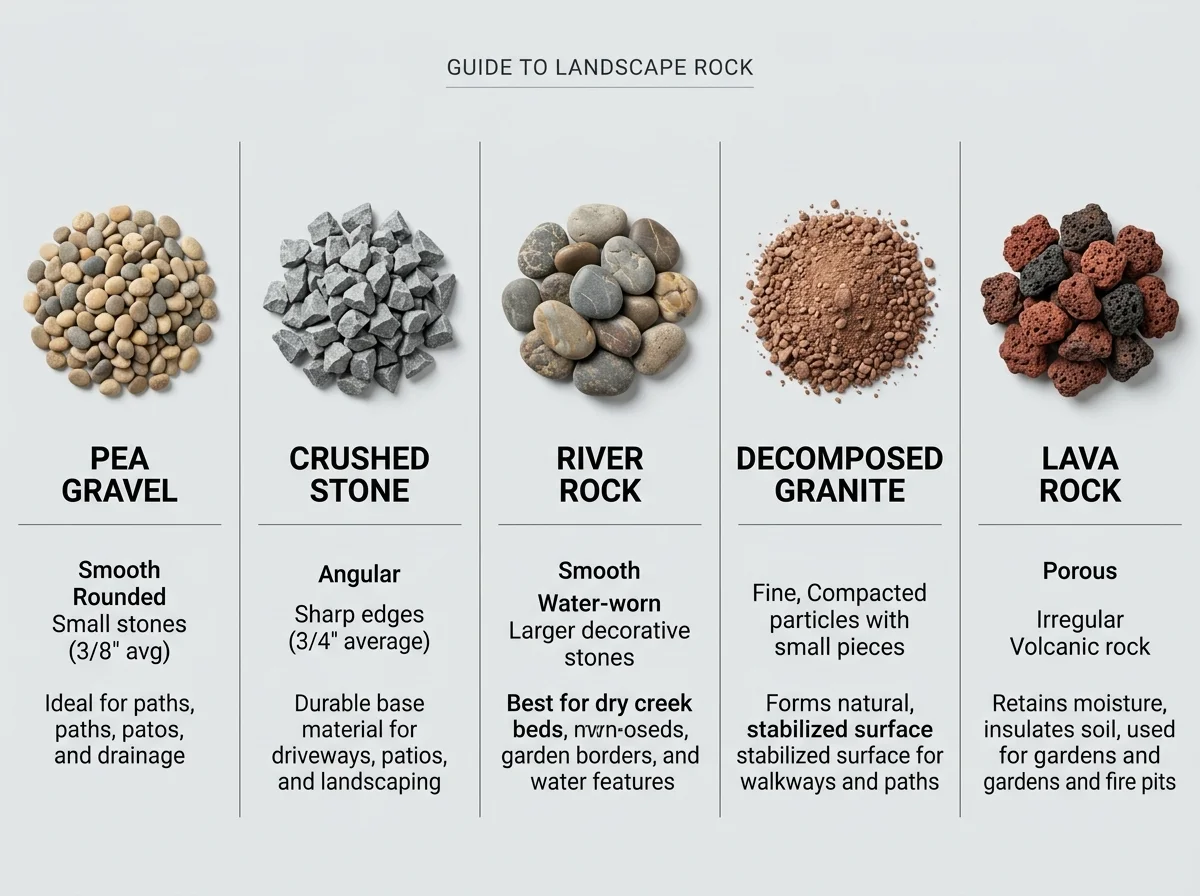
Landscape Rock Types and Coverage
Not all landscape rocks are created equal. Each type has unique properties that affect density, coverage, durability, cost, and best use. Here is a quick comparison:
| Rock Type | Best For | Not Good For |
|---|---|---|
| Pea Gravel | Garden beds, walkways, playgrounds, drainage | Driveways (shifts underfoot) |
| Crushed Stone | Driveways, road bases, French drains | Decorative beds (angular, not smooth) |
| River Rock | Dry creek beds, decorative borders, erosion control | Walking paths (too large, uneven) |
| Decomposed Granite | Walkways, rustic patios, xeriscaping | Drainage (compacts too dense) |
| Lava Rock | Garden beds, planters, fire pits | Heavy traffic areas (too light) |
| Limestone | Driveways, agricultural use, budget projects | Premium decorative features |
Here is a detailed breakdown of each type:
Pea Gravel
Pea gravel consists of small, smooth, rounded stones typically 1/8 to 3/8 inch in diameter. It is one of the most popular landscape rocks because it is affordable, comfortable to walk on, and available in many colors. At 100 lb/ft³, one ton covers 80 sq ft at 3 inches deep. Pea gravel does not compact because of its rounded shape, making it ideal for pathways, playgrounds, and decorative ground cover. However, it shifts underfoot and is not recommended for driveways without proper edging.
Crushed Stone
Crushed stone is mechanically broken into angular pieces that lock together when compacted. At 110 lb/ft³, it is denser than pea gravel and covers about 73 sq ft per ton at 3 inches. The angular shape makes it the best choice for driveways, road bases, and French drains. Crushed stone compacts into a solid, stable surface that handles vehicle traffic without shifting. It is slightly more expensive than pea gravel per ton but covers less area per ton due to higher density.
River Rock
River rock features smooth, rounded stones typically 1 to 3 inches in diameter, naturally shaped by water erosion. At 105 lb/ft³, it covers about 76 sq ft per ton at 3 inches. River rock is primarily decorative — used for dry creek beds, garden borders, water features, and erosion control. It does not compact, so it is not suitable for walking surfaces or driveways. The larger stone size means fewer stones per cubic foot, which can create voids between pieces.
Decomposed Granite
Decomposed granite (DG) is natural granite that has weathered into small particles and fine dust. At 95 lb/ft³, it is lighter than most other landscape rocks and covers about 84 sq ft per ton at 3 inches. DG compacts firmly when installed, creating a smooth, natural-looking surface popular for rustic walkways and xeriscape gardens. It needs re-compaction and occasional topping up as rain and foot traffic wear it down over time.
Lava Rock
Lava rock is a porous volcanic material that is significantly lighter than any other landscape rock. At only 55 lb/ft³, one ton covers an impressive 145 sq ft at 3 inches — nearly double the coverage of pea gravel. Lava rock is excellent for garden beds, planters, and areas where lightweight material is preferred. It does not compact and has a unique, rough texture. The main drawback is its light weight — strong winds can scatter it, and it is not suitable for high-traffic areas.
Limestone
Limestone is a sedimentary rock available in both crushed and decorative forms. At 100 lb/ft³, it has the same density as pea gravel and covers 80 sq ft per ton at 3 inches. Crushed limestone is a popular affordable option for driveways and road bases. It is slightly softer than granite or basalt, which means it can produce dust over time. Limestone is widely available across the United States, which keeps costs lower than imported decorative stones.
How Much Does Landscape Rock Cost?
Landscape rock prices vary significantly by type, region, and supplier. Here are typical U.S. price ranges:
| Rock Type | Cost per Ton | Cost per Cubic Yard | Bag Cost (0.5 ft³) |
|---|---|---|---|
| Pea Gravel | $30–$55 | $40–$75 | $4–$6 |
| Crushed Stone | $30–$50 | $40–$70 | $4–$6 |
| River Rock | $45–$100 | $60–$130 | $6–$10 |
| Decomposed Granite | $35–$60 | $45–$80 | $5–$7 |
| Lava Rock | $50–$80 | $40–$60 | $6–$9 |
| Limestone | $25–$45 | $35–$60 | $3–$5 |
Delivery Costs
Delivery is an additional cost that many homeowners overlook. Most suppliers charge $50–$150 per delivery depending on distance and load size. Delivery trucks vary in capacity, but many local suppliers deliver several tons per load. Ordering in bulk reduces the per-ton delivery cost significantly. For example, a 10-ton order with $100 delivery adds only $10 per ton to your material cost. A 2-ton order with the same $100 delivery adds $50 per ton.
Installation Costs
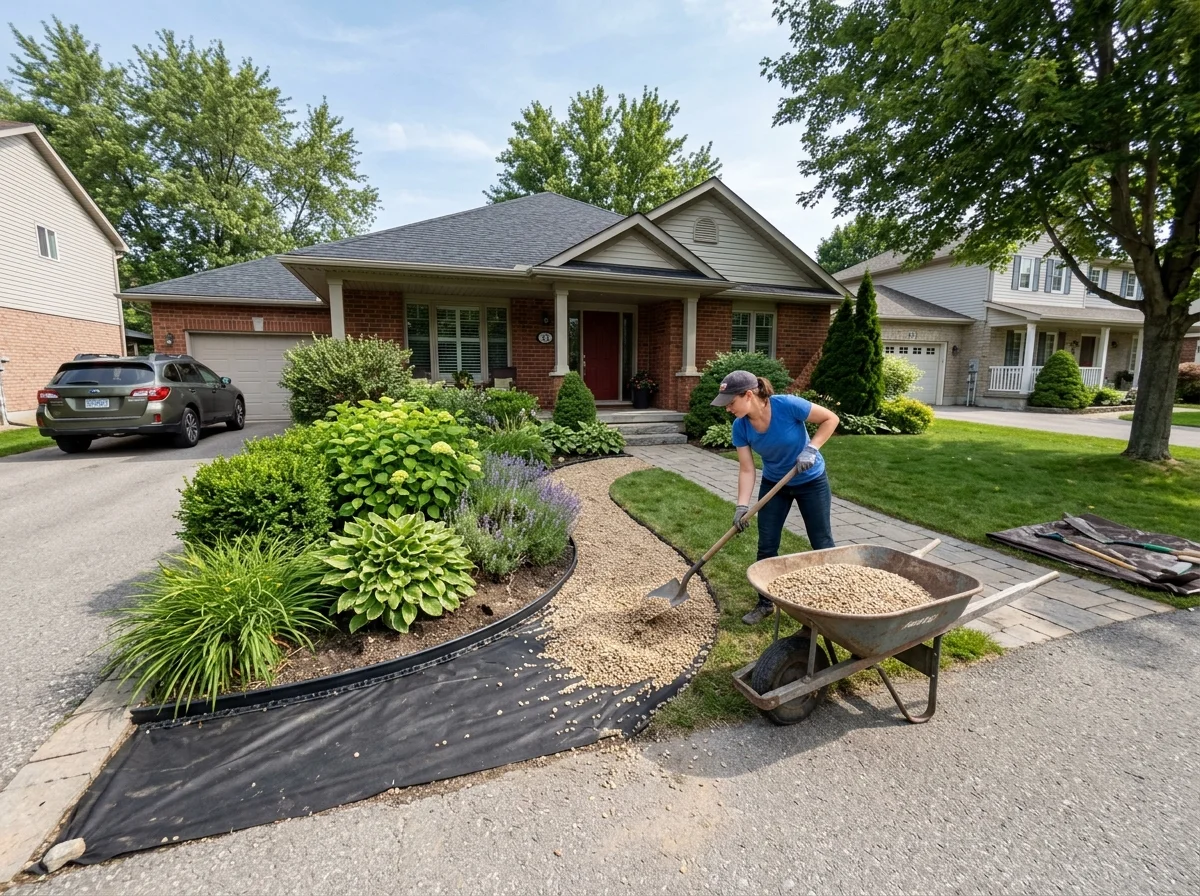
If you hire a professional, installation costs run $2–$5 per square foot including labor, landscape fabric, and edging. For a 200 sq ft garden bed, that is $400–$1,000 in labor alone. DIY installation saves significant money — the process is straightforward and many homeowners can complete a small landscape project over a weekend.
Landscape Rock vs Mulch
Many homeowners choose between rock and mulch for ground cover. Both have strengths. Here is how they compare across the factors that matter most:
| Feature | Landscape Rock | Mulch |
|---|---|---|
| Lifespan | Indefinite — does not decompose | 1–3 years before replacement |
| Weed suppression | Excellent with fabric underneath | Good initially, degrades over time |
| Moisture retention | Moderate — rocks absorb heat | Excellent — keeps soil cool |
| Cost (installed) | $3–$8 per sq ft | $1–$3 per sq ft |
| Recurring cost | None (one-time purchase) | $1–$2 per sq ft every 1–3 years |
| Best for | Driveways, walkways, drainage, low-maintenance yards | Garden beds, around trees, vegetable gardens |
| Not ideal for | Vegetable gardens (retains heat), areas with acid-loving plants | Walkways, driveways, high-traffic areas |
| Plant health | Can overheat roots in full sun; does not add nutrients | Decomposes into soil, adds organic matter |
| Fire resistance | Non-combustible — good near fire pits | Combustible when dry |
Rock wins for longevity and low maintenance. Mulch wins for plant health and initial cost. Many landscapers use both: rock for paths and high-traffic zones, mulch for planting beds. If you are deciding between the two, consider how the mulch calculator works for the organic areas of your yard.
Do You Need Landscape Fabric?
Landscape fabric is a geotextile material placed between soil and rock. It is one of the most debated topics in landscaping. Here is when it helps and when you can skip it.
Benefits of Landscape Fabric
- Weed prevention: Blocks weeds from growing through from below. Without fabric, weeds appear within months.
- Rock preservation: Prevents rock from sinking into soil over time, maintaining consistent depth and coverage.
- Easier removal: When you want to change your landscape design, fabric makes it much easier to remove rock without mixing it into the soil.
- Soil separation: Keeps rock and soil from mixing, which maintains drainage performance in French drains and gravel paths.
When to Skip It
- Under mulch in planting beds: Mulch decomposes naturally and benefits from soil contact. Fabric blocks nutrients from reaching the soil.
- Very deep installations: For driveways and road bases with 4+ inches of compacted stone, fabric is less important because the weight of the material keeps it in place.
- Sloped areas with drainage rock: In some drainage applications, fabric can trap sediment and reduce water flow over time.
Should You Buy Extra Rock?
Yes. Always order 5–10% more rock than your calculation shows. Here is why:
- Spillage: Rock spills during delivery, spreading, and edging. A 5% loss rate is typical for straightforward projects.
- Settling: Rock compacts slightly after installation, especially in walkways and driveways. The depth you spread today may be slightly less in a few months.
- Irregular ground: Uneven terrain means some areas need more rock than flat-surface math predicts. Low spots, edges, and transitions between surfaces all consume extra material.
- Second delivery cost: If you run short, a second delivery costs $50–$150 in additional shipping. Ordering 10% extra is almost always cheaper than paying for a second trip.
- Future touch-ups: Having leftover rock allows you to top off areas that settle or shift over time, especially after heavy rain or snow.
For simple rectangular beds, add 10%. For irregular shapes, curves, or features like dry creek beds, add 15–20%. Bulk orders are typically non-returnable, so factor this into your initial order.
Bulk Rock vs Bagged Rock
Most suppliers offer rock in two forms: bulk delivery by the cubic yard or ton, and pre-packaged bags (usually 0.5 cubic feet each). The right choice depends on your project size.
| Feature | Bulk Rock | Bagged Rock |
|---|---|---|
| Cost per cubic yard | $30–$100 | $150–$300 (equivalent) |
| Delivery | Supplier delivers (truck load) | DIY transport from store |
| Best for | Projects over 1 cubic yard | Projects under 0.5 cubic yard |
| Minimum order | Usually 1–2 tons | No minimum |
| Color/variety | Wide selection at landscape yards | Limited to what stores stock |
| Convenience | Requires space for pile delivery | Store-bought, carry home yourself |
A 100 sq ft garden bed at 3 inches deep needs about 1 cubic yard of rock. That is 54 bags at 0.5 cubic feet each, or one bulk delivery. Bulk rock is significantly cheaper for any project over about 0.5 cubic yard. For small touch-ups or accent areas, bags are more practical.
Use Our Free Landscape Rock Calculator
Enter your project dimensions, choose a rock type, and get instant estimates for cubic yards, tons, coverage, and cost.
Landscape Rock CalculatorCommon Mistakes When Ordering Landscape Rock
Based on years of landscaping data and customer feedback, these are the most common mistakes people make when ordering landscape rock:
Rock spills during spreading, uneven ground requires more material, and edges are never perfectly straight. Always add 10% for simple rectangular areas, 15% for irregular shapes, and 20% for complex features like dry creek beds.
The most common mistake is going too deep on decorative beds. Most garden beds need only 2 inches on landscape fabric. Going 4 inches deep doubles your material cost without improving weed suppression or moisture retention. Save the deep layers for driveways and drainage.
A cubic yard of lava rock weighs about 0.74 tons. A cubic yard of crushed stone weighs about 1.49 tons. If you order by volume but the supplier prices by weight, the cost difference is dramatic. Always know whether you are ordering by the ton or by the cubic yard.
Without fabric, rock sinks into the soil within a year or two. Weeds grow through from below. Fabric typically costs $0.30–$0.50 per square foot and saves you from having to redo the entire project in a few years.
Running short mid-project means a second delivery trip, which doubles your delivery cost. It is almost always cheaper to order 10% extra than to pay for a second delivery. Check your supplier's return policy before ordering — some allow returns on unopened bags, but bulk orders are typically non-returnable.
Bagged rock costs $4–$10 per 0.5 cubic foot. Bulk rock costs $30–$100 per cubic yard. For larger projects, bulk delivery is typically much cheaper than bags. A 100 sq ft bed at 3 inches needs about 1 cubic yard — that is 54 bags versus one bulk delivery.
Step-by-Step: How to Calculate Your Project
Measure length and width in feet. For rectangular beds, multiply to get square feet. For irregular shapes, break them into rectangles, calculate each section separately, and add the totals together. For circular areas, use π × radius².
2 inches for decorative ground cover, 3 inches for walkways and garden paths, 4 inches for driveways. Do not guess — check the depth chart above for your specific project type.
Each rock type has a different density, which changes how many tons you need. Use the coverage chart to compare. Ask your supplier for the exact density of the material you are purchasing.
Multiply area × depth (in feet) to get cubic feet. Divide by 27 for cubic yards. Multiply by density ÷ 2000 for tons. Add 10–20% waste factor. Or use our free calculator to do all the math instantly.
How to Measure Irregular Areas
Not every project area is a perfect rectangle. Garden beds curve around trees, walkways follow irregular paths, and yards have odd angles. Here is how to break complex shapes into simple geometry for accurate calculations:
Rectangles and Squares
The most common shape. Measure length and width in feet, then multiply: Area = Length x Width. For a 15 x 8 ft bed: 15 x 8 = 120 sq ft.
Triangles
Many garden beds and border areas form triangular shapes. Measure the base and the height (perpendicular to the base): Area = 0.5 x Base x Height. For a triangle with a 10 ft base and 6 ft height: 0.5 x 10 x 6 = 30 sq ft.
Circles and Semicircles
For circular areas like tree rings or round planters: Area = pi x radius². A tree ring with a 4 ft outer radius and 2 ft inner radius: (3.14 x 4²) - (3.14 x 2²) = 50.24 - 12.56 = 37.68 sq ft.
L-Shaped and Complex Beds
Break L-shaped beds into two rectangles. Measure each section separately, calculate the area of each, then add them together. For an L-shape with a 12 x 6 ft section and an 8 x 4 ft section: (12 x 6) + (8 x 4) = 72 + 32 = 104 sq ft.
Curved Borders
For gentle curves, divide the area into short straight segments and treat each as a rectangle. The more segments you use, the more accurate your measurement. For most residential projects, 3–4 segments per curve is sufficient.
Worked Examples
Example 1: Garden Bed with Pea Gravel
A 15 × 8 ft garden bed along the front of a house, filled with pea gravel at 3 inches deep:
| Step | Calculation | Result |
|---|---|---|
| Area | 15 × 8 | 120 ft² |
| Volume | 120 × (3/12) | 30 ft³ = 1.11 yd³ |
| Tons (pea gravel) | 30 × 100 ÷ 2000 | 1.50 tons |
| With 10% waste | 1.50 × 1.10 | 1.65 tons |
| Estimated Cost ($50/ton) | 1.65 × $50 | $82.50 |
Example 2: Driveway with Crushed Stone
An 80 × 12 ft single-lane driveway with a 4-inch crushed stone surface:
| Step | Calculation | Result |
|---|---|---|
| Area | 80 × 12 | 960 ft² |
| Volume | 960 × (4/12) | 320 ft³ = 11.85 yd³ |
| Tons (crushed stone) | 320 × 110 ÷ 2000 | 17.60 tons |
| With 10% waste | 17.60 × 1.10 | 19.36 tons |
| Estimated Cost ($45/ton) | 19.36 × $45 | $871.20 |
Example 3: Decorative Border with River Rock
A 30 × 3 ft decorative border along a fence, filled with river rock at 2 inches deep:
| Step | Calculation | Result |
|---|---|---|
| Area | 30 × 3 | 90 ft² |
| Volume | 90 × (2/12) | 15 ft³ = 0.56 yd³ |
| Tons (river rock) | 15 × 105 ÷ 2000 | 0.79 tons |
| With 10% waste | 0.79 × 1.10 | 0.87 tons |
| Estimated Cost ($65/ton) | 0.87 × $65 | $56.55 |
Frequently Asked Questions
How many tons of rock do I need for 100 sq ft?
At 2 inches deep, you need about 0.83 tons of pea gravel or 0.92 tons of crushed stone for 100 sq ft. At 3 inches, that increases to about 1.25 tons of pea gravel. At 4 inches, about 1.67 tons. Multiply by your rock type's density divided by 100 for exact results.
How many square feet does a ton of rock cover?
One ton of pea gravel covers about 120 sq ft at 2 inches, 80 sq ft at 3 inches, or 60 sq ft at 4 inches. Crushed stone covers slightly less due to higher density. Lava rock covers more because it is lighter — about 145 sq ft per ton at 3 inches.
What is the cheapest landscape rock?
Pea gravel and crushed limestone are the cheapest options at $30–$50 per ton. Decomposed granite costs $35–$60 per ton. River rock and decorative stone cost more at $45–$100 per ton. Prices vary by region and supplier. Delivery fees add $50–$150 per load.
How deep should landscape rock be?
2 inches for decorative ground cover, 3 inches for walkways and garden paths, 4 inches for driveways and high-traffic areas, and 6–8 inches for drainage projects and French drains. Always use landscape fabric under rock to prevent sinking into soil.
Do I need landscape fabric under rock?
Yes. Landscape fabric prevents weeds from growing through, stops rock from sinking into soil, and makes future removal much easier. Overlap fabric edges by 6–12 inches for full coverage. Fabric costs $0.30–$0.50 per square foot.
How much does landscape rock delivery cost?
Delivery typically costs $50–$150 per load depending on distance and load size. Delivery truck capacities vary by supplier. Ordering in bulk reduces the per-ton delivery cost. Ask your supplier about free delivery thresholds and available truck sizes.
Can I install landscape rock myself?
Yes. DIY installation can save $2–$5 per square foot in labor costs. The process is straightforward: clear the area, lay landscape fabric, install edging, spread rock evenly, and rake smooth. Many homeowners complete a small landscape project over a weekend.
How do I calculate rock for a circular area?
Measure the radius (distance from center to edge) in feet. Calculate area using pi x radius squared. For a 5 ft radius circle: 3.14 x 25 = 78.5 sq ft. Then multiply by your desired depth (in feet) and divide by 27 to get cubic yards. Use the coverage chart to convert to tons based on your rock type.
Data Sources
- The Home Depot – How Much Gravel Do I Need
- Lowe's – How to Calculate Gravel
- Family Handyman – How Much Gravel Do I Need
- The Spruce – How to Calculate Gravel
- CalculatorSoup – Gravel Calculator
Related Posts
- River Rock Calculator Guide — Tons, Yards & Cost
- How Much Mulch Do I Need? Calculator & Guide
- Concrete Slab Cost in 2026: What the Data Actually Says