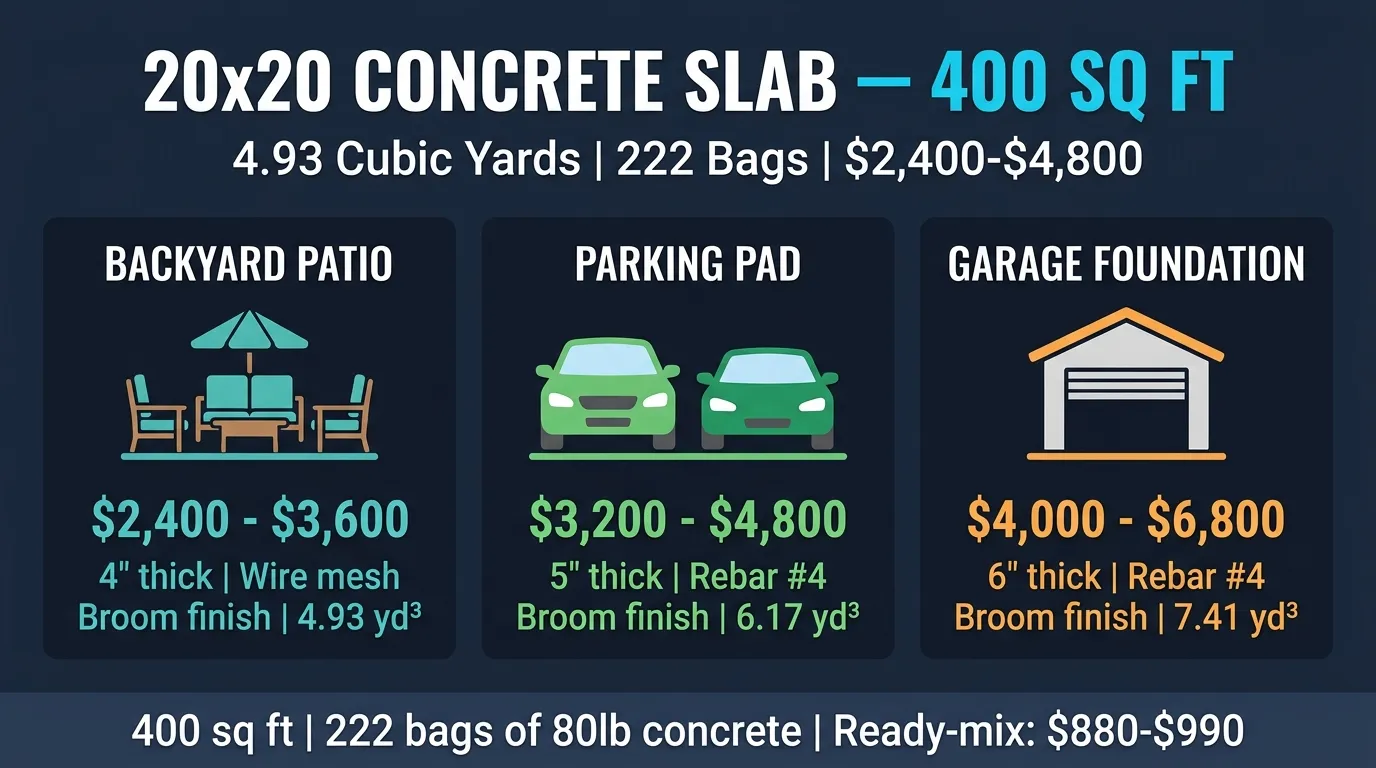
A 20x20 concrete slab requires 4.93 cubic yards of concrete at 4 inches thick, which translates to approximately 222 bags of 80-pound concrete mix or 296 bags of 60-pound mix. Professionally installed, a 20x20 slab costs $2,400 to $4,800 in 2026 for a standard 4-inch residential pour.
The 20x20 slab is the sweet spot for residential concrete projects. At 400 square feet, it is large enough for a backyard patio, a two-car parking pad, a workshop foundation, or a detached garage base. But calculating the exact concrete volume, material costs, and total budget can be confusing — especially when every contractor gives a different quote.
This guide gives you exact numbers. We have broken down the concrete volume calculation, material quantities, cost by thickness, reinforcement options, and regional pricing variations — all based on 2026 data from HomeAdvisor, Angi, the NRMCA, and contractor networks across the US.
Who should use this guide: Homeowners planning a 20x20 concrete project, contractors estimating material orders, DIYers calculating bag counts, and anyone using the Concrete Slab Cost Calculator who wants to understand the math behind the results.
Need a smaller slab? See our 10x10 concrete slab cost guide for a complete breakdown of the most common small patio and shed pad size.
Quick Answer: 20x20 Concrete Slab (2026)
| Spec | 4-Inch Slab | 5-Inch Slab | 6-Inch Slab |
|---|---|---|---|
| Square footage | 400 sq ft | 400 sq ft | 400 sq ft |
| Cubic yards | 4.93 yd³ | 6.17 yd³ | 7.41 yd³ |
| 80lb bags | 222 bags | 278 bags | 333 bags |
| 60lb bags | 296 bags | 370 bags | 444 bags |
| Ready-mix cost | $740 – $815 | $925 – $1,020 | $1,110 – $1,225 |
| Installed cost | $2,400 – $4,800 | $3,200 – $5,600 | $4,000 – $6,800 |
| Best for | Patios, walkways, shed pads | Light driveways, porches | Driveways, garages, foundations |
How to Calculate Concrete for a 20x20 Slab
The formula for concrete volume is straightforward, but one wrong step and you will be short — or swimming in extra bags.
The Formula
Volume (cubic yards) = (Length × Width × Thickness in feet) ÷ 27
All dimensions must be in feet. If your thickness is in inches, divide by 12 first.
Worked Example: 20x20 at 4 Inches
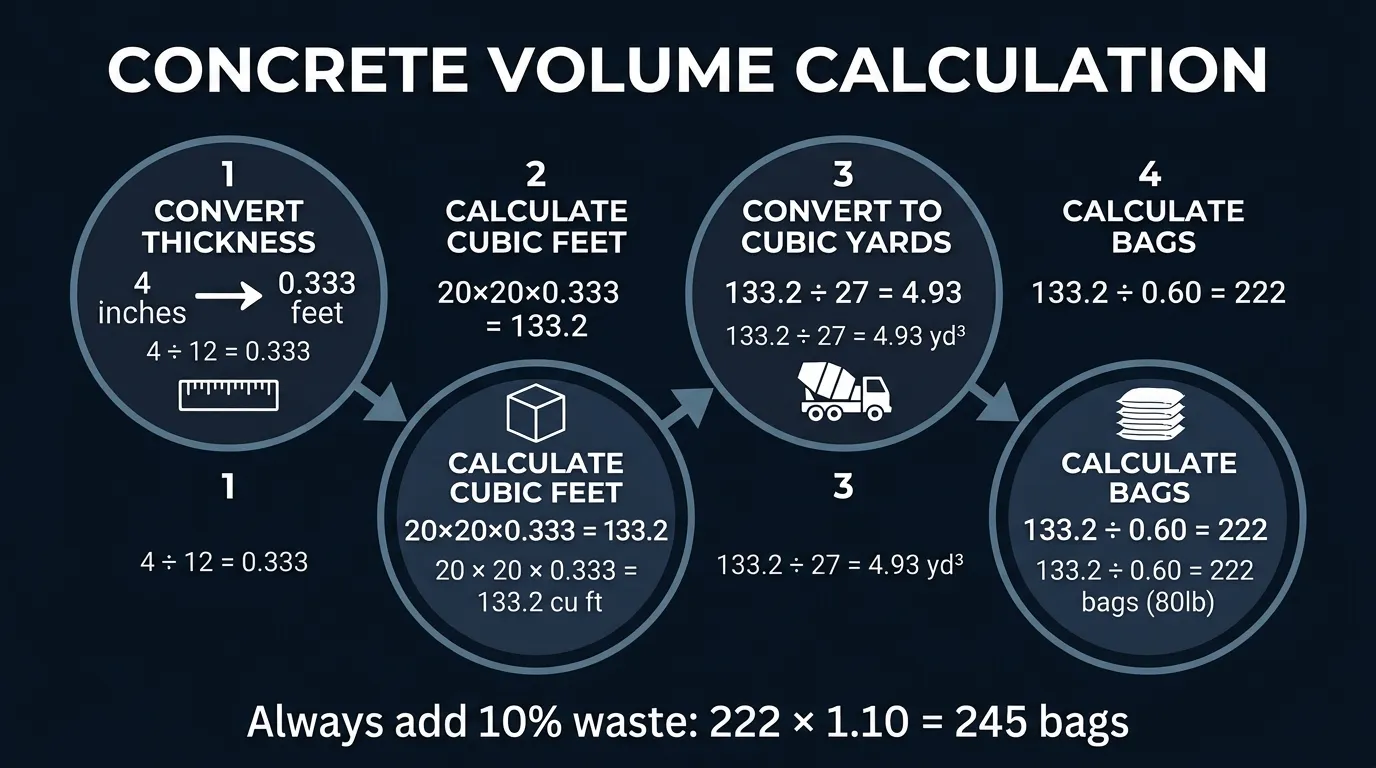
4 inches ÷ 12 = 0.333 feet
20 ft × 20 ft × 0.333 ft = 133.2 cubic feet
133.2 ÷ 27 = 4.93 cubic yards
80lb bags (0.60 cu ft each): 133.2 ÷ 0.60 = 222 bags
60lb bags (0.45 cu ft each): 133.2 ÷ 0.45 = 296 bags
Always order 10% extra for spills, uneven ground, and measurement errors.
80lb bags with 10% waste: 222 × 1.10 = 244 bags → round to 245
60lb bags with 10% waste: 296 × 1.10 = 326 bags → round to 330
Use Our Free Concrete Calculator
Our Concrete Slab Cost Calculator does all the math instantly. Enter 20 feet by 20 feet, choose your thickness, and get cubic yards, bag count, material cost, and total installed estimate. No signup required.
Concrete Slab Cost CalculatorOther Common Slab Sizes: Quick Cost Reference
Not sure a 20x20 slab is right for your project? Here are cost estimates for other popular residential slab sizes at 4 inches thick with standard broom finish. All costs assume professional installation at $6–$8 per square foot.
| Slab Size | Square Feet | Cubic Yards (4") | 80lb Bags | Installed Cost | Best For |
|---|---|---|---|---|---|
| 8 x 10 | 80 sq ft | 0.98 | 44 | $480 – $640 | Small shed pad, grill area |
| 10 x 10 | 100 sq ft | 1.23 | 56 | $600 – $800 | Small patio, shed foundation |
| 12 x 12 | 144 sq ft | 1.78 | 80 | $864 – $1,152 | Medium patio, hot tub pad |
| 12 x 16 | 192 sq ft | 2.37 | 107 | $1,152 – $1,536 | Large patio, workshop base |
| 15 x 15 | 225 sq ft | 2.78 | 126 | $1,350 – $1,800 | Medium-large patio, small garage |
| 16 x 20 | 320 sq ft | 3.95 | 178 | $1,920 – $2,560 | Two-car parking pad, large patio |
| 20 x 20 | 400 sq ft | 4.93 | 222 | $2,400 – $3,200 | Large patio, two-car pad, workshop |
| 20 x 30 | 600 sq ft | 7.41 | 333 | $3,600 – $4,800 | Garage, large workshop |
What the data says: For most homeowners, the sweet spot is 10x10 to 16x20. The 20x20 is the largest size that still qualifies as a "small project" for most contractors — above 400 sq ft, you may need a larger crew and longer pour time. Use our Concrete Slab Calculator to get exact numbers for any custom size.
20x20 Slab Cost by Thickness
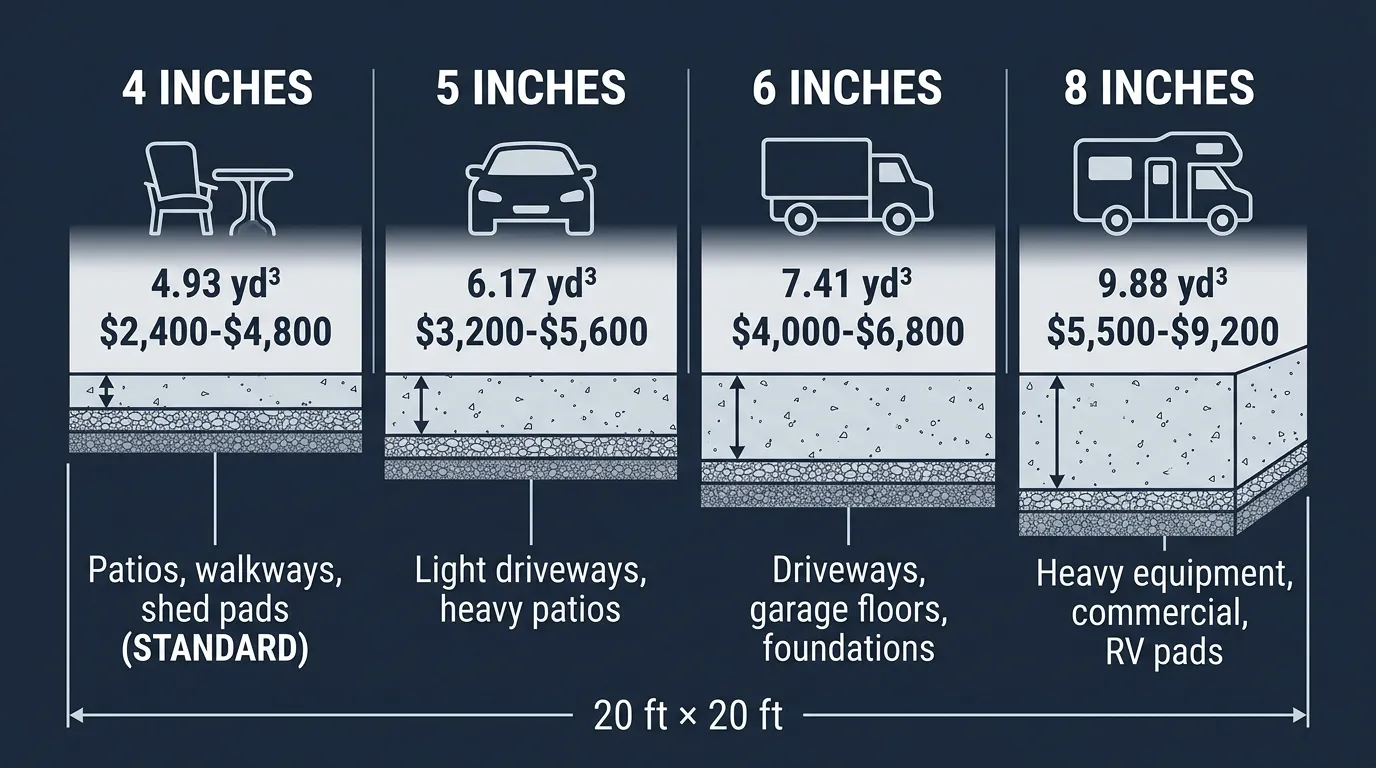
Thickness is the biggest cost driver for a 20x20 slab. More concrete means more material, more delivery fees, and more labor hours.
| Thickness | Cubic Yards | Concrete Only | Installed Cost | Best For |
|---|---|---|---|---|
| 3 inches | 3.70 | $555 – $610 | $1,800 – $3,200 | NOT recommended — cracks under load |
| 4 inches | 4.93 | $740 – $815 | $2,400 – $4,800 | Patios, walkways, shed pads (standard) |
| 5 inches | 6.17 | $925 – $1,020 | $3,200 – $5,600 | Light driveways, porches, heavy patios |
| 6 inches | 7.41 | $1,110 – $1,225 | $4,000 – $6,800 | Driveways, garage floors, foundations |
| 8 inches | 9.88 | $1,480 – $1,630 | $5,500 – $9,200 | Heavy equipment, commercial, RV pads |
What the data says: A 4-inch slab is the standard for most 20x20 residential projects. Each additional inch adds roughly $1–$2 per square foot. For a 20x20 slab, going from 4 inches to 6 inches adds about $1,600–$2,000 to your total. Only go thicker if you are parking heavy vehicles, building a foundation, or installing an RV pad.
20x20 Slab Cost by Finish Type
The surface finish affects both cost and appearance. Here is what each option costs for a 20x20 slab.
| Finish Type | Added Cost | Total 20x20 Cost | Look & Durability |
|---|---|---|---|
| Broom finish | $0 (standard) | $2,400 – $4,800 | Textured, slip-resistant, hides imperfections |
| Smooth trowel | $200 – $400 | $2,600 – $5,200 | Clean, modern, can be slippery when wet |
| Exposed aggregate | $800 – $1,600 | $3,200 – $6,400 | Decorative stone visible, excellent traction |
| Stamped concrete | $2,000 – $4,800 | $4,400 – $9,600 | Brick, stone, or wood patterns, high-end look |
| Colored (integral) | $1,200 – $2,800 | $3,600 – $7,600 | Uniform color throughout, fade-resistant |
| Acid stained | $800 – $2,000 | $3,200 – $6,800 | Varied, artistic color effects, unique patterns |
| Polished | $3,200 – $6,000 | $5,600 – $10,800 | Mirror-like finish, indoor use primarily |
What the data says: Broom finish is the default for most residential slabs and adds no extra cost. For a 20x20 patio that serves as your primary outdoor living space, a stamped or colored finish adds $2,000–$4,800 but transforms the entire backyard. Polished concrete is typically used indoors and is overkill for most exterior 20x20 projects.
20x20 Slab Cost by Reinforcement
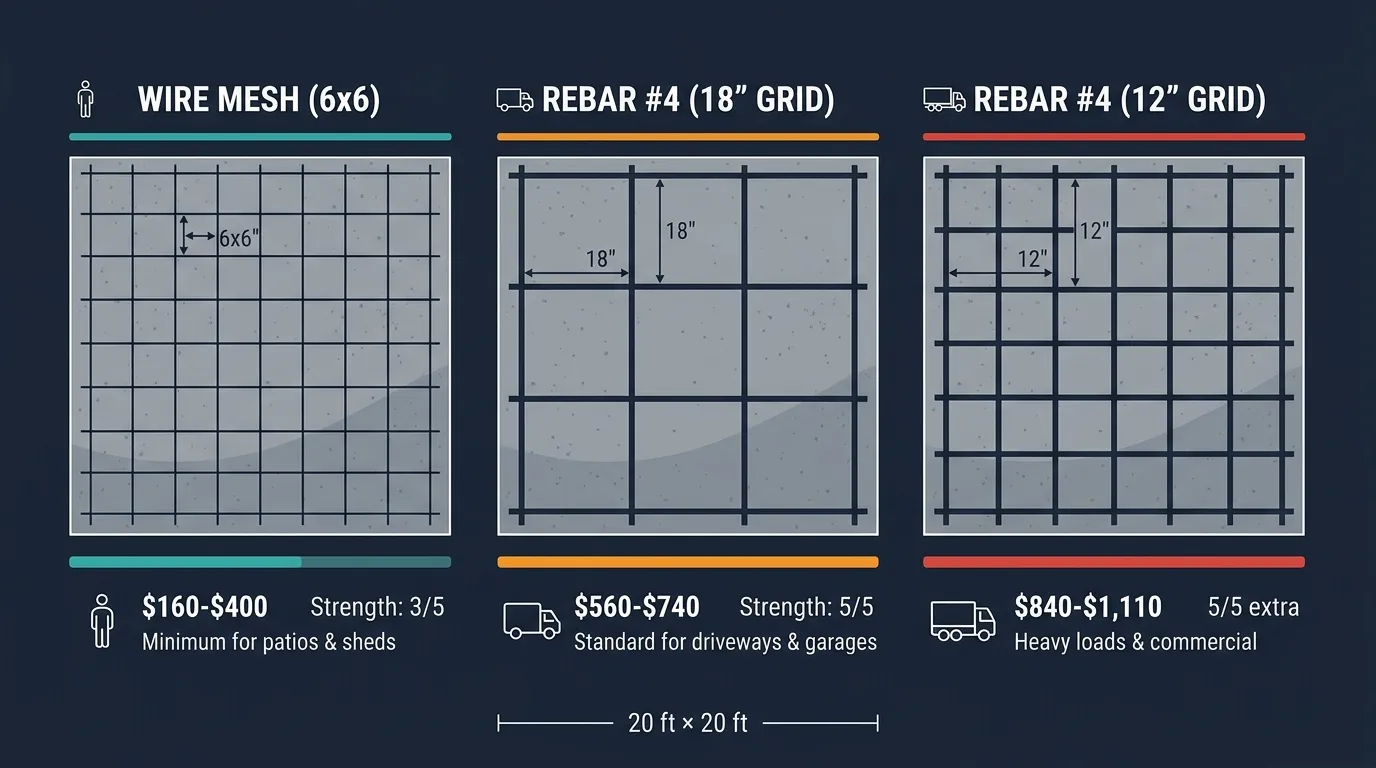
At 400 square feet, reinforcement is not optional — it is essential. A 20x20 slab without reinforcement will crack within the first year.
| Reinforcement Type | Cost for 20x20 | Strength Added | Best For | When to Skip |
|---|---|---|---|---|
| Wire mesh (6x6, 10/10) | $160 – $400 | Moderate | Patios, walkways, shed pads | Never on 20x20 — always reinforce |
| Rebar (#4, 18" grid) | $560 – $740 | High | Driveways, garage floors, foundations | Basic foot-traffic-only patios |
| Rebar (#4, 12" grid) | $840 – $1,110 | Very High | Heavy loads, commercial, RV pads | Standard residential projects |
| Fiber mesh (in mix) | $50 – $75 | Low-Moderate | Crack-resistant floors, added insurance | As standalone on thick slabs |
| Rebar + wire mesh | $720 – $1,140 | Maximum | Heavy equipment, maximum durability | Standard residential projects |
What the data says: For a 20x20 patio or shed pad, wire mesh is the minimum acceptable reinforcement. For a driveway or garage floor, upgrade to #4 rebar at 18-inch spacing. The cost difference is $400–$340, but the strength increase is dramatic. A 20x20 driveway with only wire mesh will develop cracks within 2–3 years under vehicle traffic.
DIY vs Professional Installation: 20x20 Slab
At 400 square feet, a 20x20 slab is at the upper limit of what most homeowners can realistically pour themselves. Here is the honest breakdown.
DIY Material Costs (20x20, 4-inch, broom finish)
| Item | Quantity | Unit Cost | Total |
|---|---|---|---|
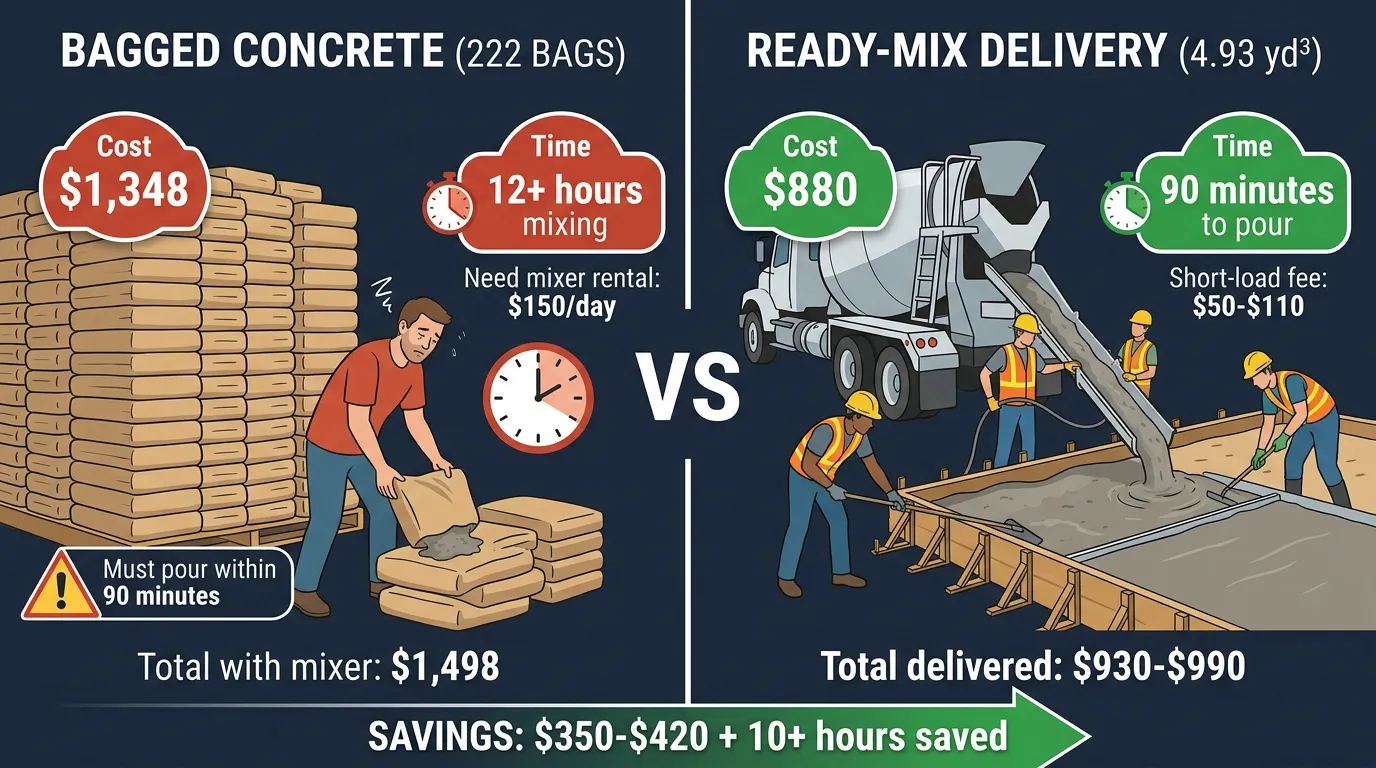
| Concrete (3,000 PSI, 4.93 yd³) | 245 bags (80lb) | $5.50/bag | $1,348 |
| OR ready-mix delivery | 5.5 cubic yards | $160/yd | $880 |
| Wire mesh (6x6) | 400 sq ft | $0.60/sq ft | $240 |
| Gravel sub-base (4") | 6 cubic yards | $35/yd | $210 |
| 2x4 forms + stakes | 80 linear ft | $2.00/ft | $160 |
| Concrete finishing tools | Rental | $150/day | $150 |
| Sealer (optional, 2 gal) | 2 gallons | $45/gal | $90 |
| TOTAL DIY (bagged) | $2,198 | ||
| TOTAL DIY (ready-mix) | $1,730 |
Professional Installation Costs (20x20, 4-inch, broom finish)
| Cost Component | Low | High | Notes |
|---|---|---|---|
| Ready-mix concrete | $740 | $815 | 4.93 cubic yards at $150–$165/yd |
| Short-load fee | $50 | $110 | Charged for orders under 10 yards |
| Delivery fee | $0 | $75 | Varies by distance from plant |
| Wire mesh | $160 | $400 | 6x6 welded wire fabric |
| Site prep (grading) | $200 | $600 | Flat site vs. sloped/uneven |
| Labor (pour + finish) | $1,200 | $2,800 | 4–6 workers, 6–8 hours |
| TOTAL PROFESSIONAL | $2,400 | $4,800 |
What the data says: Pouring a 20x20 slab yourself saves $700–$3,000 in labor. But at 400 square feet, this is a serious project. You need 4–6 people, a full day of work, and perfect timing — ready-mix concrete must be poured within 90 minutes of batching. For a 20x20 slab, most homeowners hire a contractor unless they have concrete experience and a reliable crew.
Cost Breakdown by Component: 20x20 Slab
Here is exactly where every dollar goes in a professionally installed 20x20 concrete slab.
| Component | Low | High | % of Total | What You Get |
|---|---|---|---|---|
| Ready-mix concrete | $740 | $815 | 20–25% | 4.93 cubic yards, 3,000 PSI |
| Short-load fee | $50 | $110 | 1–3% | Surcharge for small orders |
| Delivery | $0 | $75 | 0–2% | Distance-based |
| Reinforcement | $160 | $740 | 5–15% | Wire mesh or rebar |
| Site preparation | $200 | $600 | 5–15% | Grading, excavation, gravel base |
| Labor | $1,200 | $2,800 | 40–60% | Forming, pouring, finishing, cleanup |
| Finishing upgrade | $0 | $4,800 | 0–50% | Stamped, colored, exposed aggregate |
| Sealer | $80 | $200 | 2–5% | Protective coating |
| TOTAL | $2,400 | $4,800 | 100% |
What the data says: For a basic 20x20 patio, concrete material makes up 20–25% of the cost, labor is 40–60%, and everything else is 15–30%. Labor is the biggest line item — which is why DIY saves so much money, but also why mistakes are so costly to fix.
Hidden Costs for a 20x20 Slab
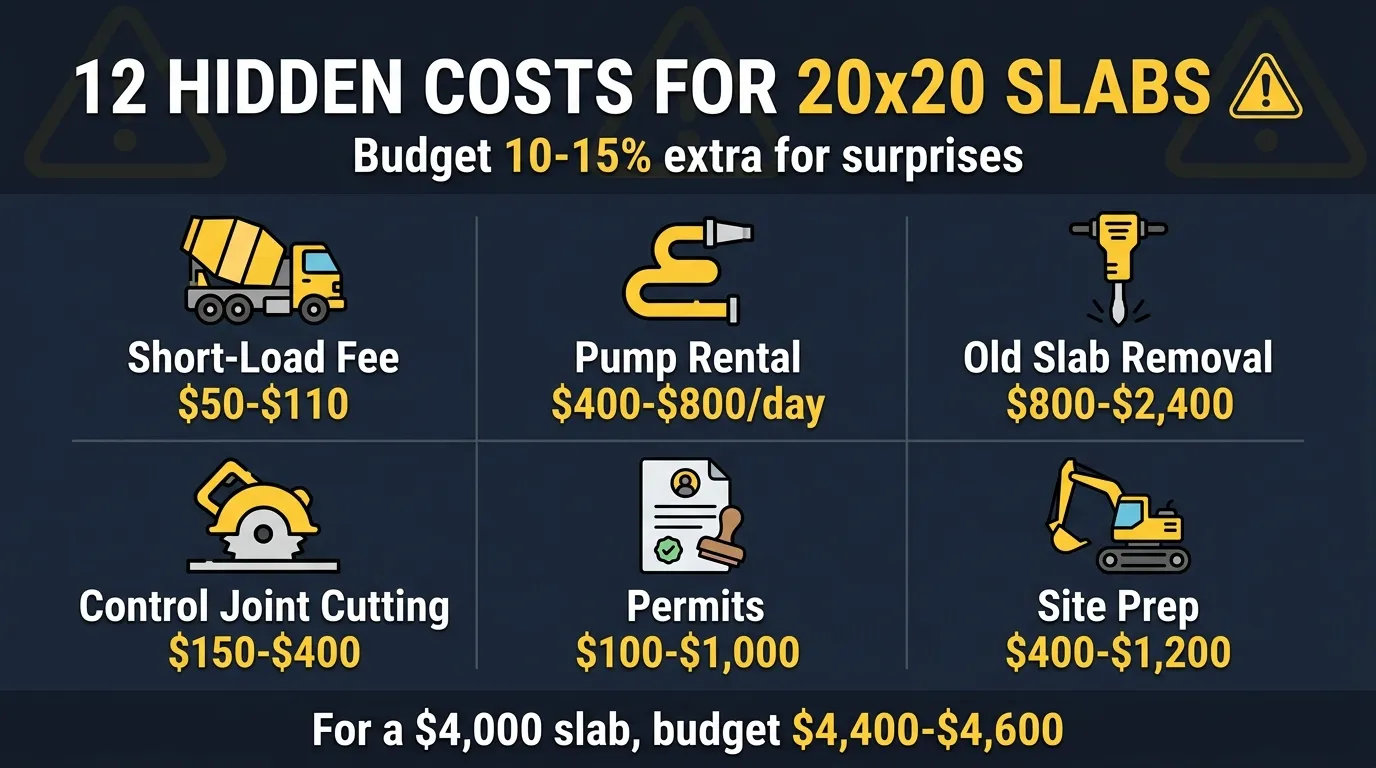
Based on contractor data and homeowner reports, here are the costs that catch people off guard on a 20x20 slab project:
| Hidden Cost | Typical Range | When It Applies | How to Avoid |
|---|---|---|---|
| Short-load fee | $50 – $110 | Ordering under 10 cubic yards | Order exactly 5 yards or coordinate with neighbor |
| Concrete pump | $400 – $800/day | Truck cannot reach pour site | Ensure truck access within 20 feet |
| Weekend delivery | $50 – $100 | Saturday/Sunday pours | Schedule for weekday |
| Fuel surcharge | Variable | Diesel price spikes | Ask for all-inclusive quote |
| Old slab removal | $800 – $2,400 | Replacing existing concrete | DIY demolition to save $500–$1,500 |
| Permits | $100 – $1,000 | Some municipalities require | Check local codes before starting |
| Excavation/grading | $400 – $1,200 | Sloped or uneven ground | DIY site prep if possible |
| Expansion joints | $100 – $300 | Required every 10–15 feet | Included in most contractor bids |
| Anchor bolts | $50 – $200 | Attaching shed or structure | Buy yourself, install during pour |
| Wait time | $75 – $150/hr | Delay between delivery and pour | Have crew ready before truck arrives |
| Cold weather protection | $200 – $600 | Pouring below 40°F | Use heated blankets or wait for spring |
| Control joint cutting | $150 – $400 | Saw-cutting joints after pour | Include in initial contract |
20x20 Slab Cost by Region (2026)
Where you build significantly affects your 20x20 slab price. Labor rates and material availability vary dramatically.
| Region | Cost Range (4-inch, installed) | Cost per Sq Ft | Key Factors |
|---|---|---|---|
| Southeast | $2,000 – $3,600 | $5 – $9 | Lowest labor rates, abundant materials |
| Midwest | $2,400 – $4,000 | $6 – $10 | Moderate labor, wide availability |
| Southwest | $2,600 – $4,400 | $6.50 – $11 | Higher transport costs, extreme heat |
| Northeast | $3,200 – $5,600 | $8 – $14 | Highest labor rates, strict permits |
| West Coast | $2,800 – $4,800 | $7 – $12 | Material shortages, labor shortages |
| Rural / Remote | +$400 – $1,200 | +$1 – $3 | Extra delivery distance, limited suppliers |
What the data says: A 20x20 slab in the Southeast costs roughly 30–40% less than the same slab in the Northeast. At 400 square feet, that difference is $1,000–$2,000. Metro areas consistently cost more than rural locations due to higher labor rates and delivery logistics. The West Coast has the highest material costs ($150–$200/yd³) while the Southeast has the lowest ($120–$150/yd³).
20x20 Slab Project Timeline
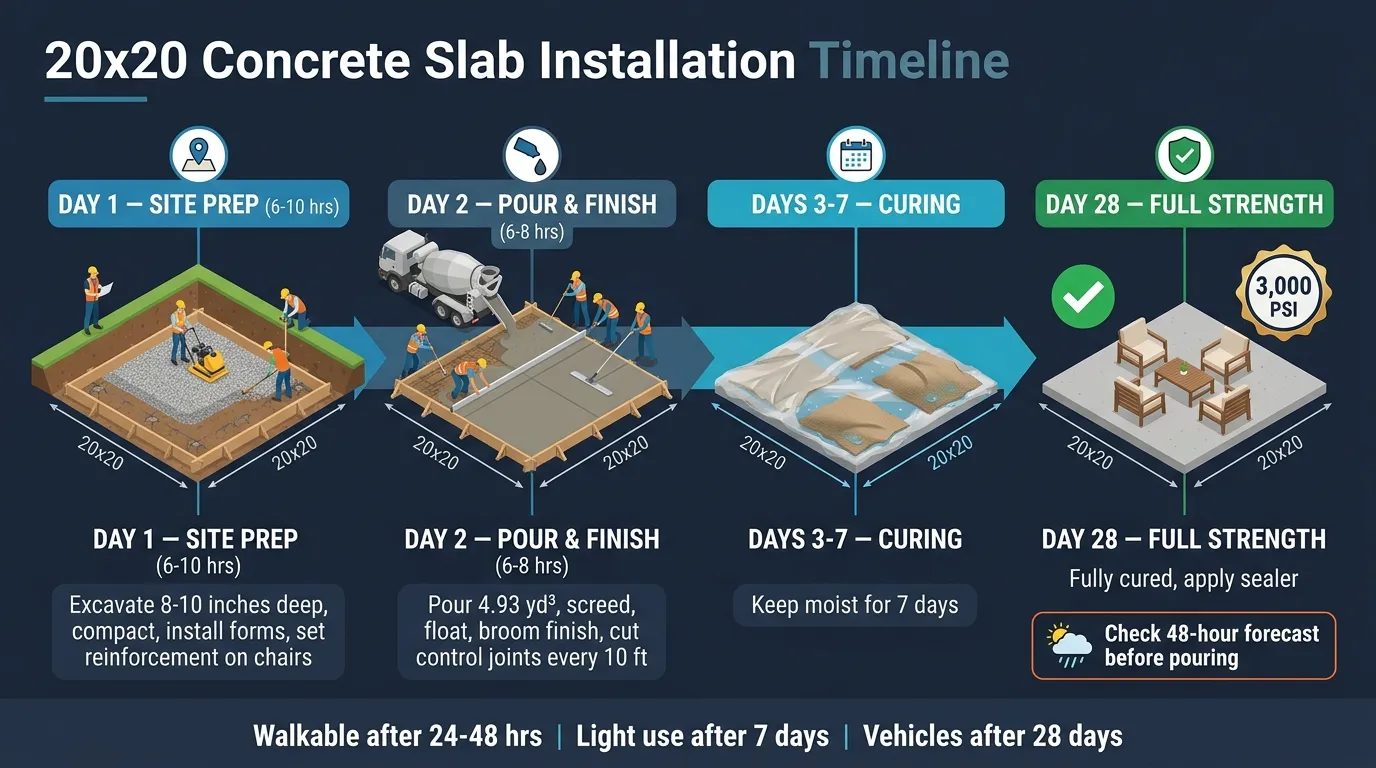
A typical 20x20 residential slab follows this timeline. Most projects take 3–7 days from site prep to walkable surface.
Excavate to required depth (typically 8–10 inches to allow for 4-inch gravel base + slab thickness). Level the area, compact the subgrade with a plate compactor, and install wooden forms. Set reinforcement on chairs so it sits in the middle of the slab thickness. For a 20x20 slab, rent a plate compactor — hand tamping is not sufficient at this size.
Concrete truck arrives (or multiple trucks for thicker pours). Pour into forms, spread with a rake, screed to level with a straight 2x4 or power screed, bull float to smooth, and apply finish. Edge the perimeter and cut control joints every 10 feet in both directions — creating a grid of 10x10 sections to prevent random cracking.
Keep the slab moist for 7 days. Cover with plastic sheeting, wet burlap, or apply curing compound. Walkable after 24–48 hours. Light use after 7 days. Full strength at 28 days. Do not seal until after 28 days.
Is a 20x20 Concrete Slab Worth the Cost?
For most homeowners, yes. Here is why a 20x20 concrete slab is a smart investment:
| Benefit | Details | Value |
|---|---|---|
| Space | 400 sq ft fits patio furniture, grill, and seating | Outdoor living room |
| Durability | Lasts 25–50+ years with minimal maintenance | $0.20–$0.40 per sq ft per year |
| Low maintenance | Occasional sealing every 2–3 years | $100–$200 every 2–3 years |
| Resale value | Adds functional outdoor living space | 50–80% cost recovery at resale |
| Versatility | Patio, parking pad, workshop, garage foundation | One slab, multiple uses |
| Strength | Supports 3,000+ PSI after 28 days | Handles vehicles, structures, heavy loads |
| Pest resistant | Unlike wood decks, concrete does not rot or attract termites | No chemical treatments needed |
What the data says: At $3,600 installed (midpoint) lasting 30 years, a 20x20 concrete slab costs approximately $120 per year — cheaper than a wood deck ($300–$500/year with maintenance) or pavers ($150–$250/year with joint sand replacement). The initial investment pays off in durability and low ongoing costs.
Cost Saving Tips for Your 20x20 Slab
You do not have to overpay for a quality slab. Here are proven ways to reduce costs without cutting corners:
- Prepare the site yourself. Excavation, grading, and gravel base installation are labor-intensive but do not require skilled trade work. DIY this step and save $400–$1,200 on a 20x20 slab.
- Choose broom finish. A basic broom finish costs $0 extra. Stamped or colored finishes can add $2,000–$4,800 to a 20x20 slab. If budget is tight, upgrade later with concrete stain or paint.
- Use wire mesh for patios, rebar for driveways. Match reinforcement to actual use. Wire mesh ($160–$400) is sufficient for foot-traffic patios. Upgrade to rebar ($560–$740) only for vehicle traffic.
- Avoid short-load fees. At 4.93 cubic yards, order exactly 5 yards to minimize the short-load fee. Some plants waive the fee at 5+ yards. Ask your supplier.
- Pour in the off-season. Contractors are less busy in late fall and early spring. Some offer 5–15% discounts during slow periods.
- Get 3 itemized quotes. Prices vary 30–50% between contractors. Get detailed written quotes with the same specs for fair comparison.
- DIY the site prep, hire for the pour. The most cost-effective hybrid approach: excavate and form yourself, hire a crew for the pour and finish. Saves $800–$1,500.
- Buy anchor bolts yourself. If attaching a shed, buy anchor bolts at a hardware store ($50–$200) instead of paying contractor markup.
- Skip control joint cutting. Include saw-cut control joints in your initial contract rather than paying a separate concrete cutter later. Saves $150–$400.
- Use fiber mesh as add-on. At $50–$75 total, fiber mesh improves crack resistance without the labor cost of installing additional mesh.
20x20 Slab vs Alternatives
Not sure if concrete is right for your 20x20 project? Here is how it compares to common alternatives.
| Material | Cost (20x20) | Lifespan | Annual Maintenance | Best For | Worst For |
|---|---|---|---|---|---|
| Concrete slab | $2,400 – $4,800 | 25–50 years | $40 – $70 | Permanent structures, patios, parking | Very tight budgets |
| Gravel pad | $400 – $1,200 | 10–20 years | $100 – $200 | Temporary parking, budget projects | Permanent structures, wet climates |
| Pavers | $3,200 – $8,000 | 30–50 years | $60 – $120 | Decorative patios, easy repair | Heavy loads, settling issues |
| Wood deck | $6,000 – $12,000 | 10–15 years | $200 – $400 | Elevated outdoor living | Ground-level, termite areas |
| Composite deck | $10,000 – $18,000 | 25–30 years | $40 – $80 | Premium outdoor living | Tight budgets, DIY projects |
| Asphalt pad | $1,600 – $3,200 | 15–20 years | $100 – $200 | Temporary parking, cold climates | Hot climates, permanent structures |
Bottom line: For a permanent, low-maintenance 20×20 surface, concrete is the most cost-effective choice over its lifespan. At 400 square feet, the cost gap between concrete and alternatives becomes significant — pavers cost 30–60% more, wood decks cost 2–3x more, and composite decks cost 4–5x more. Gravel and asphalt are cheaper upfront but require constant maintenance and do not provide a solid foundation for structures.
Concrete vs Gravel for a 20×20 Project
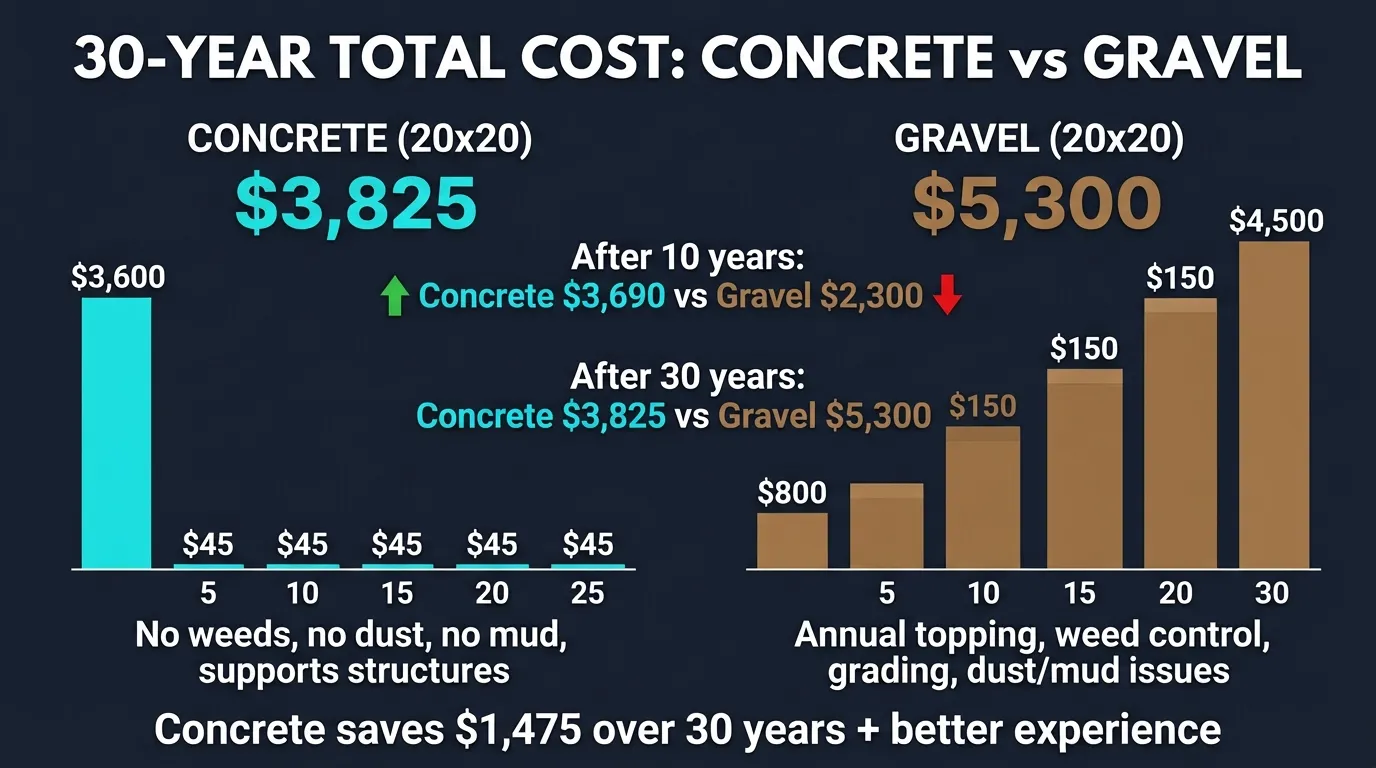
Gravel is the most common alternative homeowners consider for a 20×20 area. Here is the honest comparison:
| Factor | Concrete (20×20) | Gravel (20×20) | Winner |
|---|---|---|---|
| Initial cost | $2,400 – $4,800 | $400 – $1,200 | Gravel |
| Lifespan | 25–50 years | 10–20 years | Concrete |
| Annual maintenance | $40 – $70 | $100 – $200 | Concrete |
| Total 30-year cost | $3,600 – $6,900 | $3,400 – $7,200 | Tie |
| Foundation for structures | Yes | No | Concrete |
| Vehicle traffic | Excellent | Poor (ruts, dust) | Concrete |
| Weed growth | None | High (requires barrier) | Concrete |
| Mud / dust | None | High in wet/dry seasons | Concrete |
| Resale value | High | Low | Concrete |
What the data says: Over a 30-year lifespan, concrete and gravel cost roughly the same total amount — but concrete delivers a far better user experience. Gravel requires annual topping, weed control, and grading. It creates dust in dry weather and mud in wet weather. It cannot support structures like sheds or garages. For a 20×20 area that will see regular use, concrete is the better investment despite the higher upfront cost.
Frequently Asked Questions
How much concrete do I need for a 20×20 slab?
A 20×20 slab at 4 inches thick requires 4.93 cubic yards of concrete. This equals 222 bags of 80-pound concrete mix or 296 bags of 60-pound mix. With a 10% waste factor, order 245 bags of 80lb or 330 bags of 60lb. At 5 inches thick, you need 6.17 cubic yards. At 6 inches thick, you need 7.41 cubic yards.
How much does a 20×20 concrete slab cost?
A 20×20 concrete slab costs $2,400 to $4,800 for a standard 4-inch residential pour with broom finish and wire mesh reinforcement in 2026. Add decorative finishes, thicker pours, or rebar reinforcement and the range extends to $4,000–$9,200. DIY material costs run $1,730–$2,200.
How many bags of concrete for a 20×20 slab?
A 20×20 slab at 4 inches thick requires 222 bags of 80-pound concrete mix or 296 bags of 60-pound mix. Always add 10% extra for waste: 245 bags of 80lb or 330 bags of 60lb. For a 20x20 slab, ready-mix delivery is usually cheaper and far less labor than mixing bags.
How thick should a 20×20 patio slab be?
4 inches is the standard thickness for a 20×20 patio slab. This is sufficient for foot traffic, patio furniture, and light vehicle use when reinforced with wire mesh. If you are parking vehicles regularly, building a foundation, or installing an RV pad, upgrade to 6 inches with rebar reinforcement. A 3-inch slab is not recommended for any 20x20 permanent installation.
How much does a 20×20 concrete slab weigh?
A 20×20 slab at 4 inches thick weighs approximately 19,980 pounds (about 10 tons). At 6 inches, it weighs approximately 29,970 pounds (about 15 tons). Concrete weighs 150 pounds per cubic foot. A 20x20x4" slab is 133.2 cubic feet × 150 lbs = 19,980 lbs.
Do I need rebar for a 20×20 slab?
For a 20×20 patio or shed pad, wire mesh is the minimum acceptable reinforcement. For a driveway, garage floor, or foundation, use #4 rebar at 18-inch spacing. Rebar adds $400–$580 to a 20x20 slab but provides significantly more strength under vehicle loads. A 20x20 driveway with only wire mesh will develop cracks within 2–3 years.
How long does a 20×20 slab take to pour?
A 20×20 slab takes 6–8 hours to pour and finish with a crew of 4–6 people. The concrete truck unloads in 45–90 minutes, and finishing takes 3–4 hours. Curing begins immediately and continues for 28 days. The slab is walkable after 24–48 hours and ready for light use after 7 days.
Can I pour a 20×20 slab myself?
A 20×20 slab is at the upper limit of DIY feasibility. At 400 square feet, you need 4–6 people, a full day of work, and perfect timing — ready-mix concrete must be poured within 90 minutes of batching. If you have concrete experience and a reliable crew, DIY saves $1,200–$2,800. If you are new to concrete, hire a contractor. Mistakes on a 20x20 slab are expensive to fix.
Do I need a permit for a 20×20 concrete slab?
Most municipalities require a permit for a 20×20 slab because it exceeds 120–200 square feet (varies by location). Check with your local building department before starting. Permit costs range from $100 to $1,000. Unpermitted work can cause problems at resale and may violate homeowner insurance policies.
How much does it cost to remove an old 20×20 concrete slab?
Removing an old 20×20 concrete slab costs $800–$2,400, depending on thickness and accessibility. At 400 square feet, this is a significant demolition project. DIY removal is possible with a jackhammer and dumpster rental but takes 2–3 days of hard labor. Professional removal includes hauling and disposal.
What is the cheapest way to pour a 20×20 slab?
The cheapest way is to DIY with ready-mix delivery (not bagged), wire mesh, and a broom finish. Material costs run approximately $1,730. The trade-off is time, physical labor, and the risk of mistakes. For a guaranteed result with warranty, hire a contractor for $2,400–$4,000. Never skip reinforcement or proper base preparation — a 20x20 slab without wire mesh or rebar will crack and cost more to repair than the initial savings.
How much does a 20×20 stamped concrete patio cost?
A 20×20 stamped concrete patio costs $4,400–$9,600 in 2026. This includes the base slab ($2,400–$4,800) plus the stamping labor and materials ($2,000–$4,800). The pattern complexity affects price — simple ashlar slate costs less than intricate cobblestone or wood plank patterns. Color hardener adds $1,200–$2,800 more.
Can you pour concrete over an existing 20×20 slab?
Yes, if the existing slab is in good condition — no major cracks, settling, or crumbling. The old surface must be cleaned, roughened (shot-blasted or scarified), and a bonding agent applied. New concrete should be at least 2 inches thick over the old slab. If the existing slab has structural issues, remove it and pour fresh. Resurfacing an old 20x20 slab costs $1,200–$3,200 versus $2,400–$4,800 for full replacement.
Data Sources
- HomeAdvisor 2026 Concrete Cost Report
- Angi Contractor Pricing Survey 2026
- National Ready Mixed Concrete Association (NRMCA) Pricing Data
- Concrete Block Calculator 2026 Cost Guide
- CostFlowAI Concrete Slab Cost Analysis 2026
- Metal America Concrete Pricing Data 2026
- FRED (Bureau of Labor Statistics) Producer Price Index — Ready-Mix Concrete (April 2026)
- Portland Cement Association Price Trends 2024–2026
Related Calculators & Tools
- Concrete Slab Cost Calculator — Get exact cubic yards, bag count, and cost for any slab size
- Mulch & Soil Calculator — Estimate mulch for landscaping around your new slab
- Landscape Rock Calculator — Calculate gravel and rock for base preparation
- Drywall Mud Calculator — Figure out joint compound for any wall project
- Bathroom Remodel Cost Calculator — Budget your bathroom renovation