A CD ladder is a savings strategy that divides your money among multiple certificates of deposit with different maturity dates. This provides regular access to cash while helping you earn higher interest rates than keeping all your money in a single short-term CD.
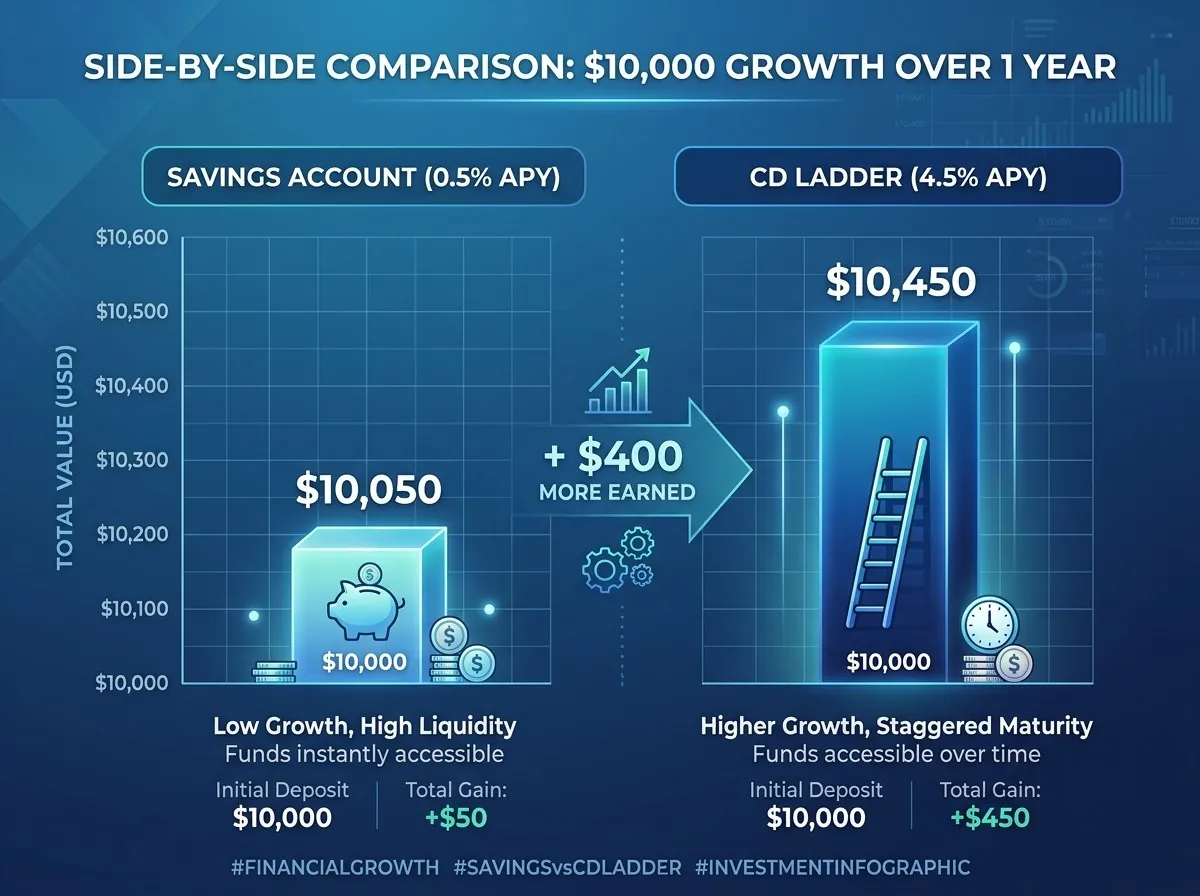
If you have cash sitting in a savings account earning 0.5% APY, you're leaving money on the table. A CD ladder strategy can earn you 7–10– more interest while keeping your money accessible on a predictable schedule.
Here's exactly how it works, how to build one, and whether it's the right strategy for your financial goals.

What Is a CD Ladder?
A CD ladder is a savings strategy where you split your money across multiple certificates of deposit with staggered maturity dates. Instead of locking all your money in one CD for 5 years, you spread it across CDs that mature at different intervals.
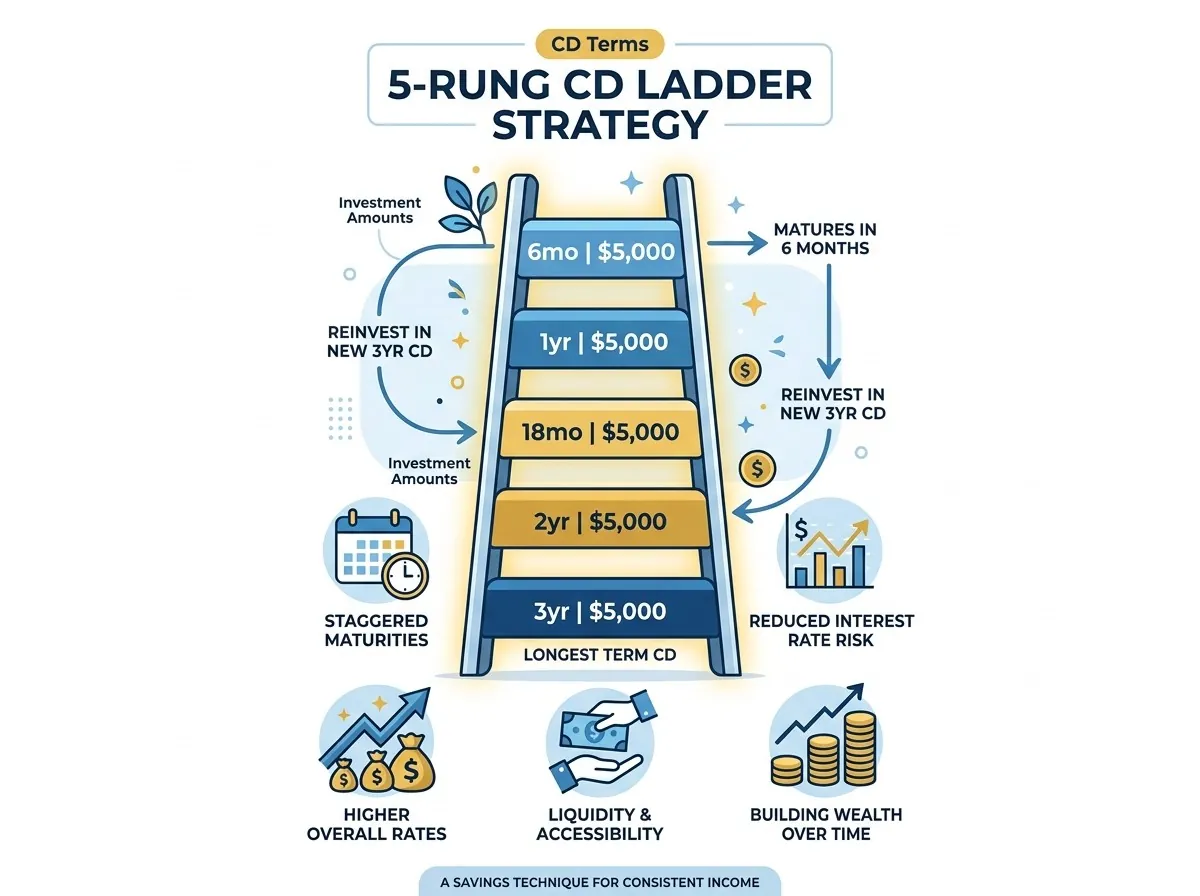
How It Works: A 5-Rung Example
Let's say you have $10,000 to invest. Here's how a 5-rung CD ladder works:
| Rung | Amount | Term | APY (2026) | Maturity |
|---|---|---|---|---|
| 1 | $2,000 | 6 months | 4.50% | Dec 2026 |
| 2 | $2,000 | 1 year | 4.75% | Jun 2027 |
| 3 | $2,000 | 18 months | 4.60% | Dec 2027 |
| 4 | $2,000 | 2 years | 4.40% | Jun 2028 |
| 5 | $2,000 | 3 years | 4.25% | Jun 2029 |
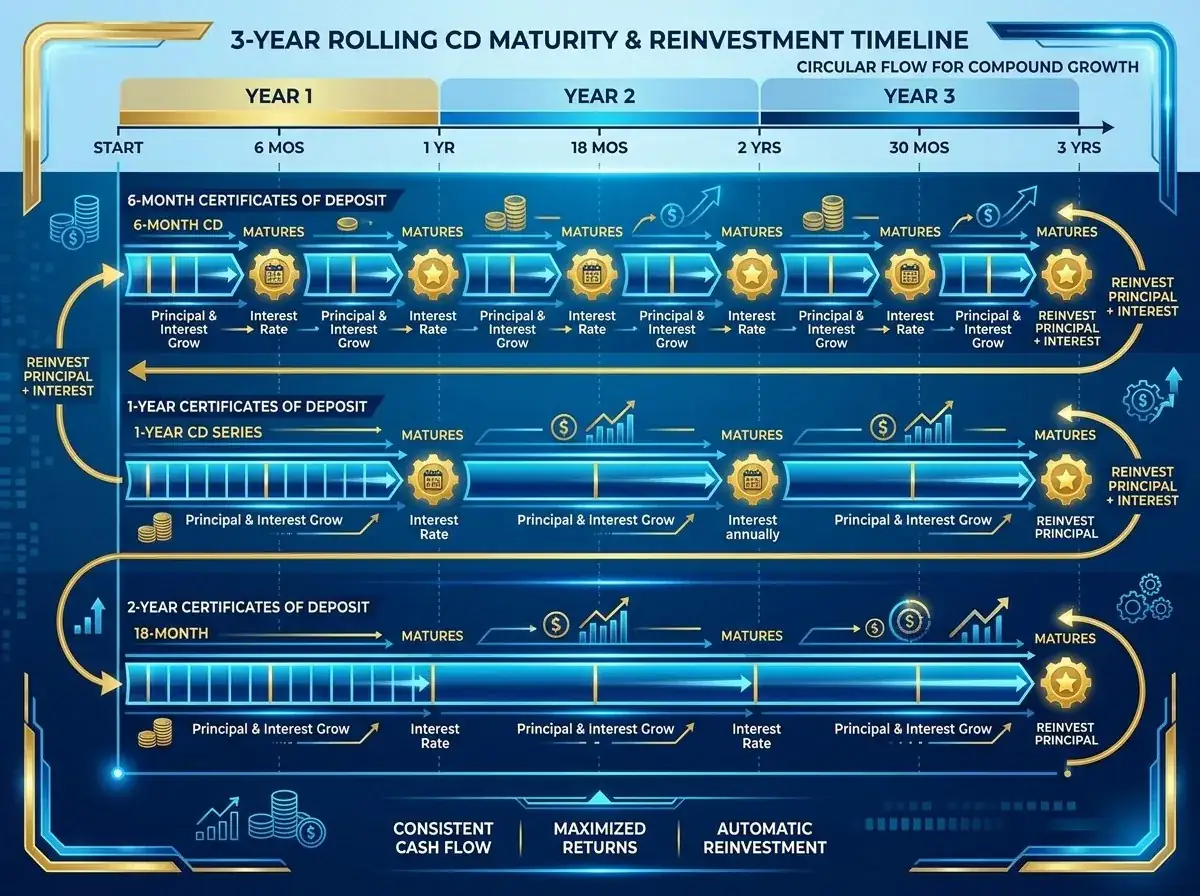
When rung 1 matures in December, you reinvest it at the best available 3-year rate. When rung 2 matures, same thing. You keep rolling forward, always earning top rates while having money coming due regularly.
Use Our Free CD Ladder Calculator
Build your custom CD ladder and see exactly how much interest you'll earn over time.
CD Ladder CalculatorCD Ladder vs Savings Account
| Feature | Savings Account | CD Ladder |
|---|---|---|
| APY (2026 avg) | 0.4% – 0.6% | 4.25% – 5.00% |
| $10,000 earns in 1 year | $40 – $60 | $425 – $500 |
| Liquidity | Instant access | At maturity dates |
| Penalty for withdrawal | None | 3–6 months interest |
| Rate guarantee | Variable, can change | Fixed for term |
| FDIC insured | Yes (up to $250K) | Yes (up to $250K) |
A CD ladder earns 7–10– more than a typical savings account while still giving you periodic access to your cash. Use our CD Calculator to see how a single CD compares, or try the CD Ladder Calculator to build your custom strategy.
How to Build Your CD Ladder
This is the total amount you want to put into CDs. Most banks require a $500–$1,000 minimum per CD.
3–5 rungs is standard. More rungs = more liquidity but slightly more complexity.
Divide your total by the number of rungs. Each rung gets an equal amount.
Purchase CDs so each matures 6–12 months apart. Start with the shortest term.
When a CD matures, reinvest it into a new CD with the longest term in your ladder.
Benefits of a CD Ladder
- Better liquidity than a single CD. Instead of locking all your money for 5 years, portions mature every 6–12 months, giving you regular access to cash.
- Higher average yield. You capture long-term rates on most of your money while keeping some short-term. Average yield is higher than a single short-term CD.
- Lower reinvestment risk. If rates rise, you only reinvest a portion at the new rate – not your entire savings. If rates fall, most of your money is already locked in at higher rates.
- Regular cash access. With a well-structured ladder, you have a CD maturing every 6–12 months – perfect for planned expenses or emergencies.
- Simple strategy. No complex investment knowledge required. Buy CDs, hold to maturity, reinvest. That's it.
- FDIC insured. Up to $250,000 per depositor, per bank – your principal is safe.
Disadvantages of a CD Ladder
- More accounts to manage. A 5-rung ladder means 5 separate CDs to track, each with its own maturity date and renewal schedule.
- Early withdrawal penalties. If you need money before a CD matures, you'll pay penalties – typically 3–6 months of interest for shorter terms, up to 12 months for longer terms.
- May underperform if rates fall. If interest rates drop significantly, you're locked into higher rates – which is actually good. But if you need to withdraw early, penalties can erase your gains.
- Not ideal for immediate cash needs. If you need instant access to all your money, a high-yield savings account is better.
- Minimum deposit requirements. Some banks require $500–$1,000 per CD, meaning a 5-rung ladder needs $2,500–$5,000 minimum.
CD Ladder vs Single CD
| Feature | CD Ladder | Single CD |
|---|---|---|
| Liquidity | High – money matures regularly | Low – all locked until maturity |
| Average APY | 4.25% – 4.75% | 4.10% – 5.10% (depends on term) |
| Reinvestment risk | Lower – staggered reinvestment | Higher – all at one rate |
| Complexity | Moderate – multiple CDs to track | Simple – one account |
| Best for | People who want balance of yield and access | People who won't need money for fixed period |
| Rate lock | Partial – some at short rates, some at long | Full – all at one rate |
When to choose a ladder: If you want regular access to some money while earning higher rates. When to choose a single CD: If you have a specific date you'll need the money (e.g., down payment in 18 months).
CD Ladder vs High-Yield Savings Account
| Feature | CD Ladder | High-Yield Savings |
|---|---|---|
| APY (2026) | 4.25% – 4.75% | 4.00% – 4.50% |
| Access to money | At maturity dates | Instant |
| Penalty for withdrawal | Yes – early withdrawal penalty | No penalty |
| Rate guarantee | Fixed for term | Variable – can change anytime |
| FDIC insured | Yes | Yes |
| Minimum balance | $500 – $1,000 per CD | Often $0 |
| Best for | Money you won't need for 6+ months | Emergency fund, daily expenses |
High-yield savings accounts are closing the gap – some offer 4.00%+ APY. But CD ladders still win for money you can commit to locking for 6 months or longer.
Common CD Ladder Mistakes
- Investing everything at one bank. Spread CDs across 2–3 banks to stay within FDIC limits ($250K per bank) and compare rates.
- Missing maturity dates. If you don't reinvest on time, your CD auto-renews at whatever rate the bank offers – often lower. Set calendar reminders 1–2 weeks before each maturity.
- Ignoring early withdrawal penalties. Know the penalty before you invest. A 6-month CD with a 3-month penalty means you could lose half your interest if you withdraw early.
- Forgetting the grace period. Most banks give you a 7–10 day grace period after maturity to make changes. After that, the CD auto-renews. Mark these dates.
- Auto-renewing without checking rates. Banks often auto-renew at below-market rates. Always compare the auto-renewal rate to current best rates before accepting.
- Not laddering at all. Some people buy 5 CDs all at the same term. That defeats the purpose – stagger the maturities.
Is a CD Ladder Worth It?
A CD ladder is worth it if you have cash you won't need for at least 6 months and want to earn more than a savings account without taking on investment risk. Here's who benefits most:
| Scenario | CD Ladder? | Why |
|---|---|---|
| Emergency fund | Yes – short ladder | 3–6 month CDs give better rates than savings while keeping some cash accessible |
| Home down payment | Yes – match timeline | Build a ladder that matures when you plan to buy (1–3 years out) |
| Retirement income | Yes – rolling ladder | Provides regular income with higher rates than bonds in low-rate environments |
| College savings | Maybe | 529 plans offer tax advantages CDs don't. But CDs are simpler for short-term goals |
| Vacation fund | Yes – short ladder | 3–6 month CDs earn more than savings while you save up |
| Daily spending money | No | Use a checking or high-yield savings account instead |
When Should You Use a CD Ladder?
A CD ladder makes sense in these specific situations:
- You have a lump sum you won't need immediately. If you just received an inheritance, bonus, or tax refund and want to earn more than a savings account while keeping some access.
- You're saving for a specific goal with a timeline. Buying a house in 2 years? Build a 2-year ladder where CDs mature as you approach your purchase date.
- Interest rates are high and you want to lock them in. When rates are favorable, a ladder lets you lock in high rates on most of your money while maintaining some flexibility.
- You want to diversify beyond stocks. CDs are a conservative, guaranteed-return option. A ladder provides better returns than savings without market risk.
- You're building a retirement income stream. A rolling CD ladder can provide predictable quarterly or semi-annual income in retirement.
Current CD Rates (June 2026)
| Term | Top Rate | Average Rate | Best For |
|---|---|---|---|
| 3 months | 4.75% | 4.20% | Emergency fund ladders |
| 6 months | 5.00% | 4.50% | Short-term savings |
| 1 year | 5.10% | 4.75% | Medium-term goals |
| 18 months | 4.90% | 4.60% | Balanced approach |
| 2 years | 4.75% | 4.40% | Goal-based saving |
| 3 years | 4.60% | 4.25% | Long-term locking |
| 5 years | 4.50% | 4.10% | Maximum yield |
CD Ladder Variations
3-Rung Ladder (Simple)
Best for beginners. Split $6,000 into three $2,000 CDs: 6-month, 1-year, and 2-year. Total first-year interest: ~$270.
5-Rung Ladder (Standard)
Best balance of yield and liquidity. Split $10,000 into five $2,000 CDs: 6-month through 3-year. Total first-year interest: ~$460.
Barbell Strategy
Split between short-term (3-month) and long-term (5-year) CDs. You get quick access to some money plus maximum yield on the rest.
Tax Considerations

CD interest is taxed as ordinary income at your federal tax rate. If you're in the 22% bracket and earn $460 in CD interest, you'll owe about $101 in federal tax.
Frequently Asked Questions
What if I need my money before the CD matures?
You'll pay an early withdrawal penalty – typically 3–6 months of interest for shorter terms and up to 12 months for longer terms. Some banks offer "no-penalty" CDs with slightly lower rates.
How much do I need to start a CD ladder?
Most banks require $500–$1,000 minimum per CD. A 5-rung ladder needs $2,500–$5,000 minimum. Some online banks have no minimum.
Are CDs better than high-yield savings accounts?
CDs earn more (4–5% vs 0.5%), but you lock your money for the term. If you need instant access, use a high-yield savings account. For money you won't need for 6+ months, CDs win.
What happens when a CD matures?
The bank typically auto-renews at the current rate (often lower). Set a reminder to reinvest manually into a new CD at the best available rate.
Can I add money to a CD after opening it?
Generally no – CDs are fixed deposits. If you want to add regularly, open a new CD at each maturity and add your new savings to it.
What's the best CD ladder for retirees?
A 3-rung ladder (3-month, 6-month, 1-year) provides regular income with higher rates. Reinvest each CD as it matures for rolling income.
How many rungs should a CD ladder have?
Most experts recommend 3–5 rungs. A 3-rung ladder is simpler to manage, while a 5-rung ladder provides better balance between yield and liquidity. More than 5 rungs adds complexity without much benefit.
Can I use CDs from different banks in my ladder?
Yes, and it's actually recommended. Using multiple banks lets you shop for the best rates at each term and stay within FDIC insurance limits ($250,000 per bank).
What's a no-penalty CD and should I use one?
A no-penalty CD lets you withdraw before maturity without paying a penalty – but typically offers a lower APY. They're useful if you want CD-like rates with savings-account flexibility.
How do CD rates compare to Treasury bonds?
CDs and Treasury bonds offer similar yields, but CDs are FDIC-insured while Treasuries are backed by the U.S. government. Both are extremely safe. CDs are simpler to buy through your bank.
Data Sources
- Bankrate – Best CD Rates (2026)
- NerdWallet – Best CD Rates (2026)
- FDIC – Deposit Insurance FAQs (2026)
- Investopedia – Certificate of Deposit (CD) Guide (2026)
- Investopedia – cd-ladder-strategy (2026)
Related Posts
- Concrete Slab Cost in 2026: What the Data Actually Says
- How to Price Your Paintings: A Complete Guide
- How Much Firewood Do I Need? Cord Calculator, Cost & Buying Guide
Related Calculators
- CD Ladder Calculator – Build your custom CD ladder and see projected earnings
- CD Calculator – Calculate interest for a single certificate of deposit