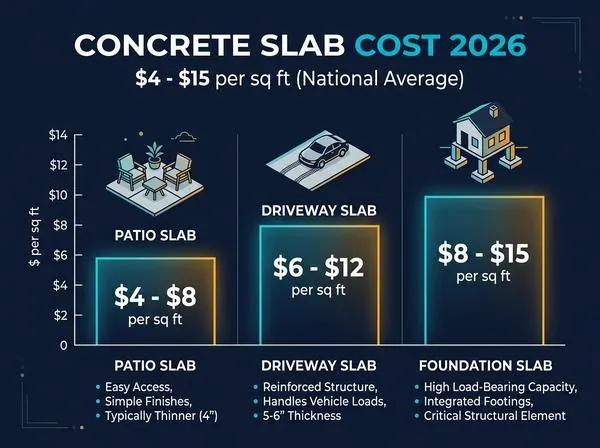
A concrete slab typically costs $4–$15 per square foot installed in 2026, depending on thickness, reinforcement, labor, and location. A standard 4-inch residential slab averages $6–$8 per square foot, while heavy-duty 6–8 inch slabs run $10–$15 per square foot. A standard 20–20 slab (400 sq ft) runs $2,400–$4,800 professionally installed, while a small 10–10 shed pad costs $400–$800.
If you're planning a concrete slab – whether for a shed, patio, garage, or foundation – the first question is almost always: "How much is this going to cost?"
The short answer? $4 to $15 per square foot, depending on where you live, what you're building, and who you hire. But the real answer is far more nuanced.
This guide cuts through the guesswork. We've analyzed data from multiple sources – HomeAdvisor, Angi, the National Ready Mixed Concrete Association, and contractor estimates across the US – to give you a clear, data-driven picture of concrete slab costs in 2026.
The Big Picture: Cost Summary
| Metric | Range | Source |
|---|---|---|
| Cost per square foot | $4 – $15 | RM4L, HomeBuddy |
| Concrete per cubic yard | $125 – $165 | MidWest Precast |
| Typical project total | $2,000 – $8,000 | HomeBuddy |
| 10–10 slab (100 sq ft) | $400 – $800 | RM4L |
| 20–20 slab (400 sq ft) | $2,400 – $4,800 | MidWest Precast |
| Labor as % of total | 40% – 60% | Angi 2026 |
Concrete Slab Cost by Size
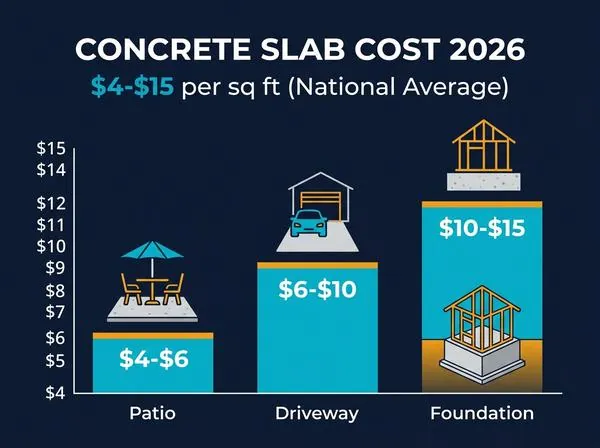
One of the most common questions is "How much does a slab cost for my specific size?" Here's a breakdown of estimated costs for the most popular slab dimensions, based on a standard 4-inch residential slab at $6–$8 per square foot installed.
| Slab Size | Square Feet | Estimated Cost (4-inch) | Estimated Cost (6-inch) |
|---|---|---|---|
| 8 – 10 | 80 sq ft | $480 – $640 | $720 – $960 |
| 10 – 10 | 100 sq ft | $600 – $800 | $900 – $1,200 |
| 12 – 12 | 144 sq ft | $864 – $1,152 | $1,296 – $1,728 |
| 12 – 20 | 240 sq ft | $1,440 – $1,920 | $2,160 – $2,880 |
| 16 – 20 | 320 sq ft | $1,920 – $2,560 | $2,880 – $3,840 |
| 20 – 20 | 400 sq ft | $2,400 – $3,200 | $3,600 – $4,800 |
| 24 – 24 | 576 sq ft | $3,456 – $4,608 | $5,184 – $6,912 |
| 20 – 30 | 600 sq ft | $3,600 – $4,800 | $5,400 – $7,200 |
| 30 – 40 | 1,200 sq ft | $7,200 – $9,600 | $10,800 – $14,400 |
Use Our Free Concrete Calculator
Get a custom estimate for your project in seconds.
Concrete Slab Cost CalculatorWhat Actually Drives the Cost?
Based on industry data, here are the five biggest factors that determine what you'll pay.
1. Slab Thickness
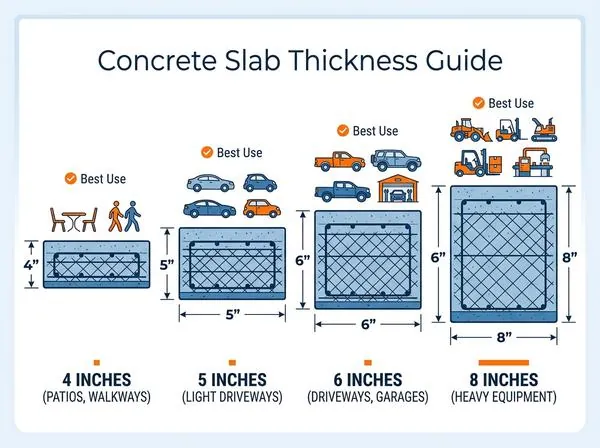
Thickness is the single biggest cost driver. More thickness = more concrete = higher cost.
| Thickness | Best For | Cost per sq ft |
|---|---|---|
| 4 inches | Patios, walkways, shed pads | $4 – $8 |
| 5 inches | Light-use driveways, porches | $5 – $9 |
| 6 inches | Driveways, garage floors | $6 – $10 |
| 8 inches | Heavy equipment, commercial | $8 – $12 |
What the data says: A standard 4-inch slab is sufficient for most residential projects. Each additional inch adds roughly $1–$2 per square foot. For a 500 sq ft slab, going from 4 inches to 6 inches adds about $1,000–$2,000 to your total.
2. Reinforcement
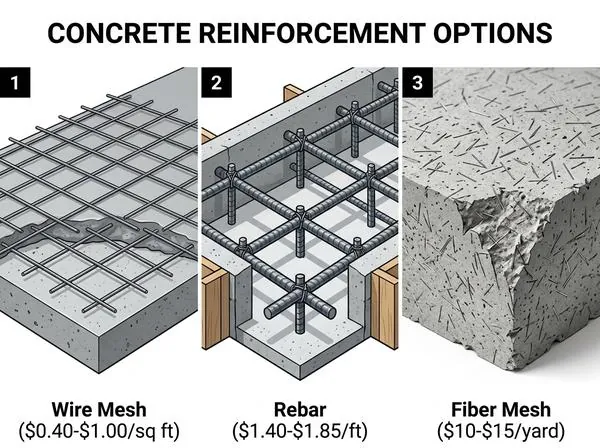
Concrete is strong under compression but weak under tension. Reinforcement prevents cracking.
| Reinforcement Type | Cost Range | Best For |
|---|---|---|
| Wire mesh | $0.40 – $1.00 per sq ft | Light-duty slabs, patios |
| Rebar | $1.40 – $1.85 per foot | Driveways, garages, foundations |
| Fiber mesh | $10 – $15 per cubic yard | Crack-resistant floors |
3. Site Preparation
Site prep is often overlooked – and it can cost thousands. If you're also landscaping around your new slab, check our Mulch & Soil Calculator to estimate materials for the surrounding area.
| Prep Work | Average Added Cost |
|---|---|
| Basic grading | $500 – $1,500 |
| Excavation and leveling | $1,000 – $3,500 |
| Gravel sub-base | $1 – $3 per sq ft |
| Permits | $50 – $1,000 |
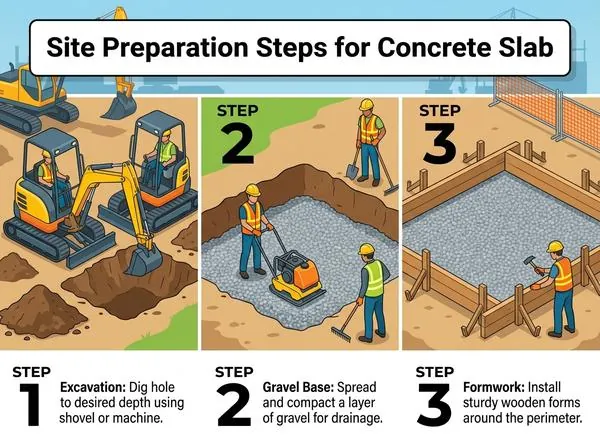
What the data says: If the concrete truck can't reach your site, you may need a concrete pump – costing $400–$800 per day. Poor soil conditions can add $0.50–$2.00 per square foot for grading.
4. Labor
Labor typically makes up 40% to 60% of your total foundation cost.
| Category | Cost per sq ft |
|---|---|
| Labor only | $2 – $5 |
| Materials only | $3.50 – $7 |
| Installed total | $6.50 – $10.50 |
What the data says: Labor rates vary dramatically by region. High-demand metro areas typically have higher rates and longer lead times.
5. Location & Delivery
Concrete prices vary by region. A standard concrete truck holds 10 cubic yards; if you order less, you'll pay a short-load fee of $40–$110.
| Cost Component | Typical Range |
|---|---|
| Concrete material | $125 – $165 per yard |
| Short-load fee | $40 – $110 per load |
| Delivery fee | $50 – $150 |
| Pump hire | $400 – $800 half-day |
Concrete Slab Costs by Region
Where you build matters. Labor rates, material availability, and local regulations all affect your final price. Here's how costs typically break down across major US regions.
| Region | Average Cost per sq ft | Key Factors |
|---|---|---|
| Northeast | $8 – $15 | Higher labor rates, strict permits, shorter building season |
| Midwest | $5 – $10 | Lower labor costs, moderate material prices, wide availability |
| South | $4 – $9 | Lowest labor rates, longer building season, fewer frost concerns |
| West | $7 – $14 | Higher material transport costs, seismic requirements in some areas |
Metro areas consistently cost more than rural locations. A slab in downtown Chicago or Los Angeles can run 20–30% above the regional average due to higher labor rates and delivery logistics.
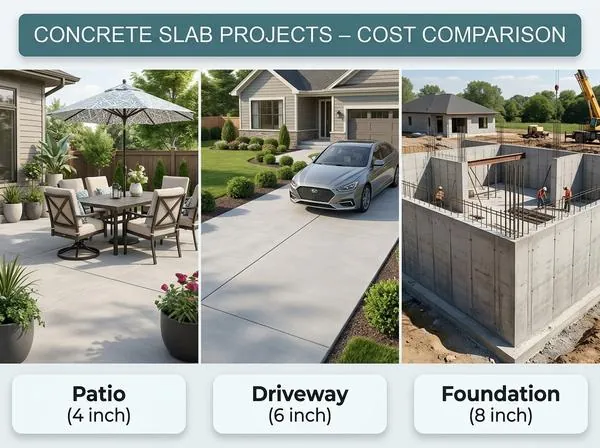
Cost by Project Type
Different projects require different specs – and different budgets.
| Project Type | Thickness | Cost per sq ft | Total Cost (Example) |
|---|---|---|---|
| Shed foundation | 4 inches | $4 – $8 | $400 – $800 (10–10) |
| Patio (plain) | 4 inches | $4 – $12 | $700 – $2,400 (small) |
| Patio (stamped) | 4 inches | $9 – $30 | $1,500 – $5,000+ |
| Driveway/garage | 6 inches | $8 – $15 | $2,400 – $4,800 (400 sq ft) |
| Slab foundation | 4-6 inches | $6.50 – $10.50 | $13,000 – $21,000 (2,000 sq ft) |
Hidden Costs Most Homeowners Miss
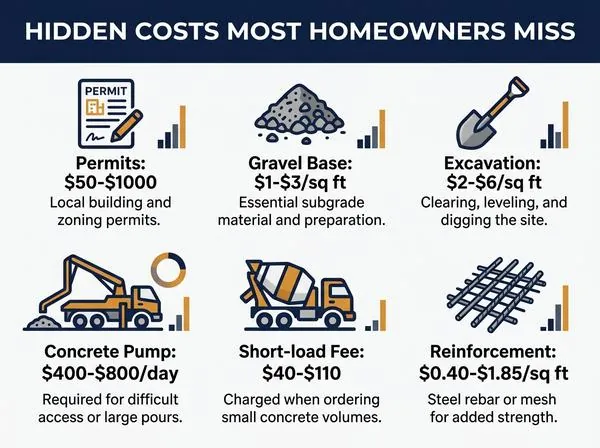
Based on contractor data, here are the costs that catch people off guard:
| Hidden Cost | Typical Range |
|---|---|
| Permits | $50 – $1,000 |
| Gravel sub-base | $1 – $3 per sq ft |
| Excavation/old concrete removal | $2 – $6 per sq ft |
| Concrete pump rental | $400 – $800/day |
| Short-load fees | $40 – $110 |
| Reinforcement (rebar/mesh) | $0.40 – $1.85 per sq ft |
| Decorative finishes | $2 – $15 per sq ft |
How to Estimate Your Own Project
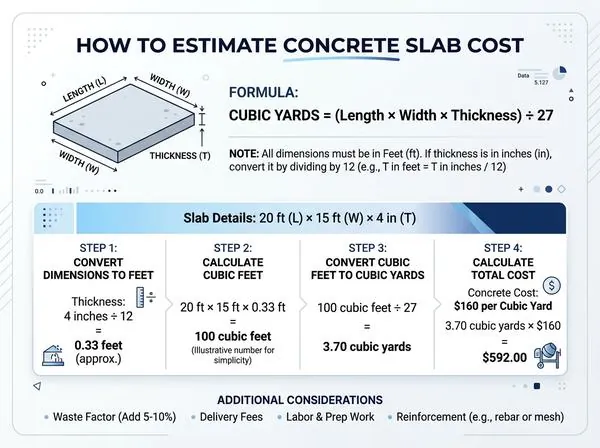
If you want a quick estimate, here's the math:
Volume (cubic yards) = (Length – Width – Thickness in feet) – 27. For a 4-inch slab: Thickness in feet = 4 – 12 = 0.33. Volume = (10 – 10 – 0.33) – 27 = 1.23 cubic yards.
Material Cost = Cubic Yards – Price per Yard. At $140/yard: 1.23 – $140 = $172.
Total Cost = (Square Footage – Installed Cost per sq ft). For a 10–10 slab at $8/sq ft: 100 – $8 = $800.
Use Our Free Calculator
Our Concrete Slab Cost Calculator does all the math for you. Enter length, width, thickness, adjust concrete price per yard, include or exclude labor – get instant, accurate estimates. No signup required.
Concrete Slab Cost CalculatorConcrete Slab vs Gravel: Which Is Right for You?
Not sure whether you need a concrete slab or if gravel will do the job? Here's an honest comparison to help you decide.
| Factor | Concrete Slab | Gravel |
|---|---|---|
| Cost per sq ft | $4 – $15 installed | $1 – $3 installed |
| Lifespan | 25 – 50+ years | 10 – 20 years (needs replenishing) |
| Maintenance | Low – occasional sealing | High – annual regrading and topping |
| Durability | Excellent for vehicles and structures | Poor for vehicles – rutting and displacement |
| Drainage | Poor without proper grading/slope | Excellent – naturally permeable |
| Aesthetics | Clean, modern, customizable finishes | Rustic, casual, limited options |
| Best for | Driveways, garages, patios, shed pads, foundations | Walkways, temporary surfaces, parking areas, drainage |
| Resale value | Increases home value significantly | Minimal impact |
Bottom line: If you're building something permanent or need to park vehicles, go with concrete. If you need a quick, budget-friendly surface for foot traffic or temporary use, gravel works fine. Use our Landscape Rock Calculator to estimate gravel costs for your project.
Concrete Slab Project Timeline
A typical residential concrete slab project follows this timeline. Total time varies by size and weather, but most small-to-medium projects take 1–2 weeks from planning to full strength.
1–5 days. Get local permits (if required), call 811 for utility locates, and get at least 3 contractor quotes. Permit costs vary by location.
1–2 days. Remove topsoil, dig to required depth, level the area, and compact the subgrade. Poor soil may need additional stabilization.
1 day. Lay 4–6 inches of gravel sub-base, set wooden or metal forms to define slab edges, and install reinforcement (rebar or wire mesh).
Half day. Concrete truck arrives, pours concrete into forms, workers spread and level it. Must be completed in one continuous pour.
4–8 hours. Screeding, bull floating, troweling, and edging. Decorative finishes (stamping, staining) add extra time.
24–48 hours to walk on, 7 days for light traffic, 28 days for full strength. Keep moist during curing for best results.
Is a Concrete Slab Worth the Cost?
For most homeowners, yes. Here's why:
| Benefit | Details |
|---|---|
| Resale value | A concrete patio or driveway can return 50–80% of its cost at resale, according to Remodeling Magazine's Cost vs Value report. |
| Durability | Concrete lasts 25–50+ years with minimal maintenance. Asphalt needs resurfacing every 10–15 years. |
| Low maintenance | Occasional sealing every 2–3 years. No annual regrading or topping like gravel. |
| Lifespan | At $8/sq ft lasting 30+ years, that's roughly $0.27 per sq ft per year – cheaper than most alternatives. |
| Energy efficiency | Concrete maintains cooler surface temperatures, reducing heat island effect around your home. |
Concrete Cost Saving Tips
You don't have to overpay for a quality slab. Here are proven ways to reduce your costs without cutting corners:
- Schedule multiple pours. If you need multiple slabs (patio + shed pad), have the contractor do them in one visit. You'll save on mobilization and delivery fees.
- Prepare the site yourself. Excavation and grading are labor-intensive but don't require skilled trade work. DIY this step and save $500–$2,000.
- Compare at least 3 quotes. Prices vary dramatically between contractors. Get detailed written quotes with the same specs for fair comparison.
- Optimize slab thickness. A 4-inch slab is sufficient for most patios and walkways. Don't over-spec – going from 4 to 6 inches adds $1–$2/sq ft.
- Avoid short-load fees. Order exactly what you need or coordinate with a neighbor to share a full truck (10 cubic yards). Short-load fees add $40–$110.
- Skip decorative finishes. A basic broom finish costs $1–$2/sq ft. Stamped or stained finishes can add $5–$15/sq ft.
- Ask about fiber mesh. Fiber mesh reinforcement ($10–$15/cubic yard) is cheaper than rebar ($1.40–$1.85/foot) and sufficient for many residential slabs.
Frequently Asked Questions
What's the average cost of a concrete slab in 2026?
$6 to $12 per square foot installed, or $4 to $8 for the concrete alone.
How much does a 20–20 concrete slab cost?
Approximately $2,400 to $4,800 for a professionally installed 4-inch slab.
How much concrete per yard?
$125 to $165 per cubic yard, with an average of $140 for standard residential mix.
Does a concrete slab need rebar?
For driveways and garages, yes. For patios and shed pads, wire mesh is usually sufficient.
Should I DIY or hire a pro?
Unless you have experience, hire a pro. Mistakes in mixing, leveling, or finishing can cost more to fix than the savings.
How thick should my slab be?
4 inches for patios and walkways, 6 inches for driveways and garages.
How long does concrete take to cure?
24-48 hours to walk on, 7 days for light traffic, 28 days for full strength.
What's the most expensive part of a slab?
Usually labor, which can account for 40-60% of the total cost.
Can I pour concrete over existing concrete?
Yes, if the existing slab is in good condition – no major cracks, settling, or crumbling. The old surface must be cleaned, roughened, and a bonding agent applied. New concrete should be at least 2 inches thick over the old slab. If the existing slab has structural issues, remove it and pour fresh.
Is thicker concrete always better?
Not necessarily. Thickness should match the intended use. A 4-inch slab is perfect for patios and walkways. Going thicker than needed wastes money – a 6-inch slab costs 25–50% more than a 4-inch slab for the same area. Match thickness to load requirements, not "more is better" thinking.
How much does a concrete truck hold?
A standard concrete mixer truck holds 10 cubic yards. That's enough for a 20–20 slab at 4.5 inches thick, or roughly 400 square feet. If you need less than 10 yards, you'll pay a short-load fee of $40–$110. Coordinate with neighbors or schedule multiple pours to fill a truck.
Data Sources
- RM4L Concrete Slab Cost Guide (2026)
- MidWest Precast Average Concrete Slab Cost (2026)
- HomeBuddy Concrete Slab Cost Guide (2026)
- BuildWise 10x20 Slab Pricing Guide (2026)
- CostToBuild Residential Foundations (2026)
- Home Project Calculators Concrete Cost Calculator
- Angi Foundation Cost Data (2026)
- Concrete Network Prices (2026)
Related Posts
- Cost to Pour Concrete Slab 2026: Per Sq Ft Data
- Concrete Driveway Installation Cost 2026
- Concrete Slab Cost by Size: Complete 2026 Guide
- How Much Mulch Do I Need? Calculator & Guide
- Drywall Mud Coverage per Gallon: Complete Guide
- How Much Firewood Do I Need for Winter?
- Landscape Rock Calculator: How Much Do You Need?
Related Calculators
- Concrete Slab Cost Calculator – Get exact cubic yards, bag count, and total cost
- Mulch & Soil Calculator – Estimate mulch, soil, and compost for landscaping
- Landscape Rock Calculator – Calculate rock, gravel, and sand needed
- Drywall Mud Calculator – Figure out how much mud your project needs
- Bathroom Remodel Calculator – Budget your bathroom renovation