A CD calculator estimates the maturity value and total interest earned on a certificate of deposit using your deposit amount, APY, term length, and compounding frequency. It removes the guesswork from comparing CDs across banks and terms, showing you exactly how much you will earn before committing your money.
In this guide, we explain how CD calculators work, how the compound interest formula is applied, and how to use a CD calculator to compare rates and maximize your returns in 2026.

What Is a CD Calculator?
A CD calculator is a free online tool that computes the future value of a certificate of deposit. You enter your deposit amount, the interest rate or APY, the term length, and how often interest compounds. The calculator then returns your maturity value (the total amount you receive at the end of the term), the total interest earned, and the effective annual yield.
Unlike a basic savings account where rates can change at any time, a CD locks in your rate for the full term. The calculator helps you compare different scenarios — for example, whether a 12-month CD at 5.1% earns more than an 18-month CD at 4.9% — before you commit your money.
Try Our Free CD Calculator
Calculate your exact CD earnings with different rates, terms, and compounding frequencies.
CD CalculatorKey Features of CDs
- Fixed interest rate — Your rate is locked in for the entire term, protecting you from rate drops
- Fixed term — Money is locked for 3 months to 5+ years depending on the CD type
- FDIC insured — Protected up to $250,000 per depositor, per bank
- Early withdrawal penalty — You pay a fee if you need money before maturity (typically 3-12 months of interest)
- Minimum deposit — Most banks require $500-$1,000 to open a CD
- Auto-renewal — Most CDs auto-renew at maturity unless you specify otherwise
Types of CDs
Not all CDs are the same. Here are the most common types you will encounter:
- Traditional CD — The standard option. Fixed rate, fixed term, early withdrawal penalty.
- No-Penalty CD — Allows you to withdraw early without penalty. Usually offers a slightly lower rate.
- Bump-Rate CD — Gives you the option to "bump" your rate once during the term if rates rise.
- Step-Up CD — The rate automatically increases at predetermined intervals during the term.
- Jumbo CD — Requires a large deposit (typically $100,000+) but offers higher rates.
- IRA CD — A CD held within an Individual Retirement Account, offering tax advantages.
How to Use a CD Calculator
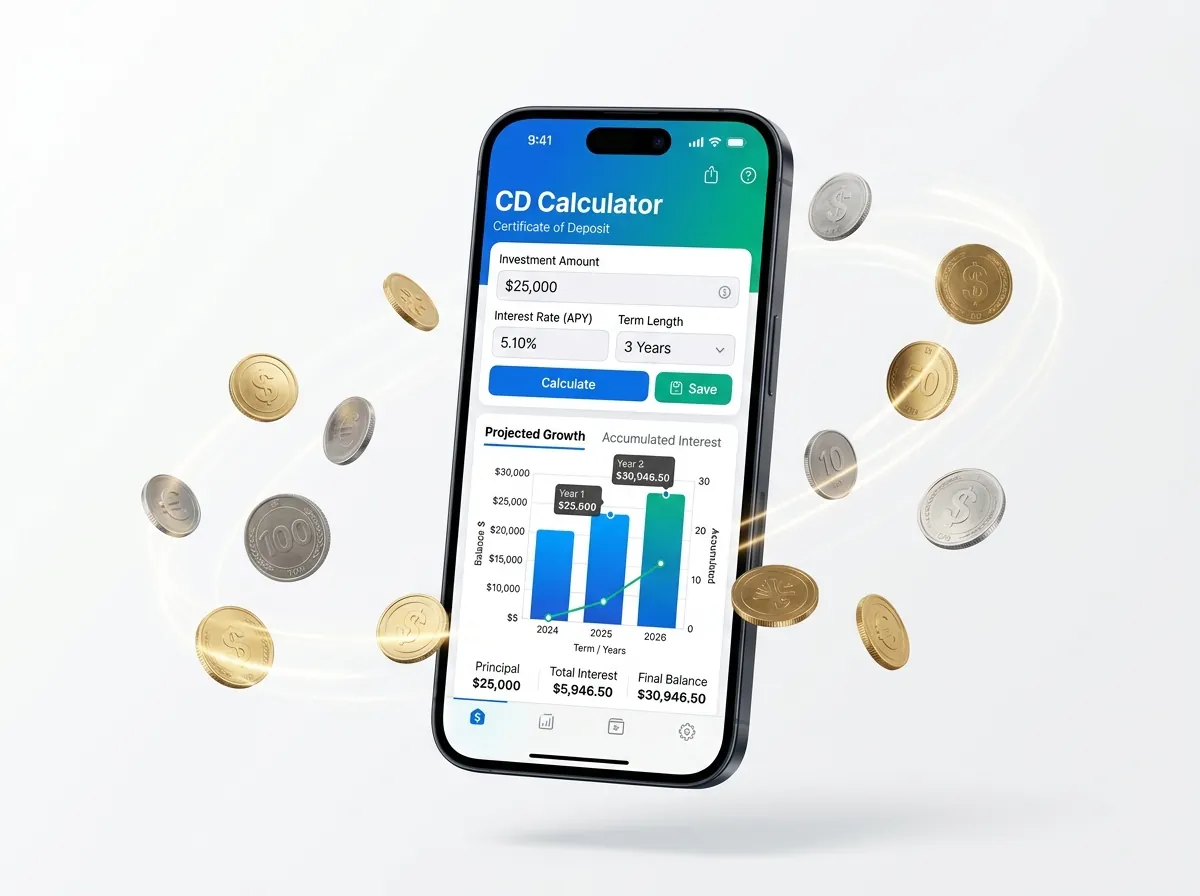
How much do you plan to invest? Most banks require $500-$1,000 minimum. Jumbo CDs start at $100,000. The higher your deposit, the more interest you earn.
Enter the annual percentage yield offered by your bank. APY includes the effect of compounding, so it reflects your true annual return. Check Bankrate or your bank's website for current rates.
Choose how many months you want to lock your money. Common terms are 3, 6, 12, 18, 24, 36, and 60 months. Longer terms usually offer higher rates but reduce liquidity.
The calculator returns your maturity value (total amount at end of term), total interest earned, and effective APY. Use these numbers to compare different CD options side by side.
CD Interest Formula
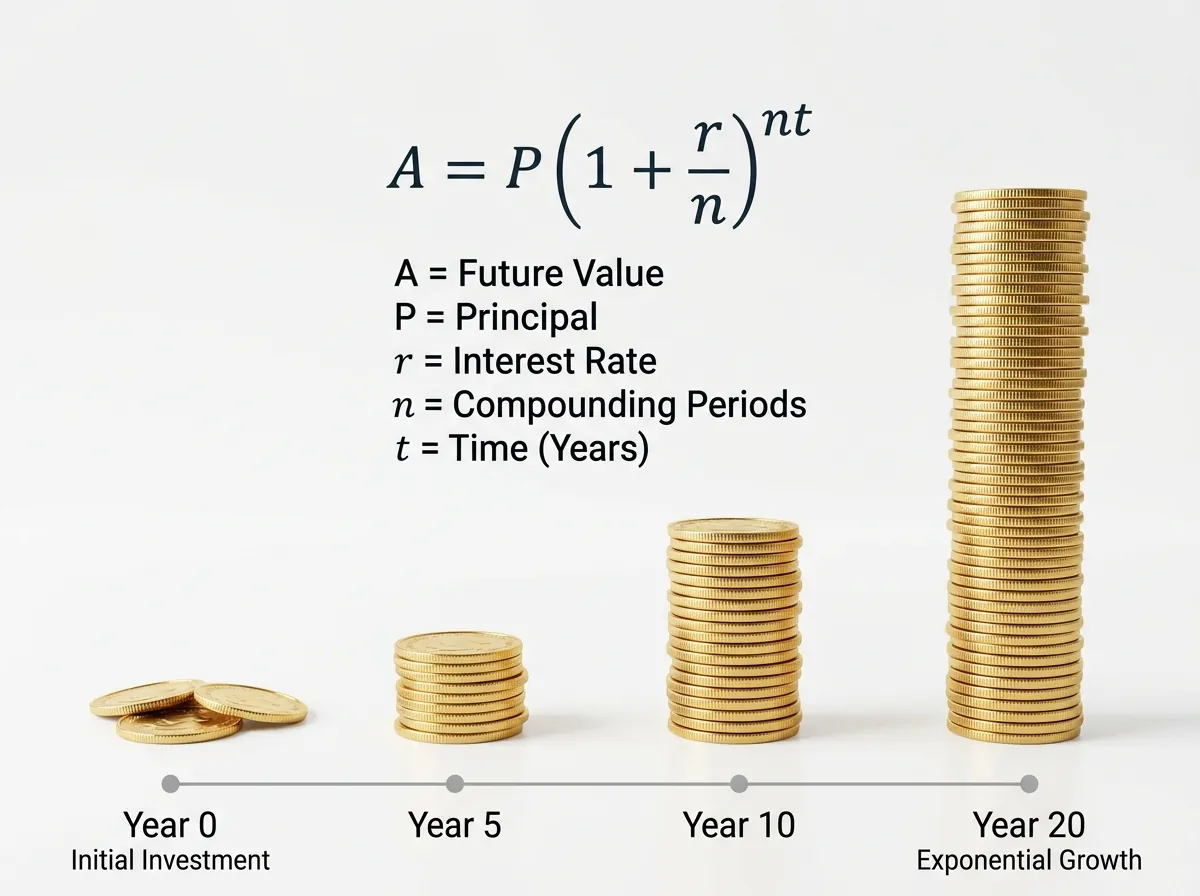
CDs earn compound interest, meaning you earn interest on your interest. Unlike simple interest where you only earn on the original principal, compound interest calculates interest on both the principal and the accumulated interest from previous periods. This is why CDs grow faster than regular savings accounts.
Where: P = Principal (initial deposit), r = Annual interest rate (decimal), n = Compounding frequency (times per year), t = Time in years
Variables Explained
- P (Principal) — This is the amount you initially deposit into the CD. For example, $10,000.
- r (Rate) — The annual interest rate as a decimal. For 4.5%, r = 0.045.
- n (Compounding Frequency) — How many times per year interest is calculated and added. Monthly = 12, Daily = 365, Quarterly = 4.
- t (Time) — The number of years your money is invested. For 12 months, t = 1. For 24 months, t = 2.
Compound Interest Formula Breakdown
The formula works in three steps:
r/n gives you the periodic rate. For 4.5% compounded monthly: 0.045 / 12 = 0.00375 per month.
(1 + 0.00375) = 1.00375. Raise this to the total number of compounding periods (n × t). For 12 months: 1.00375^12 = 1.04594.
$10,000 × 1.04594 = $10,459.40. Your interest earned is $459.40.
Worked Example
Let's calculate the maturity value for a $10,000 CD at 4.5% APY for 12 months with monthly compounding:
P = $10,000 · r = 0.045 · n = 12 (monthly) · t = 1 year
0.045 ÷ 12 = 0.00375
(1 + 0.00375)^12 = 1.00375^12 = 1.04594
$10,000 × 1.04594 = $10,459.40
$10,459.40 − $10,000 = $459.40
| Compounding | Interest Earned | Final Value | APY |
|---|---|---|---|
| Annually | $450.00 | $10,450.00 | 4.50% |
| Quarterly | $457.65 | $10,457.65 | 4.58% |
| Monthly | $459.40 | $10,459.40 | 4.59% |
| Daily | $460.25 | $10,460.25 | 4.60% |
More frequent compounding means slightly more interest, but the difference between monthly and daily is only about $1 per year on a $10,000 CD.
APY vs Interest Rate
Many people confuse APY with the quoted interest rate. They are related but different — and understanding the distinction matters when comparing CDs.
What Is APY?
APY (Annual Percentage Yield) is the effective annual return on your deposit. It accounts for compounding — the effect of earning interest on previously accumulated interest. If a bank quotes 4.5% interest compounded monthly, your APY is actually 4.59%. The APY gives you a more accurate picture of what you will earn.
Why APY Matters More Than APR
APR (Annual Percentage Rate) does not account for compounding. Two CDs with the same APR but different compounding frequencies will earn different amounts. APY normalizes this by showing the true annual return. When comparing CDs, always compare APY — it is the apples-to-apples number.
| Term | Typical APY | Best For |
|---|---|---|
| 3 Months | 4.20% – 4.75% | Short-term savings, emergency fund parking |
| 6 Months | 4.50% – 5.00% | Emergency funds, near-term goals |
| 1 Year | 4.75% – 5.10% | Most savers, best overall rate |
| 3 Years | 4.25% – 4.60% | Longer-term growth, goal-based saving |
| 5 Years | 4.10% – 4.50% | Maximum yield, long-termlock in |
When a CD Calculator Is Most Useful
A CD calculator is not just for checking a number. It is a decision-making tool that helps you make smarter financial choices in several scenarios:
- Planning savings goals: Target a specific dollar amount by a certain date. The calculator tells you how much you need to deposit today to reach that goal.
- Comparing banks: Different banks offer different rates and compounding frequencies. Run each through the calculator to see which actually earns you more.
- Choosing between terms: A 12-month CD at 5.1% might earn more than an 18-month CD at 4.9%. The calculator makes this comparison instant.
- Estimating maturity value: Know exactly how much you will receive when your CD matures. This helps with tax planning and budgeting.
Factors That Affect CD Earnings
Interest Rate (APY)
The single biggest factor. A 1% higher rate on a $10,000 CD earns an extra $100+ per year. Always shop for the highest APY available from FDIC-insured institutions.
CD Term
Longer terms generally offer higher rates, but they also lock your money away longer. A 5-year CD earns more total interest than a 1-year CD, but you lose access to that money for 4 additional years.
Compounding Frequency
More frequent compounding earns more interest. Daily compounding earns slightly more than monthly, which earns more than quarterly. The difference is small — typically $5-15 per year on a $10,000 CD — but it adds up over larger deposits.
Initial Deposit
The more you deposit, the more you earn. Doubling your deposit doubles your interest. Jumbo CDs ($100,000+) often qualify for premium rates that smaller deposits do not.
CD Calculator vs Manual Calculation
You can calculate CD interest by hand using the formula, but a calculator saves time and eliminates errors. Here is a comparison:
| Method | Pros | Cons |
|---|---|---|
| CD Calculator | Instant results, error-free, easy to compare scenarios, handles complex compounding | Requires internet, limited to built-in options |
| Manual Calculation | No tools needed, helps understand the formula | Time-consuming, prone to rounding errors, difficult for daily compounding |
For most people, a calculator is the practical choice. Manual calculation is useful for understanding how the formula works, but not for comparing multiple CD options.
CD Calculator vs Savings Account
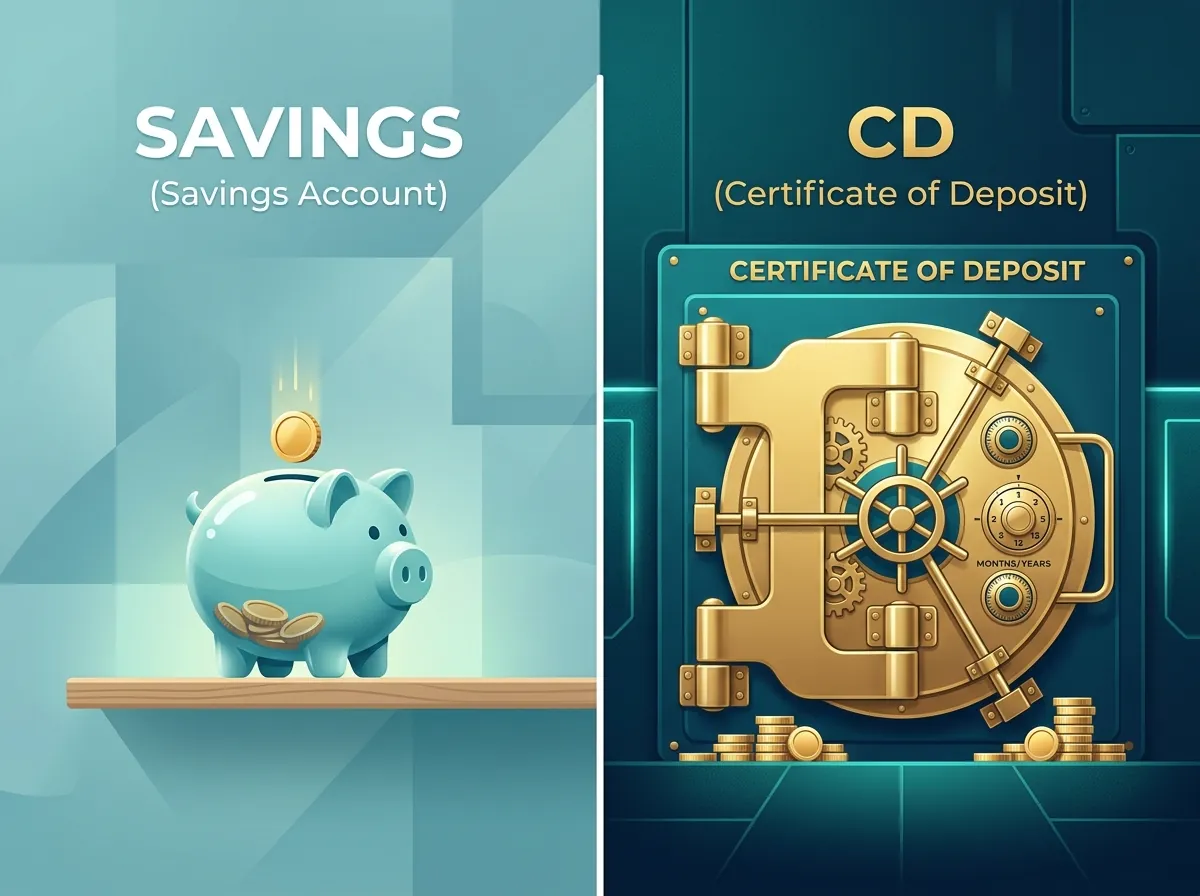
| Feature | Savings Account | 1-Year CD |
|---|---|---|
| APY (2026 avg) | 0.4% – 0.6% | 4.75% – 5.10% |
| $10,000 earns in 1 year | $40 – $60 | $475 – $510 |
| $10,000 earns in 5 years | $200 – $300 | $2,500 – $2,800 |
| Liquidity | Instant access | Locked for term |
| Rate guarantee | Variable, can change | Fixed for term |
| FDIC insured | Yes (up to $250K) | Yes (up to $250K) |
A 1-year CD earns 8-10x more than a savings account. Over 5 years, that difference grows to $2,300+ on a $10,000 deposit.
When to Choose a Savings Account
- Emergency fund access — Keep 3-6 months of expenses in a savings account for unexpected costs
- Short-term goals — Money needed within 3-6 months should stay liquid
- Regular deposits — If you are building savings gradually, a savings account allows ongoing contributions
- Flexibility — No penalties for withdrawals, no lock-up period
When to Choose a CD
- Have a lump sum — If you have $5,000+ sitting in savings, a CD can earn much more
- Won't need the money — If you can lock it away for 6+ months without touching it
- Want guaranteed returns — CDs offer fixed rates, so you know exactly how much you will earn
- Are saving for a specific goal — Wedding, vacation, down payment with a known timeline
Best CD Rates in 2026
| Term | Top Rate | Average Rate | Best For |
|---|---|---|---|
| 3 months | 4.75% | 4.20% | Emergency fund, short-term savings |
| 6 months | 5.00% | 4.50% | Short-term goals |
| 1 year | 5.10% | 4.75% | Best overall rate |
| 18 months | 4.90% | 4.60% | Medium-term goals |
| 2 years | 4.75% | 4.40% | Goal-based saving |
| 3 years | 4.60% | 4.25% | Longer-term planning |
| 5 years | 4.50% | 4.10% | Maximum yield |
Common CD Mistakes to Avoid
- Choosing the wrong term — Locking money into a 5-year CD when you need it in 2 years means paying an early withdrawal penalty. Match the term to your timeline.
- Ignoring APY — Two CDs with the same interest rate but different compounding frequencies earn different amounts. Always compare APY for a true apples-to-apples comparison.
- Early withdrawal penalties — If you might need the money early, choose a no-penalty CD or a shorter term. A 3-month interest penalty on a 6-month CD wipes out half your earnings.
- Not comparing banks — Online banks often pay 0.5-1% more than traditional banks. That is $50-100 more per year on a $10,000 CD. Always shop around.
- Forgetting inflation — A 4.5% CD rate with 3% inflation means your real return is only about 1.5%. CDs preserve capital but do not build wealth aggressively.
Tips to Maximize CD Returns
- Build a CD ladder — Split your money across CDs with different maturity dates. This gives you regular access to your cash while earning higher rates. As each CD matures, reinvest at the longest term. Learn more about CD laddering →
- Shop for the best rates — Online banks typically offer 0.5-1% higher rates than traditional banks. Credit unions may offer even better rates.
- Consider a CD bullet strategy — Instead of staggering maturities, buy multiple CDs that all mature at the same time. Useful when you have a large expense coming up.
- Reinvest at maturity — Set a reminder before your CD matures so you can reinvest at the best available rate instead of accepting auto-renewal terms.
- Use tax-advantaged accounts — Hold CDs in IRAs or Roth IRAs to defer or eliminate taxes on interest, boosting your effective return.
Tax Considerations
CD interest is taxed as ordinary income at your federal tax rate. If you are in the 22% bracket and earn $500 in CD interest, you will owe about $110 in federal tax. State taxes may also apply depending on where you live.
Consider holding CDs in a tax-advantaged account (IRA, Roth IRA) to avoid annual tax on interest. This is especially beneficial for higher-rate, longer-term CDs where the tax drag can significantly reduce your effective returns.
Tax Tips for CD Investors
- Use tax-advantaged accounts — Hold CDs in IRAs or Roth IRAs to defer or eliminate taxes on interest
- Consider municipal CDs — Some states offer tax-free CDs for residents
- Track your interest — Banks report interest earned on Form 1099-INT
- Plan withdrawals strategically — If possible, withdraw CDs in years with lower income to reduce tax burden
Frequently Asked Questions
What is a CD calculator?
A CD calculator estimates the maturity value and total interest earned on a certificate of deposit using your deposit amount, APY, term length, and compounding frequency. It helps you compare different CD options before committing your money.
How is CD interest calculated?
CD interest is calculated using compound interest based on the initial deposit, annual percentage yield (APY), compounding frequency, and investment term. The formula is FV = P(1 + r/n)^(nt), where P is principal, r is annual rate, n is compounding frequency, and t is time in years.
What is a good CD rate in 2026?
In 2026, top CD rates range from 4.5% to 5.1% APY depending on term length. 1-year CDs typically offer the best rates around 5.0-5.1%, while 5-year CDs offer 4.4-4.5%.
Are CDs better than savings accounts?
Yes, CDs typically earn 4-5% APY while savings accounts earn 0.4-0.6%. A $10,000 CD earns $450-500 per year vs $40-60 in savings. The tradeoff is CDs lock your money for a fixed term.
What is the difference between APY and interest rate?
The interest rate is the annual rate used to calculate interest on your principal. APY (Annual Percentage Yield) accounts for compounding and reflects the true annual return. APY is always higher than or equal to the interest rate because it includes the effect of compounding.
How does compounding frequency affect CD returns?
More frequent compounding means more interest earned. Daily compounding earns slightly more than monthly, which earns more than quarterly. For a $10,000 CD at 4.5%, the difference between daily and annual compounding is about $10 per year.
What happens if I withdraw from a CD early?
Most banks charge an early withdrawal penalty of 3-6 months of interest for shorter terms and up to 12 months for longer terms. This penalty can reduce your principal, so CDs are best for money you won't need until maturity.
When should I use a CD calculator?
Use a CD calculator when comparing rates across banks, choosing between different term lengths, planning savings goals with a specific target, or estimating how much interest you will earn before committing to a CD.
Data Sources
- Bankrate – Best CD Rates (2026)
- NerdWallet – Best CD Rates (2026)
- FDIC – Deposit Insurance FAQs (2026)
- Investopedia – Certificate of Deposit Guide (2026)