Drywall Mud Coverage Per Gallon
One gallon of drywall mud typically covers 35–100 square feet, depending on the finish level, mud type, and number of coats applied. For a standard Level 4 finish with all-purpose pre-mixed compound, expect about 100 sq ft per gallon per coat.
This guide covers everything you need to know: coverage rates by finish level, the formula for calculating exact amounts, mud types and drying times, plus a free calculator to eliminate guesswork.
Who should use this guide: DIY homeowners finishing drywall in a room or addition, contractors estimating material costs, and anyone using the Drywall Mud Calculator who wants to understand the numbers behind the results.
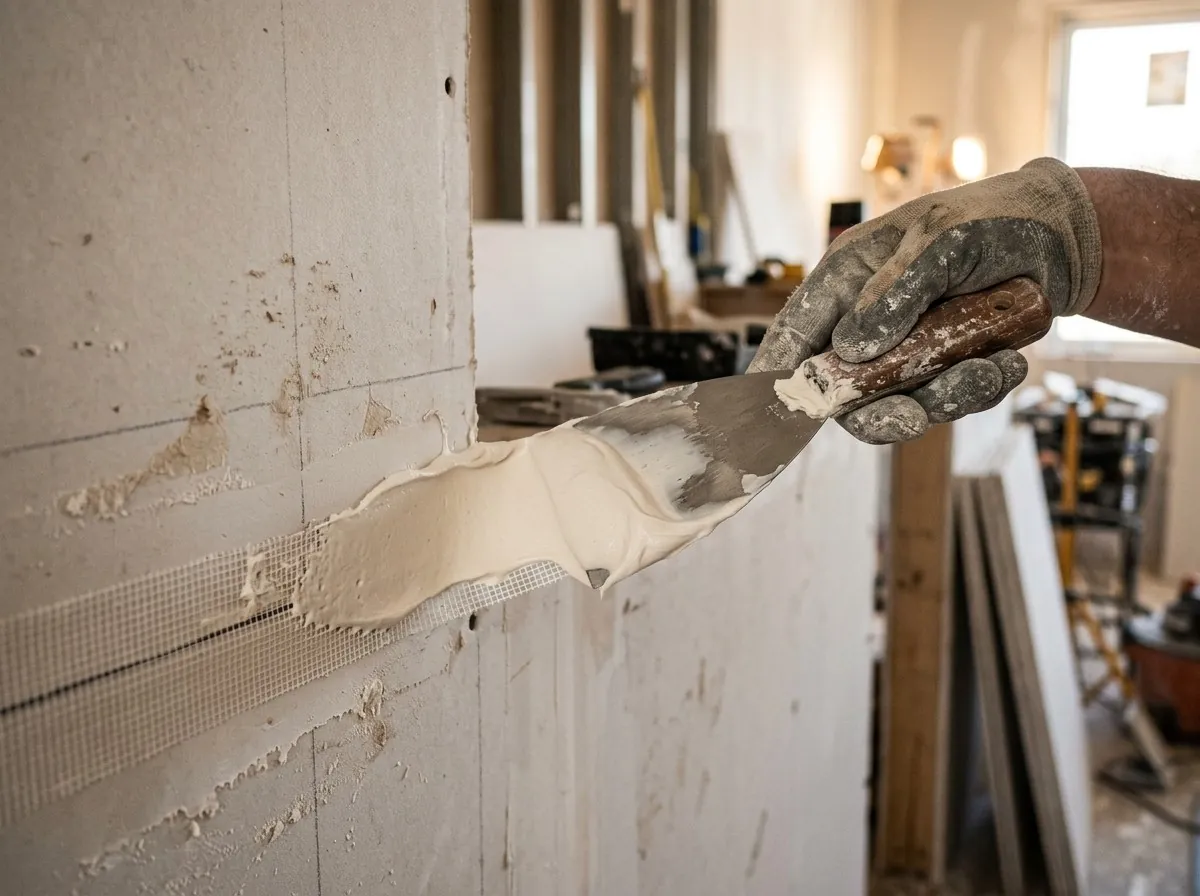
How to Use the Drywall Mud Calculator
Our free Drywall Mud Calculator does the math for you. Here's how to get accurate results:
Multiply each wall's height by width and add them together. For a 12×12 room with 8 ft ceilings, that's (12×8)×4 = 384 sq ft. Subtract doors (21 sq ft each) and windows (12–15 sq ft each).
Select Level 1–5. Level 4 is standard for most rooms. Level 5 adds a skim coat for critical lighting areas. Each level changes the coverage rate.
Standard finishing uses 3 coats (tape, fill, finish). Level 5 adds a 4th skim coat. More coats = more mud needed.
Enter 10–15% to account for spillage, drying in the pan, and edge work. This prevents running out mid-project.
The calculator shows gallons needed, gallons with waste, bucket counts (3.5 gal and 5 gal), and estimated cost.
Use Our Free Drywall Mud Calculator
Enter your wall dimensions and get the exact amount of joint compound you need — no guesswork.
Drywall Mud CalculatorDrywall Mud Coverage Formula
The formula for calculating how much drywall mud you need is straightforward:
To add a waste factor:
Variable breakdown:
- Wall Area — Total square footage of all walls to be mudded (subtract doors and windows)
- Coats — Number of compound layers (typically 3 for Level 4, 4 for Level 5)
- Coverage Rate — Sq ft per gallon, which varies by finish level (35–100 sq ft/gal)
- Waste% — Typically 10–15% for spillage, tool residue, and edge work
Worked Example
Let's calculate mud for a 400 sq ft wall area at Level 4 finish with 3 coats and 10% waste.
Gallons Needed = (400 × 3) ÷ 40 = 30 gallons
Gallons With Waste = 30 × 1.10 = 33 gallons
Estimated Cost = 33 × $18 = $594
Result: 33 gallons of joint compound. That's about 10 buckets of 3.5 gallons or 7 buckets of 5 gallons. Use the calculator to model your own project.
Drywall Finish Levels Explained
Drywall finish levels determine how smooth and polished your walls look. Higher levels require more coats, more compound, and more sanding. Choosing the right level affects your total mudusage and project cost.
Level 1 – Tape Coat Only
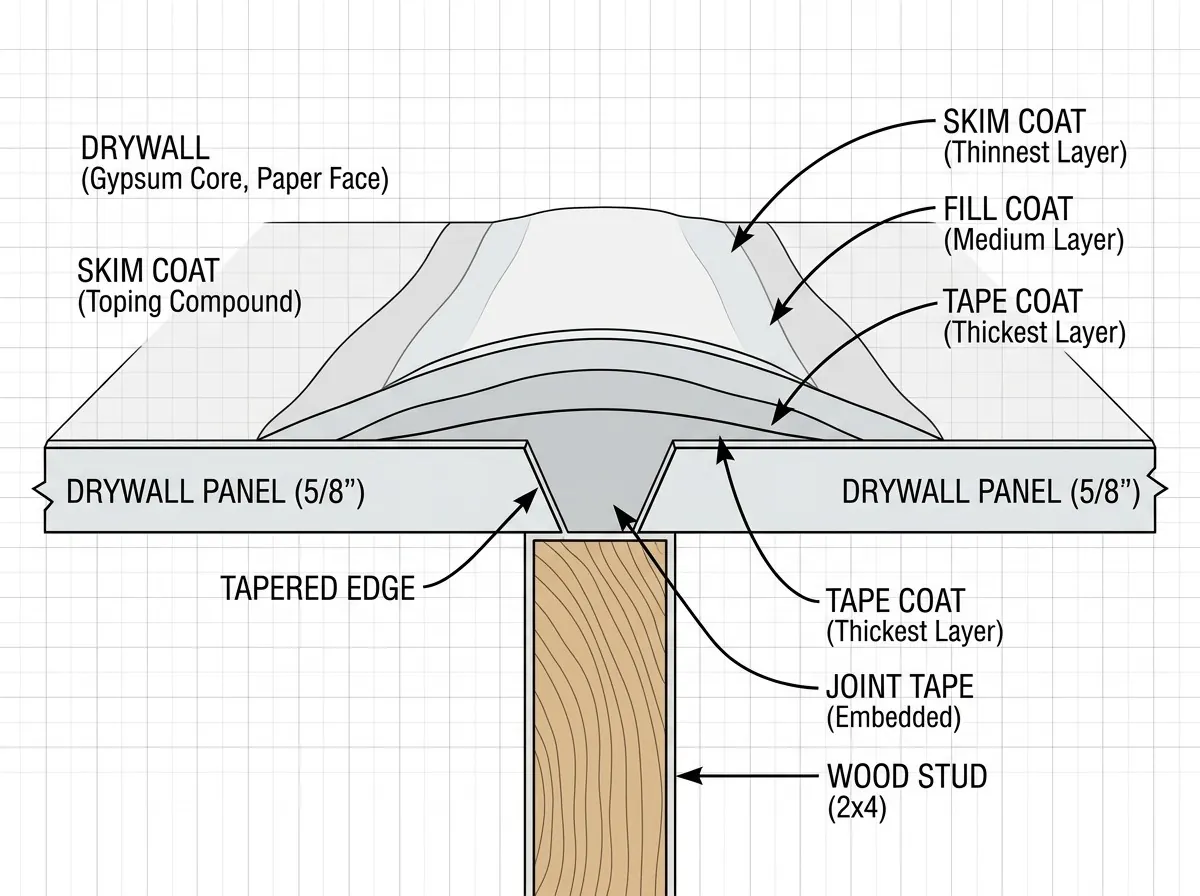
A single tape coat embeds joint tape in compound. No additional coats are applied. This is the minimum standard — surfaces are sealed but not smooth. Best for garages, utility rooms, and areas behind tile or paneling where appearance doesn't matter.
Level 2 – Tape + Fill Coat
Two coats: tape coat plus a fill coat that covers the tape. Surfaces are smooth enough for paint but show visible tool marks. Suitable for concrete ceilings, warehouses, and utility areas where aesthetics are secondary.
Level 3 – Tape + Fill + Finish Coat
Three coats applied and sanded. Surfaces are smooth enough for heavy textures like knockdown or popcorn. Not ideal for flat paint in critical lighting. Use this level in rooms with heavy wall textures.
Level 4 – Standard Finish
Three coats with final sanding. The industry standard for most residential and commercial spaces. Produces a smooth, paintable surface suitable for flat, eggshell, and satin paints. This is what most homeowners need.
Level 5 – Premium Finish
Three coats plus a full skim coat over the entire wall. The highest quality finish — eliminates joint compound show-through under gloss paint and critical lighting. Required for high-end residential, commercial lobbies, and areas with wall sconces or raking light.
| Level | Coats | Best For | Cost Impact |
|---|---|---|---|
| Level 1 | 1 | Garages, utility spaces, behind tile | Lowest |
| Level 2 | 2 | Concrete ceilings, utility areas | Low |
| Level 3 | 3 | Heavy textures (knockdown, popcorn) | Moderate |
| Level 4 | 3 + sanding | Standard rooms, flat/eggshell paint | Standard |
| Level 5 | 3 + skim coat | Critical lighting, gloss paint, high-end | Highest |
Coverage by Finish Level
Each finish level has a different coverage rate because higher levels use more compound per square foot. Here's the breakdown:
| Finish Level | Coverage (sq ft/gal) | Coats | Gallons per 400 sq ft |
|---|---|---|---|
| Level 1 | 100 | 1 | 4 gallons |
| Level 2 | 70 | 2 | 11.4 gallons |
| Level 3 | 50 | 3 | 24 gallons |
| Level 4 | 40 | 3 | 30 gallons |
| Level 5 | 35 | 4 | 45.7 gallons |
Types of Drywall Mud
Not all drywall mud is the same. The type you choose affects coverage, drying time, sanding ease, and finish quality.
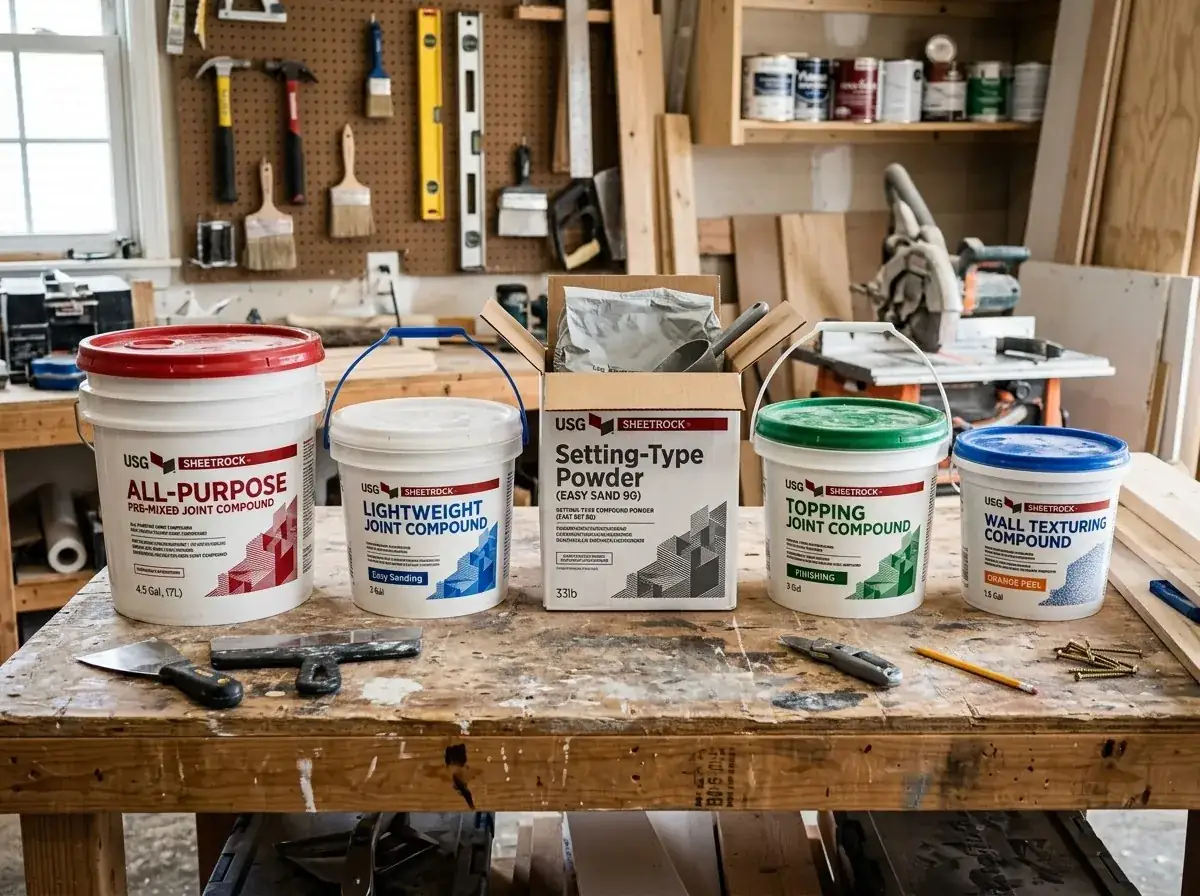
All-Purpose (Pre-Mixed)
The most common and affordable option. Comes ready to use in 1-gallon and 5-gallon buckets. Covers about 100–120 sq ft per gallon. Works for taping, filling, and finishing. The go-to choice for most residential projects.
Lightweight (Pre-Mixed)
Contains tiny air bubbles that make it lighter and easier to sand. Covers slightly more per gallon (110–130 sq ft) because of the added volume. Ideal for top coats and finish work where easy sanding matters. Costs a bit more than all-purpose.
Setting Compound (Hot Mud)
A dry powder you mix with water. Sets chemically rather than drying by evaporation — available in 5-minute, 20-minute, 45-minute, and 90-minute variants. Stronger than pre-mixed, with less shrinkage. Best for first coats, repairs, and filling deep holes. Covers about 80–100 sq ft per gallon.
Topping Compound
Designed for the final skim coat. Sands easily and produces a very smooth finish. Covers 120–150 sq ft per gallon. Not recommended for taping — it doesn't bond as well as all-purpose. Use it for the last coat on Level 4 and Level 5 finishes.
Texturing Compound
Thicker consistency made for spray and knockdown finishes. Covers only 60–80 sq ft per gallon because of the heavier application. Use a texture sprayer for best results. Available in pre-mixed and dry-mix forms.
| Type | Coverage (sq ft/gal) | Best For |
|---|---|---|
| All-Purpose | 100 – 120 | General taping and finishing |
| Lightweight | 110 – 130 | Easy sanding, top coats |
| Setting Compound | 80 – 100 | Quick patches, deep fills, first coats |
| Topping | 120 – 150 | Final skim coat, smooth finish |
| Texturing | 60 – 80 | Spray and knockdown finishes |
Drywall Mud Drying Time
Drying time determines how fast you can apply the next coat. Plan your project schedule around these times:
| Mud Type | Typical Dry Time | Notes |
|---|---|---|
| All-Purpose (pre-mixed) | 24 hours | Depends on thickness, humidity, and temperature |
| Lightweight (pre-mixed) | 12 – 24 hours | Dries slightly faster due to air content |
| Setting 5-min | 5 – 15 minutes | Very fast — small patches only |
| Setting 20-min | 20 – 30 minutes | Good for first coat and repairs |
| Setting 45-min | 45 – 60 minutes | Balanced speed and working time |
| Setting 90-min | 90 – 120 minutes | Longer working time for larger areas |
| Topping compound | 24 hours | Thin coats may dry in 12 hours |
| Texturing compound | 24 hours | Heavy textures take longer to dry fully |
Common Drywall Mud Mistakes
Avoid these errors to save mud, time, and frustration:
- Applying thick coats — Thick layers take longer to dry, shrink more, and are harder to sand. Apply thin, even coats for better results.
- Skipping drying time — Applying the next coat before the previous one is fully dry causes cracking, bubbling, and poor adhesion.
- Buying too little mud — Running out mid-project means another trip to the store and potential color/texture inconsistency between batches.
- No waste allowance — Always add 10–15% for spillage, tool residue, and edge work. Skipping this means you'll run short.
- Wrong finish level — Using Level 5 mudusage for a garage project wastes money. Match the finish level to the room's purpose.
- Using wrong mud type — Topping compound won't bond tape properly. All-purpose is best for taping; topping is for final coats only.
Tips to Reduce Mud Waste
Joint compound isn't expensive per gallon, but waste adds up on larger projects. These tips help you use every drop efficiently:
- Mix properly — Stir pre-mixed mud to a smooth, lump-free consistency before applying. Add a splash of water if it's too thick.
- Use correct knife size — Start with a 6-inch knife for the tape coat, 10-inch for the fill coat, and 12-inch for the finish coat.
- Apply thin coats — Multiple thin coats use less mud overall than one thick coat, and they dry faster with less shrinkage.
- Keep bucket sealed — Open buckets dry out and form a skin. Cover with plastic wrap under the lid to keep mud fresh.
- Clean tools regularly — Dried mud on knives and pans wastes compound and creates rough application. Clean between coats.
How to Store Leftover Drywall Mud
Joint compound can last months or even years if stored properly. Here is how to keep leftover mud usable for future touch-ups and repairs:
- Seal the bucket tightly: Press plastic wrap directly onto the surface of the mud before closing the lid. This prevents air from reaching the compound and forming a crust.
- Store upside down: After sealing, flip the bucket upside down. The weight of the mud creates an air seal around the lid, keeping the compound fresh significantly longer.
- Keep in a cool, dry place: Avoid temperature extremes. A basement or climate-controlled garage works best. Freezing ruins pre-mixed mud — it becomes gritty and unusable after thawing.
- Label with the date: Write the purchase date on the bucket. Pre-mixed all-purpose compound typically lasts 6-12 months when stored properly. Setting compound (powder form) lasts indefinitely if kept dry.
- Revive dried mud: If the surface has a thin crust, carefully remove it and stir the mud beneath. Add a small amount of water and mix thoroughly. If the entire bucket has hardened, discard it — hardened mud cannot be restored to its original consistency.
Joint Compound vs Spackle
These two products look similar but serve very different purposes. Using the wrong one leads to poor results.
| Feature | Joint Compound | Spackle |
|---|---|---|
| Use | Drywall joints, seams, corner bead | Small holes, dings, nail pops |
| Coverage | 35–100 sq ft per gallon | Fills small areas only (pints/quarts) |
| Dry Time | 12–24 hours (pre-mixed) | 1–2 hours |
| Shrinkage | Minimal when applied thin | Very low — designed for small fills |
| Sanding | Easy to sand (especially lightweight) | Very easy to sand |
| Container Size | 1 gallon, 5 gallons | Pint, quart, small tubs |
| Best Projects | New drywall, remodeling, taping | Small repairs, patching holes |
Rule of thumb: If you're taping joints or finishing new drywall, use joint compound. If you're filling a nail hole or small dent, use spackle.
Texture Coverage Rates
Textured finishes use more mud than flat coating. Here's what to expect:
| Texture Type | Coverage per Gallon | Mud Needed per 100 sq ft |
|---|---|---|
| Orange peel | 75 – 100 sq ft | 1.0 – 1.3 gallons |
| Skip trowel | 80 – 100 sq ft | 1.0 – 1.25 gallons |
| Knockdown | 50 – 75 sq ft | 1.3 – 2.0 gallons |
| Popcorn (acoustic) | 40 – 60 sq ft | 1.7 – 2.5 gallons |
| Swirl | 60 – 80 sq ft | 1.25 – 1.7 gallons |
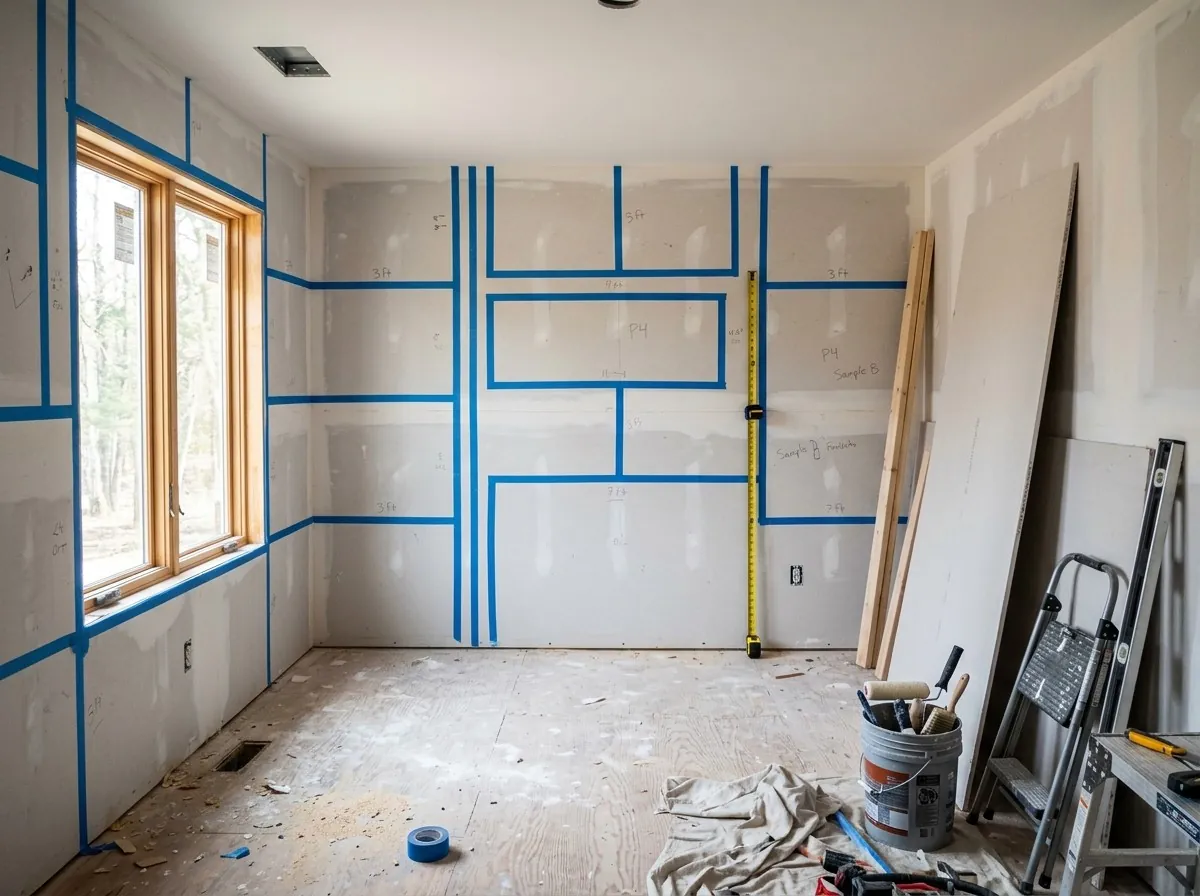
Cost Estimate
| Mud Type | Container Size | Cost | Coverage (1 coat) |
|---|---|---|---|
| All-purpose (pre-mixed) | 1 gallon | $8 – $12 | 100 sq ft |
| All-purpose (pre-mixed) | 5 gallon | $18 – $25 | 500 sq ft |
| Lightweight (pre-mixed) | 1 gallon | $10 – $15 | 110 sq ft |
| Setting-type (20-min) | 25 lb box | $12 – $18 | ~200 sq ft |
| Setting-type (90-min) | 25 lb box | $10 – $15 | ~200 sq ft |
For a typical 12×12 room (384 sq ft of wall), you'll need about 4 gallons per coat. For three coats, that's 12 gallons total — roughly $96–$144 for pre-mixed mud (or $54–$75 if buying 5-gallon buckets).
Drywall Mud and Tape Calculator: How Much Do You Need?
When taping drywall joints, you need both joint compound and drywall tape. The tape reinforces the compound at seams and corners, preventing cracks. Here is how to estimate both materials together:
| Room Size | Wall Area | Mud Needed (3 coats) | Tape Needed | Est. Total Cost |
|---|---|---|---|---|
| 8x8 ft | 256 sq ft | 8 gallons | 50 – 75 linear ft | $75 – $120 |
| 10x10 ft | 320 sq ft | 10 gallons | 60 – 90 linear ft | $90 – $150 |
| 12x12 ft | 384 sq ft | 12 gallons | 75 – 110 linear ft | $105 – $175 |
| 12x14 ft | 416 sq ft | 13 gallons | 80 – 120 linear ft | $115 – $190 |
| 16x20 ft | 640 sq ft | 20 gallons | 120 – 180 linear ft | $175 – $290 |
Tape rule of thumb: For a standard room, plan for roughly 1 linear foot of tape per 3–5 sq ft of wall area (this covers all joints, seams, and corners). Paper tape is cheaper ($2–$4 per roll, 75–100 ft), while mesh tape ($5–$8 per roll) is self-adhesive and faster to apply but requires setting-type compound for the first coat.
Use our Drywall Mud Calculator to get exact quantities for your specific room dimensions and finish level.
Joint Compound Calculator: Finish Level Matters
The amount of joint compound you need depends heavily on the drywall finish level you choose. Higher finish levels require more coats and more compound:
| Finish Level | Coats | Coverage per Gallon (per coat) | Gallons per 100 sq ft (all coats) |
|---|---|---|---|
| Level 1 (Taping) | 1 coat | 100 sq ft | 1.0 |
| Level 2 | 2 coats | 100 sq ft | 2.0 |
| Level 3 | 3 coats | 50 sq ft | 6.0 |
| Level 4 (Standard) | 3 coats + skim | 40 sq ft | 7.5 – 10.0 |
| Level 5 (Premium) | 4+ coats | 35 sq ft | 11.0 – 14.0 |
What the numbers mean: For 400 sq ft of wall at a standard Level 4 finish (3 coats + skim coat), you need approximately 30 gallons of joint compound. For a premium Level 5 finish, that jumps to 44–56 gallons. This is why Level 5 costs significantly more — the extra skim coats and sanding cycles consume substantially more material.
Frequently Asked Questions
How much drywall mud does one gallon cover?
One gallon of drywall mud typically covers 35–100 square feet, depending on the finish level and number of coats. Higher finish levels require more compound because additional skim coats are applied. For a standard Level 4 finish, expect about 100 sq ft per gallon per coat.
How much does 5 gallons of drywall mud cover?
About 500 square feet for one coat using all-purpose pre-mixed compound. For a full three-coat finish, that covers roughly 167 sq ft of wall.
How many square feet does a 5-gallon bucket cover?
500 sq ft per coat for standard application. Knockdown or heavy textures reduce this to about 300–400 sq ft per coat.
How much drywall mud for a 12×12 room?
About 12 gallons for a full three-coat finish (4 gallons per coat × 3 coats). This assumes standard 8-foot ceilings and standard door/window openings.
How much drywall mud do I need for 400 sq ft?
At Level 4 finish with 3 coats, you need approximately 30 gallons (about 9 buckets of 3.5 gallons each). This accounts for standard coverage rates and waste.
Can I use drywall mud to texture?
Yes, but use topping or texturing compound for best results. All-purpose mud works for light textures but is harder to spray and may crack on heavy textures.
How long does drywall mud take to dry?
Pre-mixed mud takes 24 hours between coats. Setting-type mud dries in 20–90 minutes depending on the variant (20, 45, or 90 minute).
Should I sand between coats?
Lightly sand high spots and ridges between coats, but don't over-sand. A damp sponge works well for smoothing without creating dust.
What is the difference between joint compound and spackle?
Joint compound is for drywall joints, seams, and corner bead. It comes in large buckets and is designed for taping and finishing. Spackle is for filling small holes, dings, and nail pops.
What finish level should I choose?
Level 4 is standard for most rooms and provides a smooth, paintable surface. Level 5 is for areas with critical lighting (gloss paint, wall sconces). Levels 1–3 are for utility spaces like garages.
How long does drywall mud last in storage?
Pre-mixed all-purpose joint compound lasts 6-12 months when stored properly with the lid sealed tight and the bucket stored upside down. Lightweight compound has a similar shelf life. Setting-type powder compound lasts indefinitely if kept dry and sealed. Always check for mold, separation, or a foul smell before using stored mud — these signs indicate spoilage.
Which brand of drywall mud is best?
USG Sheetrock brand is the industry standard and widely available at most home improvement stores. Their all-purpose lightweight compound is a favorite among pros for its smooth application and easy sanding. CertainTeed and National Gypsum also produce high-quality joint compounds that perform well. For most DIY projects, USG Sheetrock all-purpose pre-mixed compound offers the best balance of quality, availability, and price. Always check the coverage label on the specific product you buy, as formulations vary.
Related Calculators & Tools
- Drywall Mud Calculator — Get exact gallons, buckets, and cost for your project
- Acrylic Paint Coverage Calculator — Estimate paint needed after mudding
- Canvas Painting Price Calculator — Price your artwork after the walls are done
- Kitchen Remodel Calculator — Full kitchen renovation cost estimates
- Bathroom Remodel Calculator — Bathroom renovation cost estimates
Data Sources
- The Home Depot – How Much Drywall Mud Do I Need (2026)
- Lowe's – Joint Compound Coverage Guide (2026)
- Family Handyman – How to Finish Drywall
- The Spruce – Drywall Mud Coverage Calculator (2026)
- USG – Sheetrock Joint Compound Coverage Guide (2026)
- CertainTeed – Joint Compound Product Line
- National Gypsum – Joint Compound Specifications