Planning a river rock project? Whether you are building a dry creek bed, covering a garden bed, or capping a French drain, the first question is always the same: how much rock do I need? Order too little and you are making a second delivery trip mid-project. Order too much and you are stuck with a pile of expensive rock sitting in your driveway.
River rock is one of the most popular landscape materials — but estimating how much you need can be confusing. Density varies by stone size, pricing changes by region, and coverage depends on depth. This guide walks you through the correct formula, breaks down coverage by depth, shows 2026 pricing, and covers all five major use cases with recommended depths. Use the numbers here, or run your own dimensions through our free River Rock Calculator for an instant estimate.
What Is River Rock?
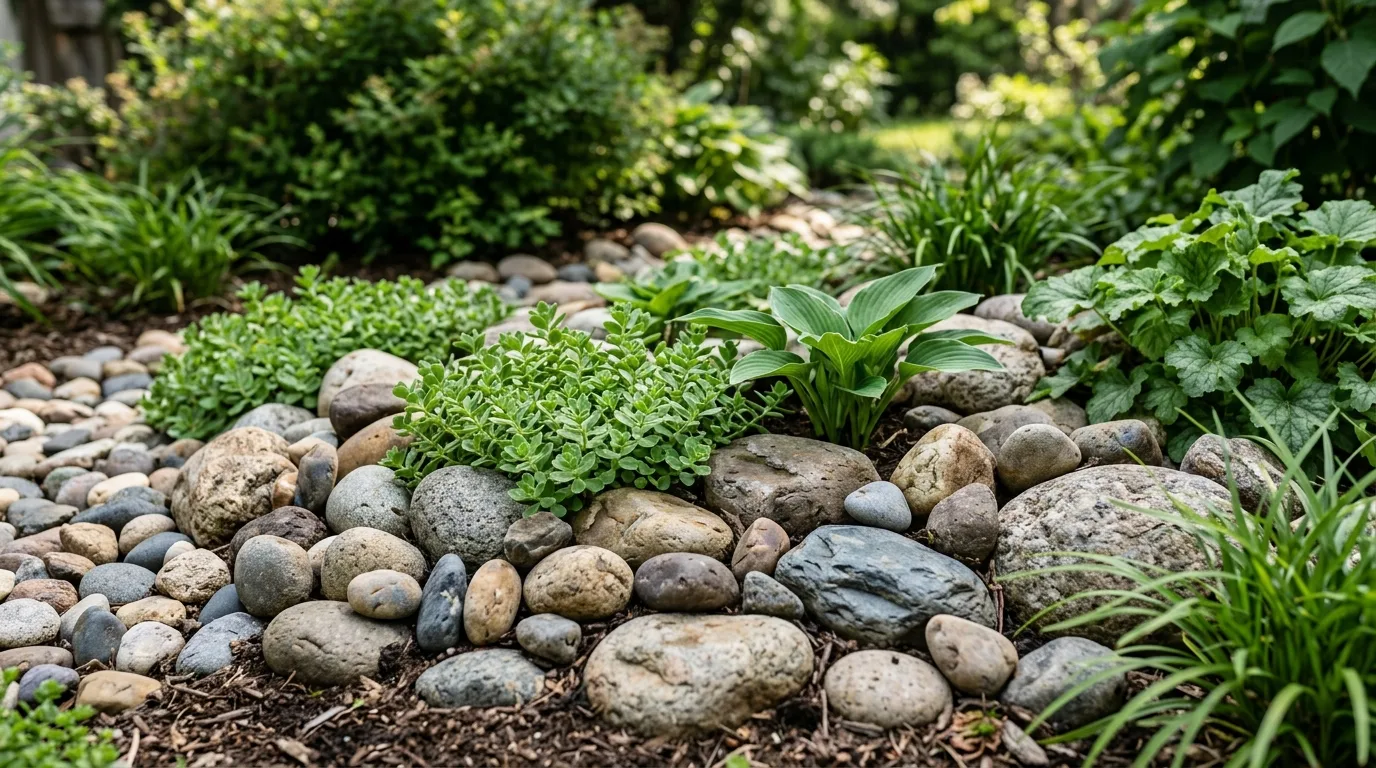
River rock is smooth, rounded landscape stone formed by natural water erosion. It comes in natural blends of gray, tan, brown, and cream, and ranges from small 0.5-inch pebbles to large 12-inch cobbles. Unlike crushed stone or gravel, river rock has no sharp edges — its rounded shape makes it ideal for decorative beds, borders, and drainage features where appearance matters.
The key difference between river rock and other landscape aggregates is durability. River rock never decomposes, does not need replacing, and stays in place during heavy rain. A properly installed river rock bed can last 20-30 years with minimal maintenance. The tradeoff is cost: river rock runs $45-$160 per ton delivered, compared to $20-$50 per ton for basic gravel. But since you never have to replace it, the long-term cost of ownership is often lower than mulch, which needs refreshing every 1-2 years.
River rock differs from gravel in shape and function. Gravel is crushed and angular — it locks together and compacts, making it ideal for driveways and base material. River rock is rounded and does not compact, making it better for decorative applications and drainage where water needs to flow through the gaps between stones.
How to Calculate River Rock Needed
The formula for river rock volume is the same one professionals use. It works for any area, any rock type, and any depth:
| Step | Formula | Example (20 x 15 ft, 3 in deep) |
|---|---|---|
| 1. Find area | Length x Width | 20 x 15 = 300 ft² |
| 2. Convert depth | Depth (in) / 12 | 3 / 12 = 0.25 ft |
| 3. Calculate volume | Area x Depth (ft) | 300 x 0.25 = 75 ft³ |
| 4. Convert to yards | Cubic feet / 27 | 75 / 27 = 2.78 yd³ |
| 5. Convert to tons | Cubic feet x density / 2000 | 75 x 85 / 2000 = 3.19 tons |
The one-line formula: Tons = (Length x Depth_in / 12 / 27) x Density x (1 + waste%). Add 10-15% for waste and settling — especially for larger stone that sits higher on the surface.
River Rock Size Guide
River rock is sold by nominal diameter. Each size class has a different density, different coverage rate, and different best use. Here is the full breakdown:
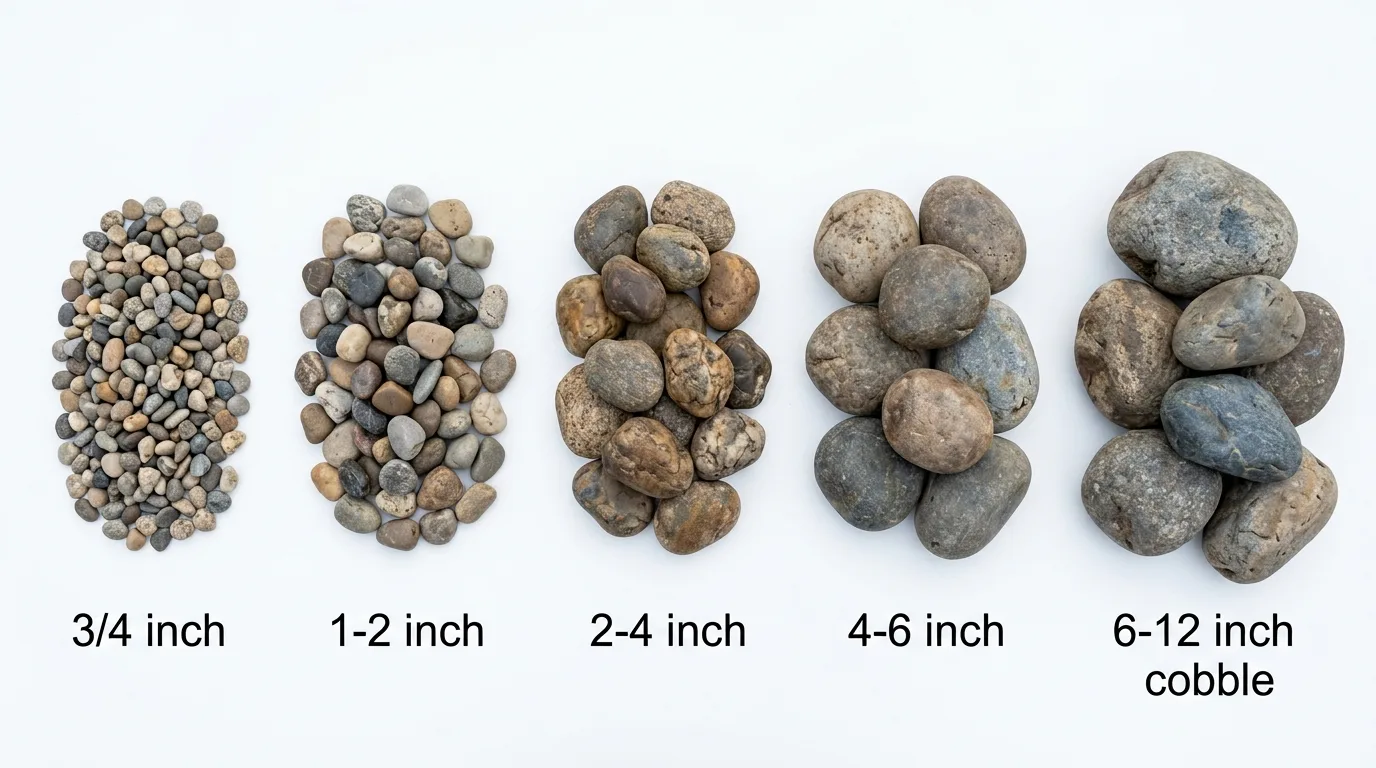
| Nominal Size | Approx Density (lb/ft³) | Best Uses |
|---|---|---|
| 3/4 - 1 inch | 95-100 | French drain cap, decorative top dressing, walkways |
| 1 - 2 inch | 90-100 | Ground cover, drainage swales, mulch alternative |
| 2 - 4 inch | 85-100 | Dry creek beds, xeriscape, feature beds |
| 4 - 6 inch | 80-100 | Boulder accent, retaining wall fill, large landscape |
| 6 - 12 inch (cobble) | 75-100 | Solo placement, water-feature edging, slope erosion |
Note: Density varies by supplier and stone composition. The ranges above reflect typical values — smaller stones pack tighter (higher density) while larger stones have more void space (lower density). Always verify density with your supplier. For estimating, using 100 lb/ft³ is the safest approach because it slightly over-orders rather than under-orders.
River Rock Coverage Chart
This chart shows how much area one ton of river rock covers at common depths. Numbers are based on 100 lb/ft³ (safe default). Actual coverage varies by stone size — smaller stone covers slightly more, larger stone slightly less.
| Depth | Sq Ft per Ton | Sq Ft per Yd³ | Tons per 100 Ft² |
|---|---|---|---|
| 1 inch | 200 | 270 | 0.50 |
| 2 inches | 100 | 135 | 1.00 |
| 3 inches | 67 | 90 | 1.50 |
| 4 inches | 50 | 68 | 2.00 |
| 6 inches | 33 | 45 | 3.00 |
| 8 inches | 25 | 34 | 4.00 |
| 12 inches | 17 | 23 | 6.00 |
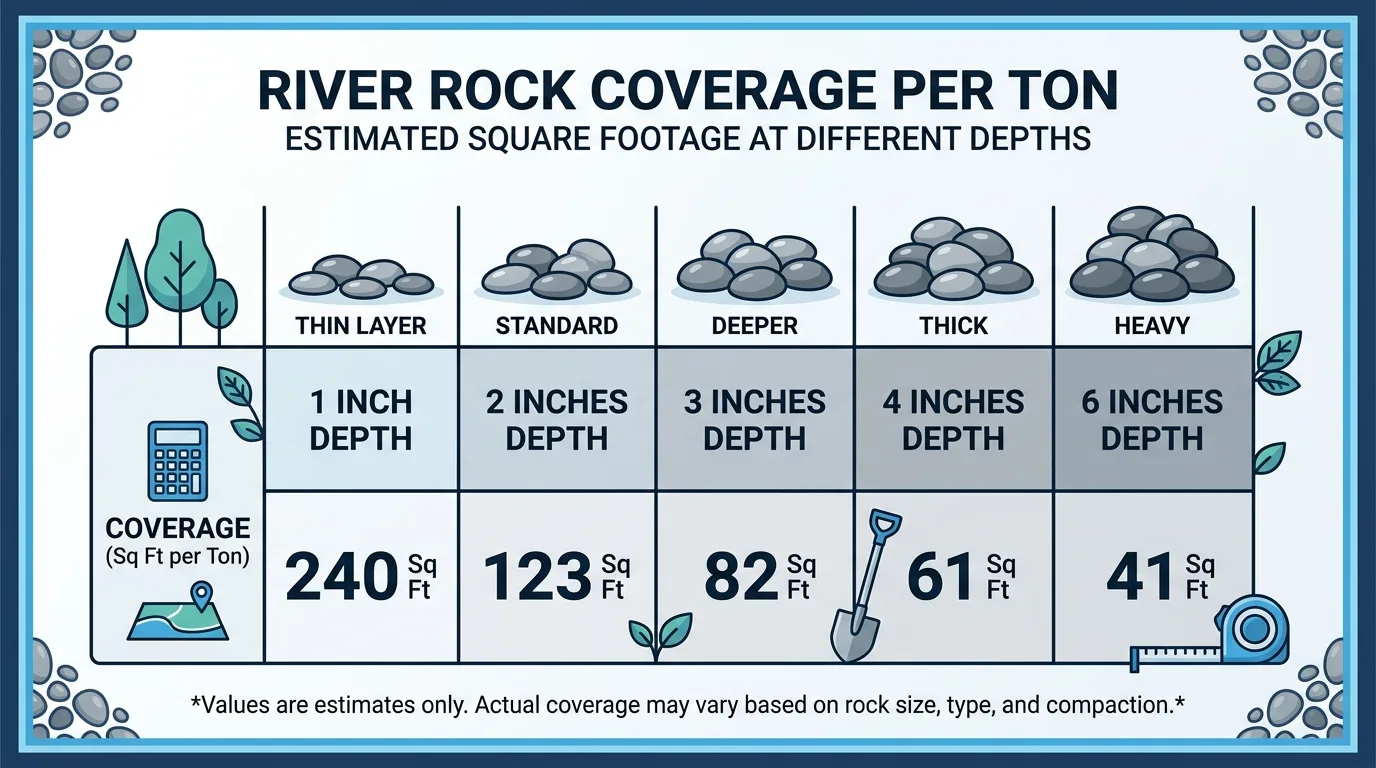
Quick rule of thumb: At 3 inches deep, 1 ton covers about 67 square feet. At 2 inches deep, 1 ton covers about 100 square feet. At 4 inches deep, 1 ton covers about 50 square feet. These are conservative estimates — actual coverage depends on your supplier's stone density.
River Rock Cost per Ton in 2026
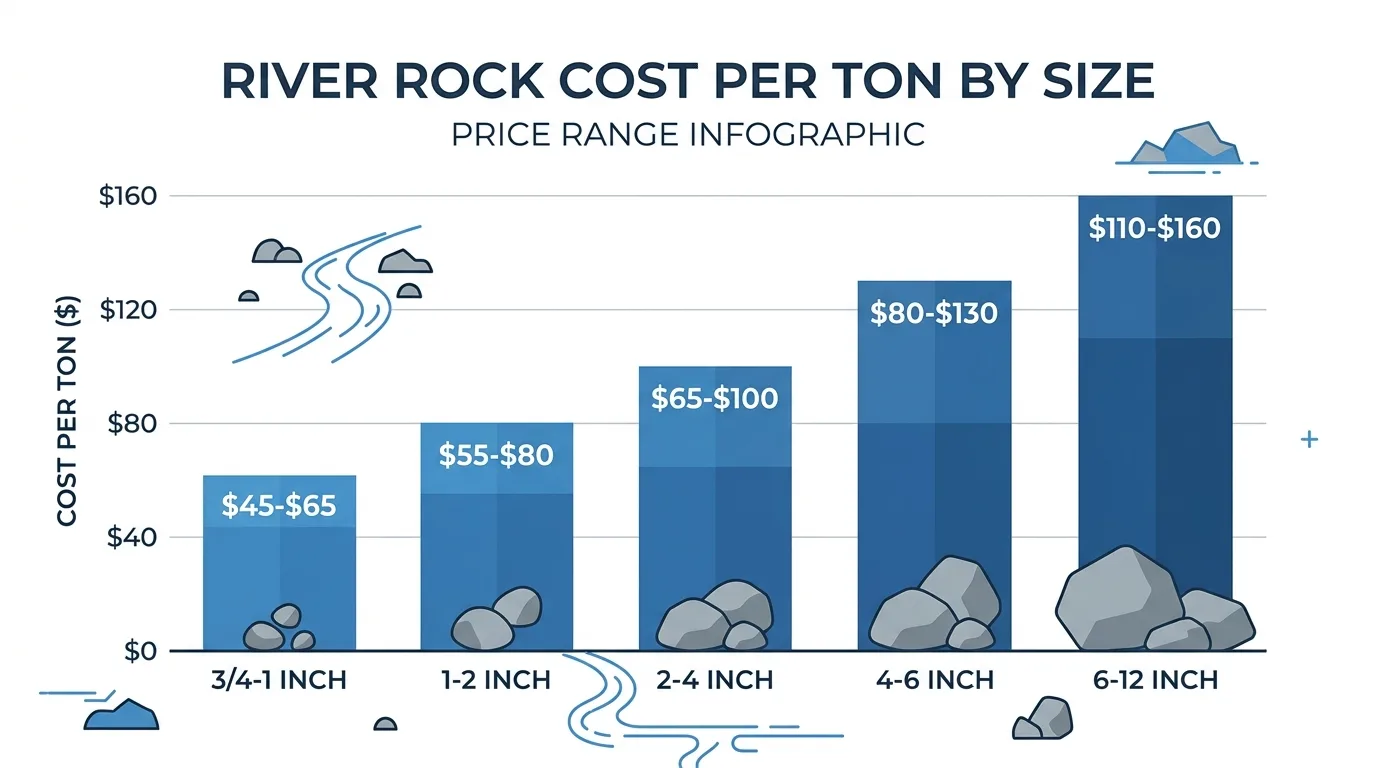
River rock pricing varies by size, region, and delivery distance. Here is what bulk-delivered pricing looks like across the U.S. in 2026:
| Stone Size | Price/Ton | Cost per 100 Ft² (at 3 in deep) |
|---|---|---|
| 3/4 - 1 inch | $45 - $65 | $67 - $97 |
| 1 - 2 inch | $55 - $80 | $82 - $119 |
| 2 - 4 inch | $65 - $100 | $97 - $149 |
| 4 - 6 inch | $80 - $130 | $119 - $194 |
| 6 - 12 inch (cobble) | $110 - $160 | $164 - $239 |
Regional variations: Midwest prices tend to be lowest due to quarry proximity. West Coast prices run 15-25% higher due to delivery distances and fuel costs. Southeast prices fall in between. Peak season (spring and summer) adds 15-25% to off-season pricing — if you can plan your project for fall or winter, you will save on both material and delivery.
Bulk vs bagged: Bagged river rock at big-box stores runs $4-$8 per 0.5 cubic foot bag — that works out to roughly $216-$432 per cubic yard. Bulk delivered pricing is $50-$160 per cubic yard. For any project over 1 ton, bulk delivery saves 50-75% compared to bagged retail.
Delivery fees: Most suppliers charge $50-$150 for delivery within 20 miles. Some offer free delivery on orders over 5-10 tons. Short-load fees ($50-$100) apply to orders under 2-3 tons. Always ask for a total delivered price before ordering.
Use Our Free River Rock Calculator
Enter your area dimensions, depth, and stone size. Get instant estimates for cubic yards, tons, and cost — materials and delivered.
River Rock CalculatorBest Uses for River Rock
River rock works for five main landscape applications. Each has a recommended depth, stone size, and installation method:
1. Dry Creek Beds
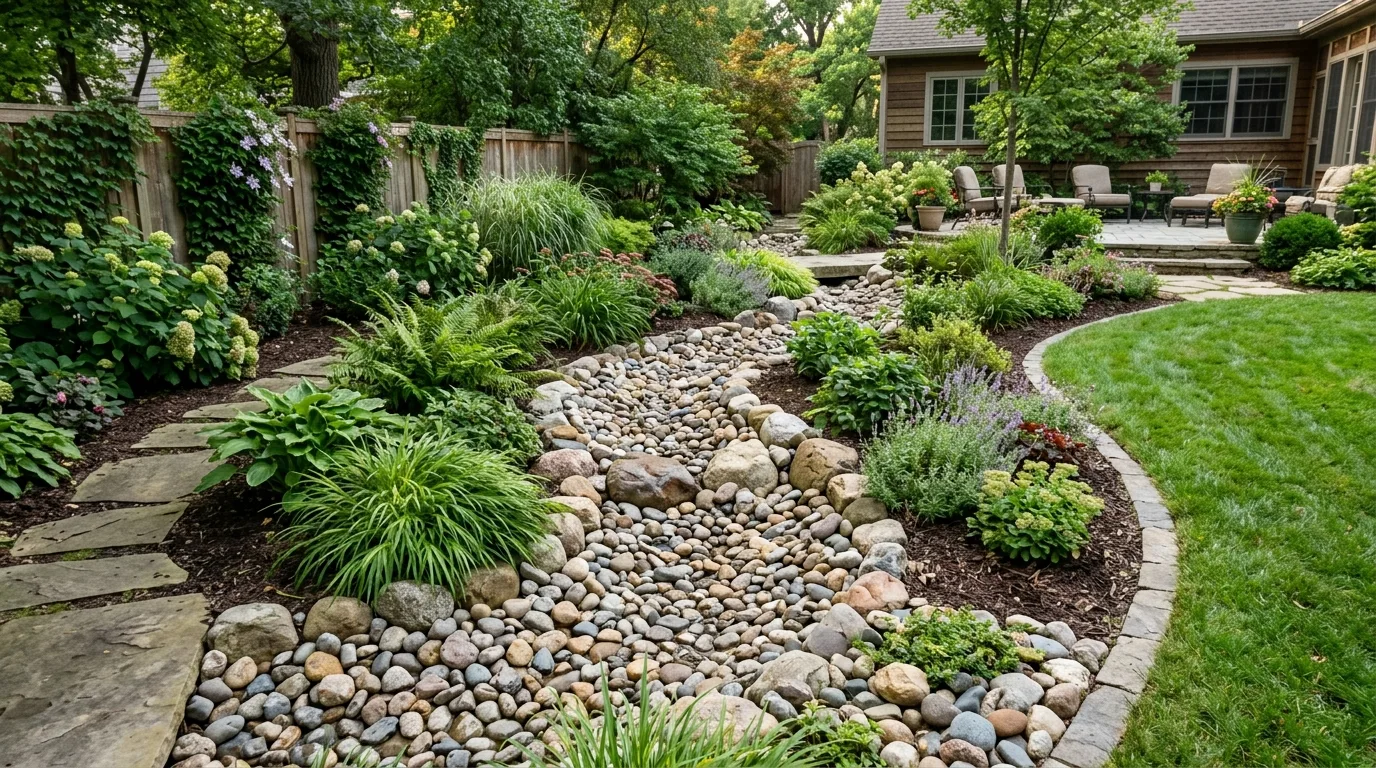
Dry creek beds are the most popular river rock feature. They channel stormwater naturally while looking like a permanent landscape element. The key is layering different stone sizes: 3-5 inch rock for the centerline water path, graduating to 1-2 inch stone along the borders. Total depth should be 4-6 inches over a compacted gravel base.
How to calculate: A 20-foot dry creek bed that is 4 feet wide and 5 inches deep needs about 50 cubic feet of rock. At 100 lb/ft³, that is roughly 2.8 tons plus 10% waste = 3.1 tons. Split the order: 2.5 tons of 2-4 inch for the centerline and 0.6 tons of 1-2 inch for the borders.
Installation tip: Do NOT put landscape fabric under dry creek beds — water needs to percolate through the rock into the soil below. Instead, lay a 6-inch compacted gravel base and place a perforated drainage pipe beneath the rock layer if you expect high-volume stormwater.
2. Garden Borders and Decorative Ground Cover
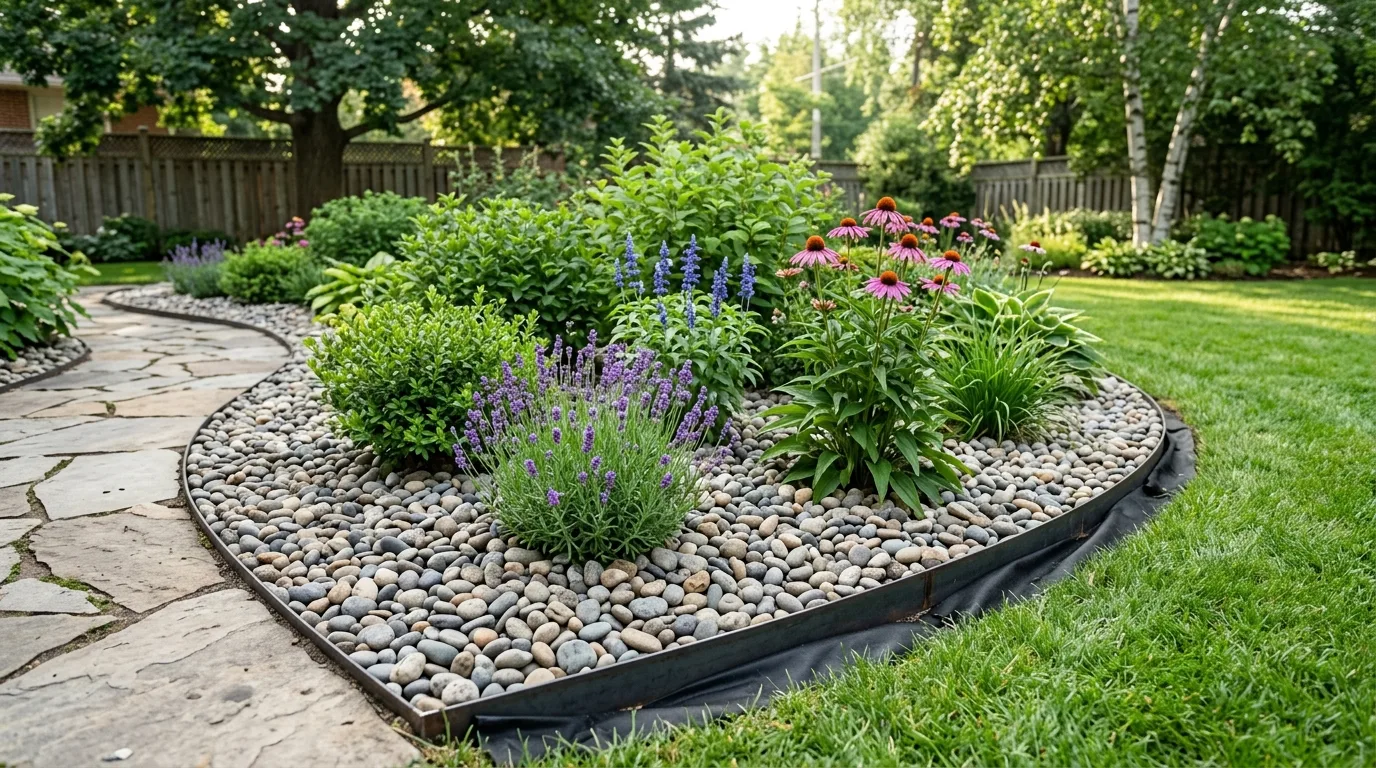
River rock makes an excellent mulch alternative that never decomposes, stays in place during wind, and reflects light to brighten shaded areas. Use 1-3 inch stone at 2-3 inches deep over landscape fabric. The fabric prevents weeds and stops rock from sinking into the soil over time.
How to calculate: A 30-foot by 10-foot garden bed at 3 inches deep needs 75 cubic feet = 2.78 cubic yards = 3.4 tons of 1-2 inch river rock. Add 10% waste = 3.74 tons. At $65/ton, that is roughly $243 delivered.
Maintenance: Expect to top-dress with about 0.5 tons per 300 square feet every 3-5 years as rock settles into the soil below. This is still cheaper than mulch, which needs $200-$400 of fresh material every 1-2 years for the same area.
3. Erosion Control
River rock stabilizes slopes and channels where water would otherwise wash away soil. For moderate slopes, use 4-6 inch stone at 6-12 inches deep. The weight and interlocking shape of larger stones prevents movement during heavy rain. On steep slopes (steeper than 1 vertical to 2 horizontal), switch to angular riprap — rounded river rock will roll downhill.
Key fact: River rock resists crushing and maintains its appearance over time, making it ideal for permanent erosion control features. For best results, place a layer of smaller 2-4 inch stone beneath the larger surface rock for structural stability.
4. French Drain Top Cap
River rock is decorative only for French drains — the drainage layer itself must be #57 angular clean stone so water flows freely through the perforated pipe. Use 1-inch river rock as a 4-6 inch decorative cap over the drain stone. The cap prevents leaf litter from clogging the drain while providing a clean finished appearance.
Critical rule: Do NOT use large river rock (2-4 inch or bigger) for French drain caps. The voids between large stones collect debris and can clog the drain. Stick with 1-inch stone — the smaller voids self-clean better and the smoother surface sheds leaves.
5. Mulch Alternative (Xeriscape)
In arid climates or water-conscious landscapes, river rock replaces mulch entirely. Use 1-2 inch stone at 2-3 inches deep over landscape fabric. The rock drains freely, stays put in wind, reflects light, and never needs replacing. The Southern Nevada Water Authority promotes this approach as a core xeriscape practice.
How to calculate: Converting a 500-square-foot lawn to xeriscape at 3 inches deep needs 125 cubic feet = 4.63 cubic yards = 5.3 tons of 1-2 inch rock. At $55/ton, that is about $292 for materials plus $100 delivery = $392 total. Compare that to sod installation at $1,500-$2,500 for the same area, plus ongoing water and maintenance costs.
What Most Online Calculators Get Wrong
The biggest mistake in river rock estimation is using a flat density for all stone sizes. Most online calculators default to 100 lb/ft³ (standard gravel density). Here is why that is wrong:
| Mistake | Impact | What to Do Instead |
|---|---|---|
| Using a density that is too low | Under-order by 10-20%, need second delivery | Use 100 lb/ft³ as safe default, or confirm with supplier |
| Not adding waste factor | Run short by 10-15% | Always add 10-15% to calculated amount |
| Guessing instead of measuring | Over or under order significantly | Measure area precisely, use calculator |
The safe approach: Using 100 lb/ft³ as the default will slightly over-order for most projects — but that is better than running short. A 20 x 15-foot bed at 3 inches deep needs 3.75 tons at 100 lb/ft³. If your supplier's actual stone is lighter (say 85-90 lb/ft³), you will have 15-20% extra material — which covers waste and settling. If you want precise numbers, confirm the actual density with your supplier before ordering.
Our River Rock Calculator uses 100 lb/ft³ as the default for safe estimating. You can adjust the density input to match your supplier's specific product data for more precise results.
River Rock vs Other Materials
How does river rock compare to alternatives for landscape ground cover?
| Factor | River Rock | Wood Mulch | Crushed Gravel | Decomposed Granite |
|---|---|---|---|---|
| Cost per ton | $45-$160 | $20-$50 | $20-$50 | $30-$60 |
| Lifespan | 20-30 years | 1-2 years | 10+ years | 5-10 years |
| Maintenance | Top-dress every 3-5 years | Replace every 1-2 years | Rake annually | Re-level every 2-3 years |
| Weed suppression | Good (with fabric) | Excellent | Fair | Good |
| Drainage | Excellent | Poor (absorbs water) | Good | Fair |
| Erosion control | Excellent | Fair (blows away) | Good | Fair |
| Appearance | Natural, high-end | Natural, warm | Industrial | Natural, earthy |
When river rock wins: Permanent features, drainage projects, xeriscape, areas with heavy rain or wind, and any project where you want a "install it and forget it" solution.
When mulch wins: Vegetable gardens, annual flower beds, areas where you need to dig frequently, and projects where warm color and soft texture matter more than permanence.
When gravel wins: Driveways, walkways with heavy foot traffic, base material for structures, and any application where compaction and stability are required.
How to Order River Rock
Follow these steps to get accurate pricing and avoid surprises:
- Calculate first, order second. Use the formula above or our calculator to get your tonnage before calling suppliers. This prevents upselling and lets you compare quotes on the same scope.
- Get at least 3 quotes. Prices vary 30-50% between suppliers for the same material. Ask for a total delivered price, not just per-ton pricing.
- Confirm stone size before ordering. "River rock" means different things to different suppliers. Some sell 1-3 inch as standard, others sell 2-4 inch. Ask for the actual diameter range.
- Ask about minimum orders. Most suppliers have a 2-3 ton minimum. If your project needs less than that, consider bagged retail or combining with a neighbor's order.
- Specify delivery placement. Some suppliers dump the rock in your driveway. Others will place it where you mark it. The latter saves you hours of wheelbarrow work.
- Order 10-15% extra. Rock settles, surfaces are uneven, and you will always use a little more than the math predicts. It is cheaper to have a small leftover pile than to pay for a second delivery.
Related Size Guides
Want more detail on specific landscape materials? These guides cover pricing, coverage, and calculation for related materials:
- Landscape Rock Calculator Guide — How much landscape rock do you need for any project
- Pea Gravel vs River Rock — Which is better for your project
- Mulch Calculator Guide — Compare mulch vs rock costs
- Sand Calculator Guide — For base material under river rock
Frequently Asked Questions
How much river rock do I need per square foot?
Using 100 lb/ft³ as the safe default, at 3 inches deep, 1 ton covers approximately 67 square feet. At 2 inches deep, 1 ton covers about 100 square feet. At 4 inches deep, 1 ton covers about 50 square feet. Actual coverage varies by stone size and supplier — always verify density with your supplier.
How many tons of river rock are in a cubic yard?
At 100 lb/ft³ (safe default), 1 cubic yard = 1.35 tons. For estimation, use 1.35 tons per cubic yard. Actual weight varies by stone size — smaller stones pack tighter (heavier), larger stones have more voids (lighter). Always confirm with your supplier.
How deep should river rock be for landscaping?
Use 2-3 inches for decorative ground cover and mulch-alternative beds. Use 3-4 inches for garden borders and feature areas. Use 4-6 inches for dry creek beds and drainage swales. Use 6-12 inches for slope erosion control. Always use landscape fabric below except for drainage features.
What size river rock is best for landscaping?
1-2 inch river rock is the value sweet-spot for general landscape beds, walkway borders, and ground cover. Step up to 2-4 inch for dry creek beds and feature areas. Use 4-6 inch only as individual accent stones. For French drain caps, use 1 inch over the drainage stone.
How much does river rock cost per ton in 2026?
2026 bulk-delivered prices range from $45-$160 per ton depending on size: 3/4-1 inch is $45-$65/ton, 1-2 inch is $55-$80/ton, 2-4 inch is $65-$100/ton, 4-6 inch is $80-$130/ton, and 6-12 inch cobble is $110-$160/ton. Delivery fees add $50-$150 on top.
Does river rock need landscape fabric underneath?
Yes for landscape beds, walkways, and mulch-alternative areas — 4-oz woven fabric blocks weeds and prevents rock from sinking into soil. No for dry creek beds and drainage features where water must percolate through. No under French drain caps since the drainage layer below already has fabric-wrapped pipe.
Can I use river rock in a French drain?
Only as a decorative top cap, not for the drainage layer itself. The drainage layer must be #57 angular clean stone so water flows freely through the perforated pipe. Cap the top 4-6 inches with 1-inch river rock for the decorative finish. Rounded river rock packs too tight for drainage.
How do I convert cubic yards to tons for river rock?
Multiply cubic yards by 1.35 (based on 100 lb/ft³). For example, 5 cubic yards = 5 x 1.35 = 6.75 tons. This is a safe estimate that slightly over-orders. Actual weight varies by stone size — confirm with your supplier for precise numbers.
How much does delivery cost for river rock?
Most suppliers charge $50-$150 for delivery within 20 miles. Short-load fees ($50-$100) apply to orders under 2-3 tons. Some suppliers offer free delivery on orders over 5-10 tons. Delivery costs are per trip, not per ton — so ordering more material in a single delivery reduces your per-ton delivery cost. Always ask for a total delivered price before committing.
Can I mix river rock with other materials?
Yes, and it is common practice. A popular approach is mixing 2-4 inch river rock on top with #57 gravel underneath for drainage projects. For garden beds, some landscapers layer river rock over a base of decomposed granite for better stability. Avoid mixing different sizes of river rock in the same layer — smaller stones fill the voids between larger ones, reducing drainage and creating an uneven appearance.
How long does river rock last?
River rock is a permanent landscape material that lasts 20-30 years or more. Unlike wood mulch that decomposes within 1-2 years, river rock does not break down, fade, or need replacing. The only maintenance is topping off low spots every 3-5 years as rock settles into the soil. A properly installed river rock bed with landscape fabric can last decades with virtually no upkeep.
Can I use river rock around trees and shrubs?
Yes, but with caution. River rock works well as a decorative ring around trees and shrubs, but do not pile it against trunks or stems. Keep rock at least 6 inches away from tree trunks to prevent moisture buildup and bark rot. For shrubs, leave a 2-3 inch gap around the base. Use 1-2 inch rock at 2 inches deep over landscape fabric. Avoid large cobble near small plants — the weight can compress roots.
Does river rock attract bugs or pests?
No — river rock is pest-resistant. Unlike wood mulch, which harbors termites, carpenter ants, and beetles, river rock provides no organic material for pests to feed on. The smooth, rounded surface also discourages nesting. This is one reason river rock is recommended near foundation walls where termite prevention matters. However, leaves and debris that accumulate on top of river rock can attract insects, so rake the surface periodically.
How do I calculate river rock for a circular area?
Use the formula: Area = pi x radius². For a 10-foot diameter circle, the radius is 5 feet, so area = 3.14 x 25 = 78.5 square feet. At 3 inches deep with 2-4 inch stone, that is 78.5 x 0.25 = 19.6 cubic feet = 0.73 cubic yards = 0.84 tons. Add 10-15% waste = 0.93 tons. Our River Rock Calculator handles circular inputs automatically.
River Rock Installation Tips
Proper installation makes the difference between a river rock bed that lasts 20 years and one that shifts, sinks, or washes away within a season. These tips come from professional landscapers and industry best practices:
Site Preparation
Start by clearing all vegetation, roots, and debris from the area. Level the soil and compact it with a hand tamper or plate compactor. For landscape beds, lay 4-oz woven landscape fabric over the prepared soil before placing rock. The fabric prevents weeds from growing up through the rock and stops the stone from sinking into the soil over time. Overlap fabric edges by 6-8 inches and staple them together at the seams.
For dry creek beds and drainage features, skip the fabric — water needs to percolate through the rock into the soil below. Instead, compact a 6-inch gravel base (crushed stone or road base) along the entire channel. This prevents the river rock from settling into the soil during heavy rain.
Edging and Containment
River rock needs physical edging to prevent migration. Steel edging is the most durable option — it holds its shape for decades and creates clean lines. Aluminum edging is lighter and easier to install but can bend under heavy loads. Plastic edging is the cheapest but degrades in UV light within 3-5 years.
Install edging at least 4 inches deep — deeper than your planned rock depth. Drive steel stakes every 3-4 feet along curves and every 6 feet on straight runs. For curves, score the back of the edging every 6 inches to allow bending without kinking.
Placing the Rock
Do not dump all the rock in one spot and rake it around. This damages the fabric below and creates uneven coverage. Instead, distribute the rock in small batches using a wheelbarrow. Dump one wheelbarrow load every 4-5 feet and spread it evenly before adding the next load. This ensures consistent depth across the entire area.
For dry creek beds, place the largest stones first along the centerline of the channel. Work outward toward the borders with progressively smaller stone. This creates a natural flow pattern and prevents the larger stones from rolling to the edges.
Settling and Compaction
Expect 10-15% settling in the first year. River rock does not compact like gravel, but the rounded stones do shift and settle into a more stable arrangement over time. Top off low spots with fresh rock after the first heavy rain season. Plan for this by ordering 10-15% more material than your initial calculation.
Seasonal Considerations
Timing affects both pricing and installation quality for river rock projects:
Spring (March-May)
Peak demand season. Prices are highest and delivery wait times are longest. If you must install in spring, order 4-6 weeks in advance and expect to pay 15-25% more than off-season pricing. The advantage: soil is moist and easy to work with, making site preparation faster.
Summer (June-August)
Good installation weather but continued high demand. Summer thunderstorms can delay delivery and installation. If you are doing a dry creek bed, install before the rainy season so the rock settles naturally during the first storms. Avoid installing during extreme heat — compacted gravel bases can crack when they dry too quickly.
Fall (September-November)
The best time to install river rock. Demand drops, prices fall 10-15%, and delivery is faster. Soil is still workable but not frozen. Fall leaves provide natural debris that helps settle new rock into its final position. Install before the first hard freeze to avoid frost heave issues.
Winter (December-February)
Lowest prices but installation challenges. Frozen ground makes excavation and compaction difficult. Some suppliers offer 20-30% off-season discounts to move inventory. If you can wait for a thaw, winter ordering for spring delivery is a smart budget move. Just make sure your supplier can store the material if delivery conditions are bad.
Common Mistakes to Avoid
These are the most frequent errors homeowners make with river rock projects:
- Using a density that is too low. Always use 100 lb/ft³ as the safe default unless your supplier confirms otherwise. Under-ordering means a second delivery trip and extra cost.
- No edging. Without physical containment, river rock migrates outward within the first year. Edging is not optional — it is essential.
- Skipping landscape fabric. Fabric prevents weed growth and rock sinking. The only exceptions are dry creek beds and drainage features where water must percolate through.
- Ordering exactly the calculated amount. Always add 10-15% for waste and settling. It is cheaper to have a small leftover pile than to pay for a second delivery.
- Using large rock for French drain caps. Stick with 1-inch stone for French drain caps. Larger stone collects debris in the voids and clogs the drain.
- Placing rock directly on bare soil. For landscape beds, always compact and level the soil first, then lay fabric, then place rock. Skipping preparation leads to uneven coverage and sinking.
- Buying bagged retail for large projects. Bagged river rock costs $216-$432 per cubic yard. Bulk delivered pricing is $50-$160 per cubic yard. For any project over 1 ton, bulk saves 50-75%.
Data Sources
- HomeGuide — Landscaping River Rock Prices (2026)
- LawnLove — River Rock Cost Guide (2026)
- HelloGravel — River Rock Sizes Chart (2026)
- BuildCalChub — River Rock Calculator (2026)
- ASTM D448 — Standard Classification for Aggregate Sizes
- Southern Nevada Water Authority — Xeriscape Conversion Study
Related Calculators
- River Rock Calculator — Get exact cubic yards, tons, and cost for any river rock project
- Landscape Rock Calculator — Estimate rock, gravel, and sand for landscaping
- Mulch & Soil Calculator — Compare mulch vs rock costs for your project
- Sand Calculator — For base material under river rock