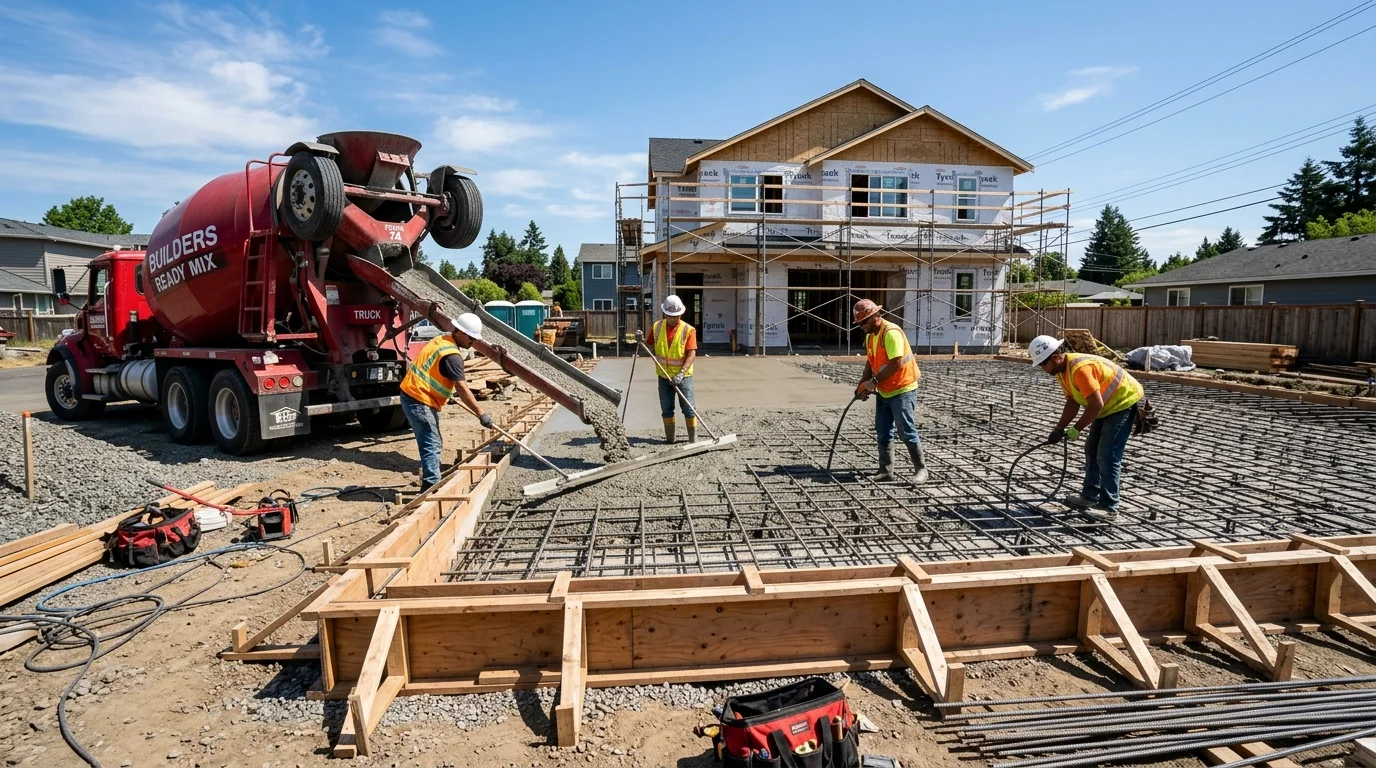
A 20x30 concrete slab costs $3,600 to $7,200 installed in 2026 for a standard 4-inch residential pour, and it needs 7.41 cubic yards of concrete. That is 334 bags of 80-pound mix if you buy bagged concrete, or $926 to $1,074 in ready-mix material at the standard 3,000 PSI price of $125 to $145 per cubic yard. At 6 inches for vehicle use you need 11.11 cubic yards and the installed range runs $4,800 to $9,600.
The 20x30 size is 600 square feet, which puts it right in the middle of the most common slab projects: a large patio, a two-car parking pad, a detached garage, a workshop, or a small barn foundation. It is big enough that truck logistics, joint layout and reinforcement choices change the bill, and small enough that one crew can place it in a single day.
Use our free Concrete Slab Calculator to get exact numbers for your thickness and finish, or read on for the itemized breakdown. For pricing across every slab size, see our cost to pour a concrete slab guide.
Run Your Own Numbers
The full Concrete Slab Calculator opens on its own page, with thickness, reinforcement and finish options, bag count, material cost and a total installed estimate.
Open the Concrete Slab CalculatorQuick Answer: 20x30 Concrete Slab (2026)
| Spec | 4-Inch Slab | 5-Inch Slab | 6-Inch Slab |
|---|---|---|---|
| Square footage | 600 sq ft | 600 sq ft | 600 sq ft |
| Cubic yards | 7.41 yd³ | 9.26 yd³ | 11.11 yd³ |
| 80lb bags | 334 bags | 417 bags | 500 bags |
| Ready-mix (3,000 PSI) | $926 – $1,074 | $1,158 – $1,343 | $1,389 – $1,611 |
| Installed cost | $3,600 – $6,000 | $4,200 – $7,200 | $4,800 – $9,600 |
| Weight | 14 tons | 17.5 tons | 21 tons |
| Typical mix | 3,000 PSI | 3,500 PSI | 3,500–4,000 PSI |
| Best for | Patios, walkways | Garage floors, workshops | Driveways, RV pads |
Ready-mix pricing above uses the 2026 standard 3,000 PSI rate of $125–$145 per cubic yard delivered that Estimators.us reports for most U.S. markets. In higher-cost markets the national delivered range is wider: Concrete Network put the nationwide figure at $160–$195 per cubic yard (2025 average $179.95), which would put 7.41 cubic yards at $1,186 to $1,445. Always price your own market, not the national number.
What a 20x30 Slab Costs: Four Independent Benchmarks
Published cost guides disagree because they measure different things. Some price the concrete only, some price a plain slab, some include site prep and contractor overhead. Here is what four separate sources actually say about a 600 square foot slab, so you can see where our headline range sits.
| Source | Per Sq Ft | 20x30 Total | What It Includes |
|---|---|---|---|
| This Old House | $4 – $8 | $2,400 – $4,800 | Concrete itself; prep, labor and finish priced separately |
| LawnStarter (avg $6.60) | $4.34 – $7.73 | $2,604 – $4,638 | Materials and labor, national average |
| Concrete Network | $6.50 – $10.50 | $3,900 – $6,300 | Materials and labor, updated July 2026 |
| Estimators.us (avg $8) | $6 – $12 | $3,600 – $7,200 | Full installed scope on level, accessible ground |
The honest read: $2,400 is what you pay when a guide is pricing concrete on a level lot with the owner handling everything else, and $7,200 is a full contractor-installed price with prep, forms, reinforcement, finish and overhead. For budgeting a real hired pour, $3,600 to $7,200 is the defensible range, with those four sources spanning $2,400 to $7,200 — a $4,800 midpoint.
Itemized Cost Breakdown for a 20x30 Slab
Every line below is priced separately so you can spot which part of a bid is out of line. Figures are for a 4-inch, 600 sq ft residential slab on level ground.
| Line Item | How It Is Priced | 20x30 Cost |
|---|---|---|
| Ready-mix concrete | 7.41 yd³ at $125–$145/yd³ | $926 – $1,074 |
| Compacted gravel base | $0.80–$1.50 per sq ft | $480 – $900 |
| Forms and stakes | 100 lin ft of perimeter at $0.50–$1.00/ft | $50 – $100 |
| Wire mesh reinforcement | $0.20–$0.50 per sq ft | $120 – $300 |
| 6-mil vapor barrier | $0.10–$0.15 per sq ft | $60 – $90 |
| Curing compound | $0.05–$0.10 per sq ft | $30 – $60 |
| Labor (place and finish) | 3-person crew, 6–10 hours for 400–600 sq ft | $1,200 – $2,400 |
| Short-load fee (if under minimum) | $50–$250 per yd³ under the plant's 8–10 yd³ minimum | $0 – $650 |
| Building permit | Patio permit median, 124 tracked cities | ~$188 ($100 – $238) |
| Old slab removal (if any) | $2–$6 per sq ft | $1,200 – $3,600 |
Two things to notice. First, concrete is not the biggest line — labor alone is 45 to 55% of every installed price, which is why identical specs produce quotes that vary so much. Second, Estimators.us reports four cost layers on every installed slab: materials 40–50%, labor 45–55%, site preparation 10–15% and equipment 5–10%, and warns that the most common source of disputes is a base bid that omits site prep, curing and permit fees. Ask what is excluded before comparing prices.
How to Calculate Concrete for a 20x30 Slab
One formula covers every thickness. Get this right and you will not over-order or run short mid-pour.
Volume (cubic yards) = (Length × Width × Thickness in feet) ÷ 27
4 inches ÷ 12 = 0.333 feet
20 ft × 30 ft × 0.333 ft = 200 cubic feet
200 ÷ 27 = 7.41 cubic yards
80lb bags (0.60 cu ft each, per the Quikrete data sheet): 200 ÷ 0.60 = 334 bags
60lb bags (0.45 cu ft each): 200 ÷ 0.45 = 445 bags
7.41 × 1.10 = 8.15 cubic yards · 334 × 1.10 = 367 bags of 80lb
8.15 yd³ × $125 to $145 = $1,019 to $1,182 in delivered ready-mix, plus base, forms, reinforcement and labor
Use Our Free Concrete Calculator
Enter 20 feet by 30 feet, pick your thickness, and get cubic yards, bag count, material cost and total installed estimate instantly. No signup required.
Concrete Slab Cost Calculator20x30 Slab Cost by Thickness
Thickness is the single biggest cost driver on a 600 square foot slab because volume scales linearly: a 6-inch slab uses 50% more concrete than a 4-inch slab of the same footprint, and an 8-inch slab uses 100% more. Installed rates below are from the Estimators.us 2026 slab-type table.
| Thickness | Cubic Yards | Concrete Only | Installed ($/sq ft) | Installed Total |
|---|---|---|---|---|
| 4 inches | 7.41 | $926 – $1,074 | $6 – $10 | $3,600 – $6,000 |
| 5 inches | 9.26 | $1,158 – $1,343 | $7 – $12 | $4,200 – $7,200 |
| 6 inches | 11.11 | $1,389 – $1,611 | $8 – $16 | $4,800 – $9,600 |
| 8 inches | 14.81 | $1,851 – $2,147 | $10 – $18 | $6,000 – $10,800 |
What that means in practice: going from 4 to 6 inches adds roughly $460 in concrete and $1,200 to $3,600 in installed cost, but it is the difference between a patio slab and one that carries a vehicle. A 4-inch slab on wire mesh is the standard for patios and walkways; anything with wheels on it should be 6 inches with rebar. Compare the same math on our 20x20 slab cost guide if you can downsize.
Choosing the Right Mix: PSI by Use
PSI is compressive strength at 28 days. Paying for strength you do not need wastes money, and under-specifying a vehicle slab is how floors crack.
| Use | Thickness | PSI | 20x30 Installed |
|---|---|---|---|
| Residential patio | 4 in | 3,000 | $3,600 – $6,000 |
| Garage floor | 4–6 in | 3,500 | $4,200 – $7,200 |
| Driveway | 5–6 in | 3,500–4,000 | $4,800 – $9,600 |
| Commercial floor | 6–8 in | 4,000+ | $6,000 – $10,800 |
| Industrial / forklift | 8–10 in | 4,500–5,000 | $8,400 – $13,200+ |
Upgrading from 3,000 to 4,000–4,500 PSI adds $10 to $40 per cubic yard — about $74 to $300 on a 4-inch 20x30 — which is cheap insurance on a driveway in a freeze-thaw climate. Fiber reinforcement, if you want it, is a $8 to $15 per cubic yard surcharge, or roughly $59 to $111 on this slab.
Cost by Finish Type
A broom finish is the default on residential flatwork and adds nothing to your bill. Everything below is an add-on priced per square foot, so multiply by 600.
| Finish | Rate | Added to a 20x30 | Notes |
|---|---|---|---|
| Broom finish | Standard | $0 | Slip-resistant, hides trowel marks |
| Stain or dye | $3.50 – $7.50/sq ft | $2,100 – $4,500 | Color on the surface; needs resealing |
| Stamped pattern | $10 – $14/sq ft | $6,000 – $8,400 | Brick, slate or wood patterns |
| Stamped + engraved | $18 – $20/sq ft | $10,800 – $12,000 | Elaborate designs and engraving |
| Decorative, all-in | $15 – $30/sq ft | $9,000 – $18,000 | Full decorative installed range |
| Epoxy finish or sealer | ~$4.50/sq ft | ~$2,700 | Smooth epoxy or weather-resistant sealer |
Two sources price stamping differently: This Old House quotes $10–$14 per square foot for a standard stamped design, while Estimators.us puts decorative stamped work at $15–$30 per square foot all-in. The gap is pattern complexity and region, so treat $6,000 to $18,000 as the honest spread for turning a 600 sq ft pad into an outdoor living space.
Reinforcement: Wire Mesh vs Rebar (With the Math)
Reinforcement is where homeowners most often under-specify. Match the steel to the load, not to the budget.
| Type | Quantity on 20x30 | Material Cost | Best For |
|---|---|---|---|
| 6x6 W1.4 wire mesh | One 150 ft roll, or 12 sheets (5×10 ft) plus laps | $120 – $300 | Patios, foot traffic |
| #3 rebar, 18" grid | ~840 lin ft of bar | $300 – $600 | Workshops, sheds |
| #4 rebar, 12" grid | ~1,250 lin ft of bar | $480 – $720 | Driveways, RV pads |
| Fiber mesh | Added at the batch plant | $59 – $111 | Crack control, supplemental |
The rebar count, worked out: bars at 18 inches on center means 14 bars running the full 30-foot length plus 21 bars running the full 20-foot width, which is 840 linear feet. A #3 bar weighs 0.376 pounds per foot, so a #3 grid is about 316 pounds of steel; a #4 bar weighs 0.668 pounds per foot under ASTM A615, so the same grid in #4 is 561 pounds, or about 620 pounds once you add 10% for lap splices. At 12-inch spacing the same logic gives 21 bars × 30 ft plus 31 bars × 20 ft = 1,250 linear feet = 835 pounds, or about 920 pounds with laps.
For wire mesh, the Wire Reinforcement Institute's own slab table calls for 6x6 W1.4 on any 4-inch slab with a maximum dimension up to 35 feet, which covers a 20x30 — so 6x6 W1.4 is the correct style here. WWR ships as sheets or rolls: sheets are commonly 5 to 10 feet wide and 10 to 20 feet long, and rolls are normally 150 or 200 feet long at 5 to 7 feet wide. On a clean 600 sq ft rectangle a single roll covers the whole pad without seams; if you buy 5×10 sheets you need 12 to cover the area, plus extra for overlapping. At 0.21 pounds per square foot for 6x6 W1.4, the whole grid weighs only about 130 pounds. This Old House prices the steel itself at $2 to $3 per square foot for rebar, which is $1,200 to $1,800 on this slab, and wire mesh at $0.35 per square foot, about $210 for 600 square feet.
Bags vs Ready-Mix Delivery
This decision is settled by arithmetic, not preference. Bagged concrete is roughly double the material cost per yard.
| Option | Cost for 4" 20x30 | Effective $/yd³ | Practical? |
|---|---|---|---|
| Ready-mix delivered | $926 – $1,074 | $125 – $145 | Yes — one truck, one day |
| Ready-mix, high-cost market | $1,186 – $1,445 | $160 – $195 | Yes |
| 334 bags of 80lb mix | $2,054 – $2,161 | ~$277 – $291 | Only for small sections |
| 367 bags (with 10% waste) | $2,257 – $2,374 | ~$277 – $291 | Not realistic at this volume |
The bag price used above is the verified 2026 retail figure for an 80 lb bag of Quikrete Concrete Mix: $6.47 single bag and $6.15 at the 42-bag pallet break, which works out to about $291 per cubic yard. Standard 3,000 PSI ready-mix is $125 to $145. In other words, bagged concrete costs about twice as much per yard, and 334 bags weigh about 13 tons. At 0.60 cubic feet per bag, 45 bags make exactly one cubic yard.
The crossover point is around one to two cubic yards. Above that, pay for the truck. Below it, bags save you the short-load fee entirely.
Truck Logistics and Short-Load Fees
At 7.41 cubic yards your order fits in a single truck, but it lands in the range where plants charge extra for a partial load.
- Truck capacity: NRMCA states that because of weight laws the typical U.S. ready-mix truck mixer is a 9 to 11 cubic yard unit, loaded at or near rated capacity.
- Placement window: ASTM C94 requires ready-mixed concrete to be discharged on the job site within 90 minutes and before 300 revolutions after water was added. Schedule the crew, not just the truck.
- Short-load threshold: ready-mix suppliers typically set the minimum delivery volume at 8 to 10 cubic yards, and a standard transit mixer carries 8 to 10 cubic yards. Your 7.41 yd³ is under it; your 8.15 yd³ with waste may clear it. Ask the plant their exact number.
- Short-load fee: $50 to $250 per cubic yard under the minimum, which adds roughly $400 to $1,200 on a genuinely small order. On this slab, if your plant's minimum is 8 yards, a 7.41 yard order is only 0.59 yards short — about $30 to $150. Most first-time buyers forget to ask about this line at all.
- The workaround: volumetric (metered) trucks mix on site and bill only what they dispense, with no short-load fee, but the per-yard price runs 15 to 25% higher. On a borderline order that premium can be cheaper than the surcharge.
DIY vs Professional on a 20x30
| Factor | DIY (ready-mix) | DIY (bagged) | Professional |
|---|---|---|---|
| Concrete | $926 – $1,074 | $2,257 – $2,374 | Included in bid |
| Base, forms, mesh, barrier, curing | $740 – $1,450 | $740 – $1,450 | Included in bid |
| Permit + short-load fee | ~$188 + $0–$650 | ~$188 | Usually included or reimbursed |
| Labor | Your time: 2 days prep + 1 pour day | Your time + ~15 tons of bag handling | $1,200 – $2,400 built in |
| Crew needed | 4–6 helpers | 4–6 helpers | 4–6 (they bring them) |
| Risk | High — 7.41 yd³ must be placed wet-on-wet in one session; one bad section ruins 600 sq ft | Warranty, insured | |
| Realistic total | $1,900 – $3,400 | $3,200 – $4,000 | $3,600 – $7,200 |
20x30 Slab Cost by Region (2026)
Region is the largest cost variable outside of slab specification, producing a 40%+ difference for identical scopes across U.S. markets — almost entirely a labor-rate story. These are 2026 installed rates with the 600 sq ft totals worked out.
| Region | Cost per Sq Ft | 20x30 Installed | Vs. National Avg |
|---|---|---|---|
| Southeast (AL, GA, MS, SC) | $6 – $9 | $3,600 – $5,400 | −10% to −20% |
| Texas / South-Central | $6 – $10 | $3,600 – $6,000 | −10% to −15% |
| Florida | $7 – $11 | $4,200 – $6,600 | Near average |
| Midwest (OH, IN, IL, MO) | $7 – $11 | $4,200 – $6,600 | Near average |
| Mountain West (CO, UT, AZ inland) | $8 – $13 | $4,800 – $7,800 | +5% to +15% |
| Pacific Northwest (WA, OR) | $9 – $15 | $5,400 – $9,000 | +15% to +30% |
| California | $12 – $18 | $7,200 – $10,800 | +35% to +55% |
| New York / Northeast | $12 – $18 | $7,200 – $10,800 | +35% to +55% |
The same 600 sq ft slab therefore ranges from about $3,600 in the Southeast to $10,800 in California or New York — a $7,200 spread on identical specifications. Get three itemized quotes with the same PSI, thickness, base depth and reinforcement spelled out, because bids for identical scopes vary around 40% by region alone.
Permits and Inspections
Whether a 600 square foot slab needs a permit is genuinely a local question, and the honest answer is: check yours before you dig. Some jurisdictions exempt at-grade concrete flatwork entirely — Seattle's SDCI guidance, for example, says patios and concrete flatwork installed on grade do not require a building permit. Others size-limit the exemption or require one above a small threshold. Assume nothing.
- Exempt in some cities: at-grade concrete patios and flatwork are exempt outright in Seattle, and several Washington counties apply the same on-grade exemption with no size limit, provided the slab stays at grade.
- Where a fee applies: PermitsGuide tracked 124 cities and found the middle half of patio permit fees falls between $100 and $238, with a median around $188. Across all common backyard projects (decks, fences, sheds, patios, garages) it is about $188 median across 836 datapoints in 276 U.S. cities.
- Garage-equivalent comparison: a 20x30 pad often replaces or outbuilds a garage, and garage permits run $275 to $475 with a $350 median across 104 tracked cities.
- Review time: budget 1 to 4 weeks for residential review on average — this is schedule, not just money.
- Also check: setbacks, lot coverage, impervious-surface limits and HOA rules. Some cities cap the total hard surface on a lot even when the permit itself is simple.
Ask three questions before signing: is the permit fee included, who pulls it, and when is the inspection scheduled — before the pour or after? A bid that excludes permits will look cheaper until the invoice arrives.
Pour Day Timeline and Curing Schedule
Curing is a chemical reaction, not drying. Concrete gains strength by staying wet, and the first week decides how strong your slab ends up.
| When | What You Can Do | Why |
|---|---|---|
| 0–24 hours | Nobody on the slab — fence it off, keep pets and kids away | Surface is still vulnerable to impressions and print marks |
| 24–48 hours | Walk on it; keep all wheeled traffic off | Enough hardness for foot traffic, still gaining strength |
| Days 3–6 | Light activity only; no bicycles, scooters or equipment | Wheels concentrate load on a young surface |
| Day 7 | Light passenger vehicles, driven carefully | Roughly 70% of 28-day strength at 7 days |
| Days 7–10 | Cars supported; stay off the slab edges | Edges are thinner and weaker than the field |
| Days 28–30 | Full design strength at 28 days; heavy commercial vehicles wait until day 30 | 28 days is the standard strength benchmark, and Concrete Network puts normal vehicle traffic at 30 days |
Curing rules that actually move the number: the Portland Cement Association says the curing period for concrete slabs on ground (floors, pavements, parking lots, driveways, sidewalks) should be a minimum of 7 days at ambient temperatures above 40°F, and adds that additional time may be needed to attain 70% of specified strength. Use a membrane-forming curing compound, wet burlap, or plastic sheeting, and never let the first week go by dry. On temperature: PCA reports that below 50°F conditions are unfavorable for early strength development, below 40°F that development is greatly retarded, and at or below freezing little or no strength develops at all.
Control Joints Layout for a 20x30 Slab
Concrete shrinks as it cures and will crack somewhere. Control joints exist so it cracks in a straight line you chose instead of a random one across your patio.
- Spacing rule: NRMCA's CIP 6 recommends maximum joint spacing of 24 to 36 times the slab thickness, with a 4-inch slab landing at about 10 feet, and a 15 foot absolute maximum.
- Depth: the joint groove must be at least one quarter of the slab thickness and never less than 1 inch — so 1 inch deep on a 4-inch slab.
- Timing: conventional saw cuts go in 4 to 12 hours after finishing; early-entry dry-cut saws run 1 to 4 hours after finishing. Cut too late and the slab cracks where it wants to.
- Panel shape: keep panels square, with length no more than 1.5 times the width, and avoid L-shaped panels.
Applied to a 20x30 at 4 inches: cut one line down the 30-foot centerline and two lines across at the 10-foot and 20-foot marks. That produces six square 10×10 panels, uses 70 linear feet of saw cutting, and stays well inside the 10-foot spacing rule. Estimators.us prices control-joint saw cutting at $0.10 to $0.25 per linear foot, so 70 linear feet is only about $7 to $18 in tooling time — negligible against the rest of the bid.
What's Included in a Professional 20x30 Pour
- Site prep: excavation, grading and compacted gravel base (4 to 6 inches) — $480 to $900 on this size
- Forms: about 100 linear feet of forming for a 600 sq ft pad — $50 to $100 in lumber
- Vapor barrier: 6-mil poly, the 2021 IRC minimum — $60 to $90
- Reinforcement: wire mesh or rebar grid set on chairs — $120 to $720 in material
- Concrete: 7.41 to 11.11 cubic yards delivered within the ASTM C94 90-minute window
- Finishing: screed, bull float, edger, broom finish and control joints at 10-foot spacing
- Curing: compound or sheeting for the first 7 days
- Extras that cost more: line pump (about $600 for a 3-hour line-pump minimum: $175 per hour plus $75 setup), permit (patio median about $188), old slab removal ($1,200 to $3,600 for 600 sq ft)
Cost Saving Tips
- DIY the site prep. Excavation and gravel base are unskilled labor — the compacted base alone runs $480 to $900, all of it savings.
- Stay with broom finish. Stamping adds $6,000 or more on this size; stain and dye add $2,100 to $4,500.
- Order past the short-load threshold. At 8.15 cubic yards with waste you may already clear an 8-yard plant minimum — confirm with the plant rather than paying $50 to $250 per cubic yard for the privilege of 0.15 yards.
- Compare a volumetric truck. If your order sits just under the minimum, a metered truck bills only what it pours, with no short-load fee, at 15 to 25% more per yard.
- Get three itemized quotes. Identical scopes vary about 40% by region, mostly on labor rate. Make each bid state PSI, thickness, base depth, reinforcement and curing method.
- Check the permit before you compare bids. A quote excluding the permit fee is not cheaper, only later.
Frequently Asked Questions
How much does a 20×30 concrete slab cost?
$3,600 to $7,200 installed in 2026 for a standard 4-inch residential pour, broom finish and wire mesh on level ground. A plain 4-inch patio specifically lands at $3,600–$6,000, a 6-inch driveway at $4,800–$9,600, and decorative stamped work at $9,000–$18,000. Ready-mix material alone is $926–$1,074.
How much concrete do I need for a 20×30 slab?
7.41 cubic yards at 4 inches, 9.26 cubic yards at 5 inches, and 11.11 cubic yards at 6 inches. The math: 20 × 30 × (4÷12) = 200 cubic feet, and 200 ÷ 27 = 7.41. Order 10% extra — 8.15 cubic yards — to cover spillage and uneven subgrade.
How many bags of concrete for a 20×30 slab?
334 bags of 80-pound mix at 4 inches thick, or 445 bags of 60-pound mix, because an 80 lb bag yields 0.60 cubic feet. With a 10% waste factor, buy 367 bags — about 15 tons of bags at $2,257 to $2,374, or $6.15 to $6.47 per bag — more than double the ready-mix price for the same volume.
Is bags or ready-mix cheaper for this size?
Ready-mix, by a wide margin. Bagged concrete runs about $277 to $291 per cubic yard; standard 3,000 PSI delivered ready-mix is $125 to $145. Bags only make economic sense below about one to two cubic yards, or when you want to avoid a short-load fee on a tiny order.
Is a 20×30 slab a DIY project?
Borderline. You can form, reinforce and screed a 600 sq ft slab yourself, but 7.41 cubic yards must be placed in one continuous session with 4–6 helpers, and it cannot be hand-mixed from bags in time. Most homeowners DIY the prep and hire the pour. DIY ready-mix comes in around $1,900–$3,400 versus $3,600–$7,200 professional.
How thick should a 20×30 slab be?
4 inches for patios and walkways at 3,000 PSI, 5 inches for garage floors and workshops, 6 inches with #4 rebar at 3,500–4,000 PSI for driveways and RV pads. Never pour a 4-inch slab for vehicle traffic on wire mesh alone.
How much rebar does a 20×30 slab need?
An 18-inch grid takes 14 bars of 30 ft plus 21 bars of 20 ft — 840 linear feet — which is about 316 pounds in #3 or 561 pounds in #4 (roughly 620 pounds with lap splices). At 12-inch spacing with #4 it is 1,250 linear feet and about 920 pounds with laps. At 0.668 pounds per foot for a #4 bar under ASTM A615, budget $480 to $720 in material for a #4 grid.
Do I need a permit for a 20×30 slab?
Check your city. There is no single answer: some jurisdictions exempt at-grade concrete flatwork outright, others apply a size or height threshold. Where a fee applies, patio permits run $100 to $238 in the middle half of 124 tracked cities with a median around $188, and residential review takes 1 to 4 weeks. Confirm setbacks and impervious-surface limits at the same time.
How long does a 20×30 slab take to cure?
Walkable after 24 to 48 hours, light passenger vehicles at 7 days (about 70% of design strength), full strength at 28 days. Keep it moist for the first 7 days — PCA's minimum for slabs on ground above 40°F — and keep RVs and heavy commercial vehicles off until day 30.
How far apart should control joints be?
24 to 36 times the slab thickness, per NRMCA CIP 6, which is about 10 feet on a 4-inch slab with a 15-foot maximum. Cut the groove to one quarter of the thickness (1 inch minimum) and saw 4 to 12 hours after finishing. On a 20x30 that means one centerline cut plus two cross cuts for six square 10×10 panels — 70 linear feet total.
Data Sources
Every pricing figure in this article traces to one of these sources, each checked for availability before publication.
- Estimators.us — How Much Does a Concrete Slab Cost in 2026 — installed $/sq ft by slab type, ready-mix $125–$175/yd³, material line-item rates, regional table, labor data
- Concrete Network — Cost of Concrete (updated July 2026) — $160–$195/yd³ nationwide, $179.95 average in 2025, $6.50–$10.50/sq ft
- LawnStarter — Concrete Slab Cost — $4.34–$7.73/sq ft, national average $6.60
- This Old House — Concrete Slab Cost — 20x30 at $4–$8/sq ft, wire mesh $0.35/sq ft, rebar $2–$3/sq ft, stamping $10–$14/sq ft
- NRMCA — About Concrete — typical truck mixer is a 9 to 11 yd³ unit; ASTM C94 90-minute discharge rule
- NRMCA CIP 6 — Joints in Concrete Slabs on Grade — joint spacing 24–36× thickness, groove depth, saw-cut timing
- PCA — Curing Concrete (Design and Control of Concrete Mixtures, Ch. 12) — 7-day minimum cure for slabs on ground above 40°F, 70% of specified strength needs extra time, below 40°F early strength greatly retarded
- ACI 302.1R-04 — Guide for Concrete Floor and Slab Construction — joint layout responsibility and the factors that set contraction-joint spacing
- Quikrete Concrete Mix Data Sheet — 80 lb bag yields 0.60 cu ft, 60 lb yields 0.45 cu ft, unit weight about 140 lb per cu ft
- Concrete Calculator Max — 80 lb Bag Price 2026 — $6.47 single bag, $6.15 at 42+ pallet, verified August 2026
- Turn2Engineering — Rebar Size Chart (ASTM A615) — #3 bar = 0.376 lb/ft, #4 bar = 0.668 lb/ft
- Wire Reinforcement Institute — How to Specify, Order & Use WWR — 6x6 W1.4 = 0.21 lb/sq ft, slab table style for 4-inch slabs up to 35 ft, rolls 5–7 ft wide × 150 or 200 ft, sheets 5–10 ft wide
- Giatec Scientific — Concrete Cure Time — 24–48 hours foot traffic, ~70% strength at 7 days, 28-day benchmark
- Concrete Network — How Long Before You Can Drive on Concrete — walk at 48 hours, cars at 7–10 days, full use at 30 days
- AllConcreteCalculator — What Is a Short-Load Fee — 8–10 yd³ minimum, $50–$250/yd³ under it (about $400–$1,200), volumetric trucks 15–25% more per yard
- Permit Notebook — Seattle Patio Permit Guide — at-grade patio and concrete flatwork exemptions, IRC R105.2 size and height thresholds
- PermitsGuide — Building Permit Cost — 836 datapoints in 276 cities, $188 median backyard permit, patio middle 50% $100–$238 across 124 cities, garage median $350, 1–4 week reviews
- LawnLove — Concrete Removal Cost — $2–$6/sq ft, 600 sq ft slab $1,200–$3,600
- Concrete Estimator Hub — Concrete Pump Cost — line pump 3-hour minimum at $175/hr plus setup
- American Cement Association — cement and concrete price trends
Related Calculators & Tools
- Concrete Slab Cost Calculator — cubic yards, bag count and cost for any size
- Landscape Rock Calculator — gravel for the 4-inch sub-base under your slab
- Mulch & Soil Calculator — plan the landscaping around your finished pad
Related Posts
- Cost to Pour a Concrete Slab 2026 — pricing across every size
- 20x20 Concrete Slab Cost 2026 — the same math at 400 sq ft
- 30x30 Concrete Slab Cost 2026 — the same math at 900 sq ft
- 10x10 Concrete Slab Cost 2026 — where bagged concrete still wins
- How Much Landscape Rock Do I Need? — sub-base material estimate