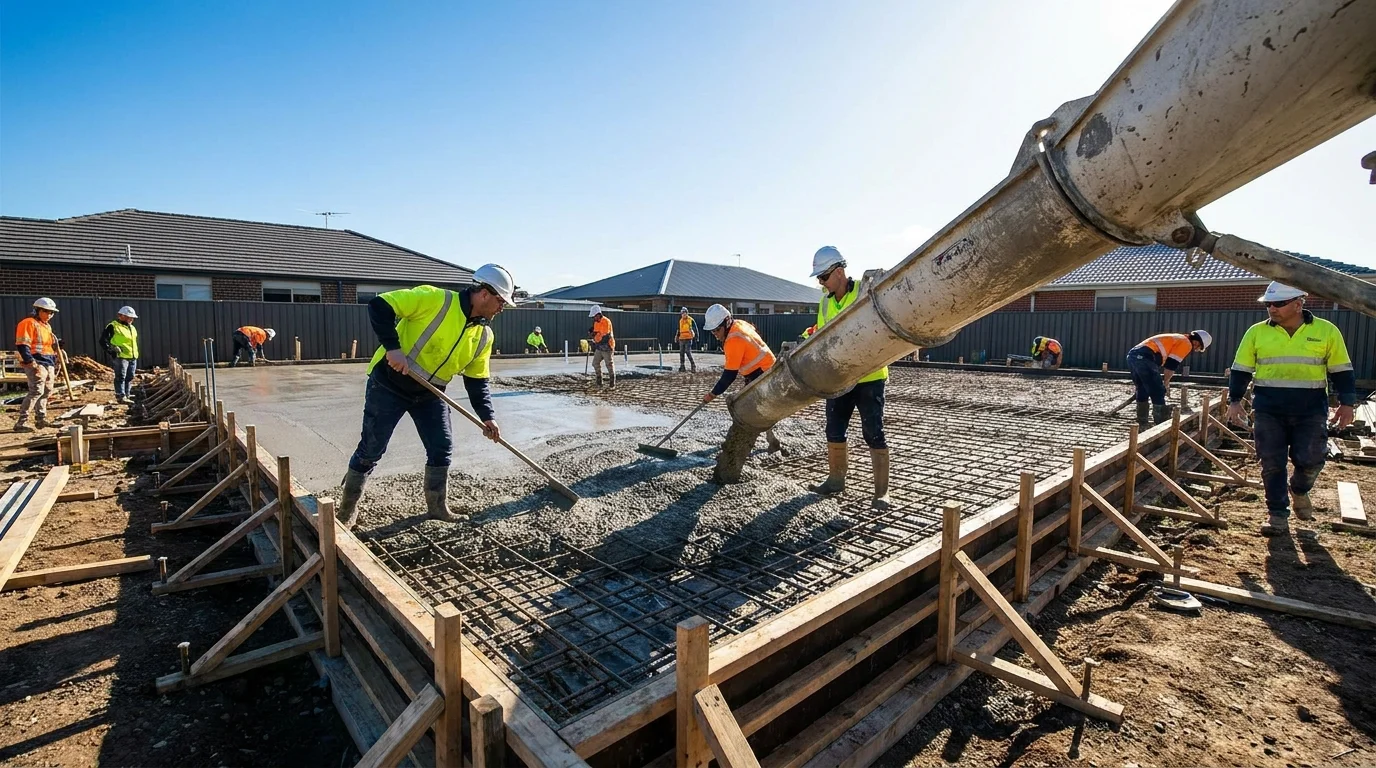
A slab foundation costs $4 to $15 per square foot installed in 2026, with most homeowners paying between $10,000 and $32,000 for a 2,000 sq ft home. The national average lands around $8 to $10 per square foot for a standard monolithic slab on stable soil. This includes concrete, reinforcement, labor, and basic site preparation.
Slab foundations are the most common foundation type in new US construction. According to NAHB analysis of the U.S. Census Bureau's 2024 Survey of Construction, 73 percent of new single-family homes started were built on slab foundations — up from 72.4 percent in 2023. They are popular because they cost less than crawl spaces or basements, require minimal excavation, and can be poured in a single operation.
Use our free Concrete Slab Calculator to get a custom estimate for your exact dimensions, or read on for the complete cost breakdown.
Free Slab Foundation Calculator
Enter your foundation dimensions and get instant cost estimates in cubic yards and total price.
Open CalculatorWhat Is Included in a Slab Foundation Cost
When a contractor quotes a slab foundation price, the cost typically includes several components. Understanding what you are paying for helps you evaluate bids and avoid surprises.
| Component | Cost Range | Notes |
|---|---|---|
| Concrete (ready-mix) | $3 – $7 per sq ft | 3,000-4,000 PSI mix, delivered |
| Reinforcement (rebar) | $2 – $3 per sq ft | Required for structural slabs |
| Vapor barrier | $0.50 – $1 per sq ft | Prevents moisture wicking |
| Formwork | $1 – $2 per sq ft | Lumber or steel forms |
| Site preparation | $0.40 – $2 per sq ft | Grading, leveling, gravel base |
| Labor | $3 – $7 per sq ft | 40-60% of total cost |
| Building permits | $450 – $2,300 | Required in all US municipalities |
| Soil testing (optional) | $1,000 – $5,000 | Recommended but not always required |
Slab Foundation Cost by House Size
Foundation cost scales directly with your home's footprint. Below are total project estimates by house size for slab foundations in 2026. These figures include labor, materials, and standard site preparation on a reasonably flat lot.
| House Size | Slab Cost | Crawl Space | Basement (Unfinished) |
|---|---|---|---|
| 1,000 sq ft | $5,000 – $16,000 | $6,000 – $18,000 | $20,000 – $50,000 |
| 1,200 sq ft | $6,000 – $19,200 | $7,200 – $21,600 | $24,000 – $60,000 |
| 1,500 sq ft | $7,500 – $24,000 | $9,000 – $27,000 | $30,000 – $75,000 |
| 2,000 sq ft | $10,000 – $32,000 | $12,000 – $36,000 | $40,000 – $100,000 |
| 2,500 sq ft | $12,500 – $40,000 | $15,000 – $45,000 | $50,000 – $125,000 |
| 3,000 sq ft | $15,000 – $48,000 | $18,000 – $54,000 | $60,000 – $150,000 |
Two-story advantage: A 2,000 sq ft two-story home has a 1,000 sq ft foundation footprint, cutting your foundation cost by approximately 40 to 50 percent compared to the same square footage in a single-story design. This is one of the strongest cost arguments for two-story homes.
Slab vs Crawl Space vs Basement: Full Comparison
Foundation type is one of the most consequential decisions in new construction. Here is a complete comparison across all major factors.
| Factor | Slab | Crawl Space | Basement |
|---|---|---|---|
| Cost (2,000 sq ft) | $8,000 – $30,000 | $16,000 – $48,000 | $28,000 – $80,000 |
| Per sq ft | $4 – $15 | $8 – $24 | $14 – $40 |
| Build time | 1 – 2 weeks | 2 – 4 weeks | 3 – 6 weeks |
| Usable space | None | Storage only | Full living area |
| Utility access | Difficult | Good | Excellent |
| Resale value | Neutral | Minimal | +$40K – $100K |
| Energy efficiency | High | Low to moderate | High |
| Moisture risk | Low | High without encapsulation | Moderate with waterproofing |
| Best climate | Warm, dry | Humid, moderate | Cold |
| Frost line | South only | Most regions | All cold climates |
| Lifespan | 50 – 100 years | 40 – 80 years | 80 – 150 years |
| Plumbing repair | Jackhammer required | Easy access | Easy access |
Pros and Cons of Slab Foundations
| Advantages | Disadvantages |
|---|---|
| Lowest upfront cost of all foundation types | No utility access — plumbing embedded in concrete |
| Fastest to build — 1 to 2 weeks from pour to framing | No storage or living space underneath |
| No moisture, mold, or pest issues from below-grade space | Not suitable for deep frost lines or expansive clay |
| Simplest to engineer and permit in warm climates | Flood damage risk — water has nowhere to drain |
| Natural heat retention — no air gap beneath floor | Plumbing repairs cost $2,000 to $5,000 per incident |
When to Choose a Slab Foundation
A slab foundation is the best choice when:
- You are building in a warm climate (South, Southeast, Southwest)
- The lot is flat with stable, well-drained soil
- Your local frost line is less than 12 inches deep
- Budget is the primary constraint
- Below-floor utility access is not a priority
Slab Foundation Types Explained
Not all slab foundations are the same. There are three main types, each with different construction methods and price points.
1. Monolithic Slab ($5 – $12 per sq ft)
A monolithic slab combines the footing and floor slab in a single continuous pour. The perimeter edges are thickened to 12 inches to support the building's structural load, while the center remains 4 inches thick. This is the most common and affordable slab type for residential construction.
Best for: Flat lots, stable soil, warm climates, single-story homes.
2. Stem Wall Slab ($6 – $18 per sq ft)
A stem wall slab adds a short concrete wall (typically 12 to 24 inches high) around the perimeter, with the slab poured inside. This elevates the home above grade, providing better drainage and protection from minor flooding. The additional forming and labor increase cost compared to a monolithic slab.
Best for: Areas with occasional flooding, sloped lots, where additional elevation is needed.
3. Slab-on-Grade ($4 – $12 per sq ft)
Slab-on-grade is the simplest form — a flat concrete slab poured directly on prepared ground with no thickened edges or stem walls. It works well for accessory structures like garages, workshops, and sheds, but is less common for primary residences due to structural limitations.
Best for: Garages, sheds, workshops, accessory structures.
| Type | Cost per Sq Ft | 2,000 Sq Ft Total | Build Time |
|---|---|---|---|
| Monolithic slab | $5 – $12 | $10,000 – $24,000 | 1 – 2 weeks |
| Stem wall slab | $6 – $18 | $12,000 – $36,000 | 2 – 3 weeks |
| Slab-on-grade | $4 – $12 | $8,000 – $24,000 | 1 week |
Cost Breakdown by Component
Understanding where your money goes helps you budget accurately and evaluate contractor bids with confidence.
Labor: 40 to 60 Percent of Total Cost
Labor is the single largest line item on any foundation project. Concrete contractors charge $50 to $150 per hour, and a standard three-person crew typically needs a full 8-hour day to pour a residential slab. This works out to $3 to $7 per square foot for a basic pour. Labor costs rise for stem wall slabs due to additional forming work.
Concrete Material: $3 to $7 Per Square Foot
Ready-mix concrete runs $125 to $175 per cubic yard delivered in 2026. A 6-inch slab for a 1,500 sq ft home needs roughly 28 cubic yards. At $150 per yard, that is $4,200 in concrete material before delivery fees. Most foundation contractors specify 3,000 to 4,000 PSI concrete. Use 4,000 PSI for any foundation in a climate with freeze-thaw cycles.
Reinforcement: $1 to $3 Per Square Foot
Rebar is required for most residential foundation slabs. It adds $2 to $3 per square foot installed. Wire mesh is a cheaper alternative at $0.15 to $0.25 per square foot, but it does not provide the same tensile strength as rebar in structural applications. Adding rebar to a 1,500 sq ft foundation adds $3,000 to $4,500 to the total.
Site Preparation: $500 to $8,000
For a slab foundation, site prep includes scraping, leveling, and laying a compacted gravel base. Grading costs $0.40 to $2 per square foot. Basic site prep for a slab runs $500 to $2,000 on a straightforward lot. Rocky soil or slopes can increase this significantly.
Permits and Inspections: $450 to $2,300
Building permits are required in nearly all US municipalities. Permit fees vary by project scope and location. Foundation inspections typically cost $300 to $1,300 additional. Always pull permits before work starts — unpermitted foundation work creates liability issues at resale.
| Cost Component | Slab Foundation | Crawl Space | Basement |
|---|---|---|---|
| Labor | $3 – $7/sq ft | $5 – $10/sq ft | $10 – $20/sq ft |
| Concrete materials | $3 – $7/sq ft | $3 – $7/sq ft | $5 – $12/sq ft |
| Reinforcement | $1 – $3/sq ft | $1 – $3/sq ft | $2 – $4/sq ft |
| Excavation | $500 – $2,000 | $2,000 – $8,000 | $5,000 – $20,000 |
| Waterproofing | Not required | $3,000 – $8,000 | $5,000 – $15,000 |
| Permits | $450 – $2,300 | $450 – $2,300 | $450 – $2,300 |
Factors That Affect Slab Foundation Cost
Two identical-size homes in different conditions can have foundation costs thousands of dollars apart. Here are the main cost drivers.
Soil Conditions
Soil is the single biggest unpredictable variable in foundation pricing. Stable, well-drained loam reduces excavation costs. Expansive clay soils, high water tables, or buried bedrock can add thousands to any foundation type. A geotechnical soil test costs $1,000 to $5,000 and is often required before permit approval. Skipping soil testing is one of the most common causes of cost overruns.
Foundation Thickness
Standard residential slabs run 4 to 6 inches thick. Multi-story homes and homes in cold climates typically use 6-inch slabs throughout. Each additional inch of thickness adds $0.50 to $1.50 per square foot in concrete cost. The International Residential Code sets a 3.5-inch minimum for residential slabs, though 4 inches is the practical standard.
Reinforcement Type
Rebar provides the strongest reinforcement at $2 to $3 per square foot. Wire mesh is cheaper at $0.15 to $0.25 per square foot but offers less structural strength. Fiber mesh can be added to the concrete mix for $10 to $15 per cubic yard. For foundation slabs, rebar is the recommended choice.
Regional Labor Rates
Foundation labor rates vary by 20 to 35 percent across the US. Northeast and West Coast metro markets run above the national median. Scheduling work in late fall or early spring often brings more competitive pricing in most regions.
Frost Line Depth
Footings must extend below the local frost line to prevent frost heave. Frost lines range from zero in Florida to 60 or more inches in Minnesota and Maine. Deeper footings mean more excavation, more concrete, and more forming labor. In cold-climate states, this often makes crawl space or basement foundations more cost-effective than a slab.
Regional Pricing: What You'll Pay by Area
Slab foundation costs vary significantly by region due to labor rates, material availability, soil conditions, and building codes.
| Region | Slab Cost per Sq Ft | Key Drivers |
|---|---|---|
| Northeast (NY, MA, NJ, PA) | $10 – $18 | High labor rates, frost line requirements, strict building codes |
| West Coast (CA, OR, WA) | $12 – $18 | High labor costs, seismic requirements, permit complexity |
| Midwest (OH, MI, IL, IN) | $6 – $12 | Moderate labor rates, wide material availability |
| Southeast (FL, TX, GA, NC) | $5 – $10 | Lowest labor rates, year-round building, favorable soil |
| Southwest (AZ, NM, NV) | $5 – $10 | Dry climate, stable soil, competitive contractor market |
| Mountain (CO, MT, WY) | $6 – $12 | Moderate labor, frost line varies by elevation |
Metro vs rural: Urban areas typically cost 15 to 30 percent more than surrounding rural areas due to higher labor rates, delivery logistics, and permit fees. A slab foundation in downtown Boston or Los Angeles will run above the regional average.
The Formula: How to Calculate It Yourself
If you want to do the math manually, here is the step-by-step process for calculating concrete volume and cost.
Length (ft) × Width (ft) = Square Feet. Example: 30 × 40 = 1,200 sq ft.
Divide inches by 12. Example: 6 inches ÷ 12 = 0.5 ft.
Square Feet × Thickness (ft) = Cubic Feet. Example: 1,200 × 0.5 = 600 cubic feet.
Cubic Feet ÷ 27 = Cubic Yards. Example: 600 ÷ 27 = 22.2 cubic yards.
22.2 × 1.10 = 24.4 cubic yards. Always round up — running short mid-pour is expensive.
24.4 × $150 = $3,660 for concrete material. Add labor ($3-$7/sq ft), reinforcement ($2-$3/sq ft), and permits for total cost.
Real-World Cost Examples
Here are three detailed cost breakdowns for different slab foundation scenarios.
Example 1: Basic Slab — 1,200 sq ft in Texas
| Component | Cost |
|---|---|
| Slab type: Monolithic, 4 inches thick | |
| Concrete: 18 cubic yards × $140/yard | $2,520 |
| Labor: $4/sq ft × 1,200 | $4,800 |
| Wire mesh reinforcement | $480 |
| Gravel base and grading | $1,200 |
| Building permit | $650 |
| Total estimated cost | $9,650 |
| Cost per sq ft | $8.04 |
Example 2: Mid-Range Slab — 1,800 sq ft in Georgia
| Component | Cost |
|---|---|
| Slab type: Monolithic, 6 inches thick | |
| Concrete: 33 cubic yards × $148/yard | $4,884 |
| Labor: $5/sq ft × 1,800 | $9,000 |
| Rebar reinforcement | $4,500 |
| Gravel base and grading | $2,000 |
| Vapor barrier | $900 |
| Building permit | $850 |
| Total estimated cost | $22,134 |
| Cost per sq ft | $12.30 |
Example 3: Premium Slab — 2,500 sq ft in California
| Component | Cost |
|---|---|
| Slab type: Stem wall, 6 inches thick | |
| Concrete: 47 cubic yards × $175/yard | $8,225 |
| Labor: $8/sq ft × 2,500 | $20,000 |
| Rebar reinforcement | $6,250 |
| Gravel base and grading | $4,500 |
| Vapor barrier | $1,250 |
| Soil testing | $2,500 |
| Building permit | $1,800 |
| Total estimated cost | $44,525 |
| Cost per sq ft | $17.81 |
Slab Foundation Lifespan and Maintenance
A properly installed slab foundation lasts 50 to 100 years. The primary threats to slab longevity are soil movement, frost heave, and plumbing leaks beneath the slab.
Common Slab Foundation Problems
- Cracking from soil movement: Expansive clay soils that shrink and swell can cause slab cracks. Repair cost: $500 to $2,000 per crack.
- Plumbing leaks beneath the slab: Water pipes embedded in or under the concrete can develop leaks that require jackhammering to access. Repair cost: $2,000 to $5,000 per incident.
- Moisture wicking: Without a vapor barrier, ground moisture can wick upward through the concrete and cause humidity problems in the home.
- Settlement: Poorly compacted soil beneath the slab can cause uneven settling and cracking over time.
Maintenance Tips
- Maintain proper drainage around the foundation — gutters should direct water at least 5 feet away from the slab edge
- Keep vegetation and trees at least 3 feet from the slab edge to prevent root damage
- Address any plumbing leaks immediately to prevent soil erosion beneath the slab
- Seal any cracks promptly to prevent water infiltration and further deterioration
How to Reduce Slab Foundation Cost
The foundation is not the place to cut structural corners, but there are legitimate ways to control cost without compromising quality.
- Match the foundation to your site: If your soil and climate support a monolithic slab, do not over-build with a stem wall slab. Discuss options with your contractor before committing to a more complex type than your site requires.
- Hit a full truckload: Ready-mix trucks hold 9 to 10 cubic yards. Ordering less triggers short-load fees of $40 to $60 per yard. Size your pour to fill the truck or combine with footings or a garage slab.
- Do the soil test first: A soil test that reveals poor conditions before design lets you engineer the right solution from the start. Finding a problem after the pour means demolition and replacement.
- Schedule during off-season: Foundation work during late fall or early spring often brings more competitive pricing as demand for crews drops.
- Handle non-structural site prep yourself: Clearing vegetation, removing an old pad, or hand-leveling modest slopes can save $500 to $1,500.
- Get three written quotes: Foundation contractor pricing varies by $3,000 to $6,000 on mid-size projects in the same market. Get at least three written quotes specifying identical scope.
Hiring a Foundation Contractor
The foundation is the most consequential part of any home build. Getting it wrong has no cheap fix.
Green Flags in a Contractor
- Licensed, bonded, and insured with proof on request
- Written contract specifying PSI, slab thickness, footing depth, and reinforcement type
- Minimum 5 years of residential foundation experience in your region
- Local references you can actually call or visit
- Pulls permits and works through inspections without resistance
- Staged payment schedule: deposit, progress payment, final on passing inspection
Red Flags That Cost You Later
- No mention of rebar or reinforcement in the quote
- Slab thickness not written into the contract
- No discussion of footing depth or frost line requirements
- Cash only or full payment demanded upfront
- Bid significantly below all other quotes without clear explanation
Frequently Asked Questions
How much does a slab foundation cost per square foot in 2026?
A slab foundation costs $4 to $15 per square foot installed in 2026, with a national average of $8 to $10 per square foot. The final price depends on slab type, thickness, reinforcement, soil conditions, and regional labor rates. For a 2,000 sq ft home, total cost ranges from $10,000 to $32,000.
What is included in a slab foundation cost?
A slab foundation cost includes concrete material ($3-$7/sq ft), reinforcement like rebar ($2-$3/sq ft), vapor barrier ($0.50-$1/sq ft), formwork ($1-$2/sq ft), site preparation ($0.40-$2/sq ft), labor ($3-$7/sq ft), and building permits ($450-$2,300). Soil testing ($1,000-$5,000) is recommended but not always required.
How much does a slab foundation cost for a 2,000 sq ft house?
A 2,000 sq ft slab foundation costs $10,000 to $32,000 installed in 2026. The national average is around $16,000 to $20,000 for a standard monolithic slab on stable soil in a moderate climate region. Costs vary by region — the same foundation might cost $12,000 in Texas but $25,000 in California.
Is a slab foundation cheaper than a crawl space?
Yes, a slab foundation is 40% to 60% cheaper than a crawl space. Slabs cost $4-$15 per square foot while crawl spaces cost $8-$24 per square foot. For a 2,000 sq ft home, a slab saves approximately $6,000 to $18,000 compared to a crawl space foundation.
How thick should a slab foundation be?
Most residential slab foundations are 4 to 6 inches thick. A 4-inch slab works for patios and shed pads. A 6-inch slab is standard for driveways, garage floors, and most residential homes. Multi-story homes and cold-climate builds typically use 6-inch slabs throughout. Each additional inch adds $0.50 to $1.50 per square foot.
What is the cheapest type of house foundation?
A monolithic concrete slab is the cheapest foundation type at $4 to $12 per square foot. It is poured in a single operation with thickened perimeter edges and requires minimal excavation, making it the most affordable option for flat lots in warm climates.
How long does a slab foundation last?
A properly installed slab foundation lasts 50 to 100 years. The primary threats are soil movement, frost heave, and plumbing leaks beneath the slab. Regular maintenance of drainage and vapor barriers extends lifespan significantly.
Do I need a soil test before building a slab foundation?
A geotechnical soil test costs $1,000 to $5,000 and is recommended before any foundation construction. It reveals soil bearing capacity, water table depth, and expansive clay presence. Skipping this test can lead to $10,000 or more in unexpected foundation problems later.
Can I convert a slab foundation to a basement?
Converting a slab to a basement is technically possible but extremely expensive, typically costing $60,000 to $150,000 or more. The process requires lifting the house, excavating beneath it, and pouring new foundation walls. It is almost never cost-effective compared to building a basement during original construction.
What states use slab foundations the most?
Slab foundations are most common in southern and southwestern states including Texas, Florida, Arizona, Georgia, and California. According to NAHB analysis of the U.S. Census Bureau's 2024 Survey of Construction, 73% of new single-family homes started were built on slab foundations, with the highest concentration in warm-climate regions where frost heave is not a concern.
Data Sources
- U.S. Census Bureau — Residential Foundation Data
- HomeAdvisor — Foundation Cost Data (2026)
- Angi — Concrete Foundation Cost Guide (2026)
- Fixr — Slab vs Crawl Space Foundation Comparison
- International Residential Code (IRC) — Foundation Requirements
- Concrete Network — Foundation Cost Data (2026)
Related Posts
- Cost to Pour Concrete Slab 2026: Per Sq Ft Pricing
- Concrete Driveway Installation Cost 2026
- Concrete Slab Cost in 2026: What the Data Actually Says
- How Much Mulch Do I Need? Calculator & Guide
- How Much Landscape Rock Do I Need? Calculator & Guide
Related Calculators
- Concrete Slab Cost Calculator — Get exact cubic yards, bag count, and total cost
- Mulch & Soil Calculator — Estimate landscaping materials around your foundation
- Landscape Rock Calculator — Calculate gravel for the sub-base