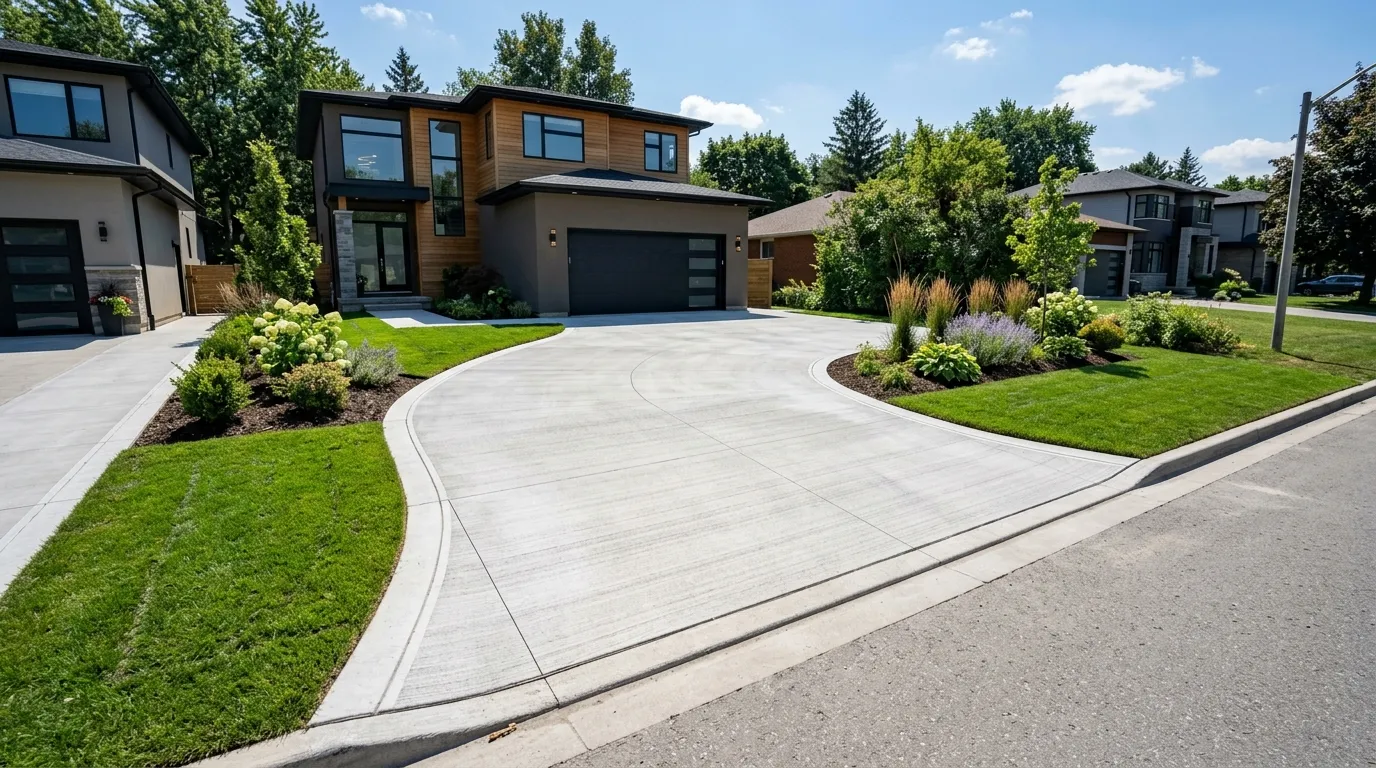
A concrete driveway costs $6 to $15 per square foot installed in 2026, with most homeowners paying around $8 to $12 per square foot for a standard broom finish. For a typical two-car driveway (600 sq ft), that translates to $4,800 to $9,000 all-in. The national average lands near $7,500, but your actual cost depends on driveway size, thickness, finish type, gravel base requirements, and where you live.
Compared to a basic concrete slab, driveways cost more because they require thicker pours (minimum 4 inches, often 6), rebar or wire mesh reinforcement as standard, a compacted gravel sub-base, and higher-PSI concrete mix (typically 4,000 PSI). These requirements add material and labor costs that a simple patio or shed pad does not demand.
Use our free Concrete Slab Calculator to get a custom estimate for your driveway dimensions, or read on for the full cost breakdown by size, region, and finish type.
Free Concrete Driveway Calculator
Enter your driveway dimensions and get instant cost estimates — cubic yards of concrete, gravel base, and total project price.
Open CalculatorConcrete Driveway Cost at a Glance
| Finish Type | Cost/Sq Ft Installed | 600 Sq Ft Driveway |
|---|---|---|
| Plain broom finish | $6 – $12 | $3,600 – $7,200 |
| Standard broom finish | $8 – $14 | $4,800 – $8,400 |
| Exposed aggregate | $9 – $15 | $5,400 – $9,000 |
| Stamped / decorative | $12 – $20 | $7,200 – $12,000 |
| Colored concrete | $10 – $16 | $6,000 – $9,600 |
These prices include materials, labor, gravel base preparation, and basic finishing. They do not include optional upgrades like heated driveway systems, decorative borders, or retaining walls.
Cost by Driveway Size
The biggest driver of total cost is simply how much concrete you need. Here is what common driveway dimensions cost for a standard broom-finish pour at 4-inch thickness:
| Driveway Size | Square Feet | Plain Broom | Decorative |
|---|---|---|---|
| Single-car (10 x 20) | 200 | $1,600 – $3,000 | $2,800 – $5,600 |
| Single-car wide (12 x 24) | 288 | $2,300 – $4,000 | $4,000 – $8,100 |
| Two-car (20 x 20) | 400 | $3,200 – $6,000 | $5,600 – $11,200 |
| Two-car standard (20 x 30) | 600 | $4,800 – $7,200 | $7,200 – $12,000 |
| Two-car wide (24 x 30) | 720 | $4,300 – $8,600 | $8,600 – $13,000 |
| Large three-car (24 x 40) | 960 | $5,750 – $11,500 | $10,500 – $18,000 |
| Long driveway (20 x 60) | 1,200 | $7,200 – $12,000 | $13,000 – $22,000 |
The cost does not scale perfectly linearly. Longer driveways require more concrete trucks (each holds about 10 cubic yards), which means more delivery fees. Very short driveways have a higher per-square-foot cost because mobilization, forms, and site prep are fixed expenses spread over less area.
Why Driveways Cost More Than Patios
A driveway and a patio might both be flat concrete surfaces, but driveways carry significantly higher installation costs. Here is why:
- Thickness: Patios can get by at 4 inches. Driveways need a minimum of 4 inches, and 5 to 6 inches is recommended for anything that will see trucks, RVs, or regular delivery vehicles. Each extra inch adds roughly $0.40 to $1.00 per square foot.
- Reinforcement: Wire mesh or rebar is optional for patios but standard for driveways. A 600 sq ft driveway needs about $240 to $600 in reinforcement materials.
- Gravel sub-base: Patios can sometimes be poured over compacted soil. Driveways always need a compacted gravel base — 4 to 6 inches of crushed stone, costing $1.10 to $1.85 per square foot.
- Higher PSI mix: Driveways should use 4,000 PSI concrete minimum (the ACI recommendation). This costs $15 to $25 more per cubic yard than standard 3,000 PSI mix.
- Finishing: Driveway finishing includes broom texture for traction, control joints to prevent cracking, and edge treatment. This adds $1 to $3 per square foot in labor.
Full Cost Breakdown
Here is where your money actually goes on a typical two-car driveway (720 sq ft, 4-inch thick, broom finish):
| Line Item | Cost Range | % of Total |
|---|---|---|
| Excavation and grading | $400 – $1,100 | ~10% |
| Gravel base (4-6 inches compacted) | $790 – $1,330 | ~14% |
| Forms, rebar, and mesh | $350 – $800 | ~8% |
| Concrete (4,000 PSI, 4 inches) | $1,335 – $1,690 | ~20% |
| Labor: finishing, joints, curing | $1,600 – $2,600 | ~31% |
| Sealer | $250 – $550 | ~5% |
| Permits and misc | $200 – $500 | ~4% |
| Total range | $4,925 – $8,570 | 100% |
Labor makes up roughly 40 to 50% of the total bill. This is where regional variation hits hardest — labor rates in the Northeast and West Coast run 30 to 50% higher than in the Southeast and Midwest.
Gravel Base: The Hidden Cost
Every driveway needs a compacted gravel sub-base. Skipping this step saves $500 to $1,000 upfront but virtually guarantees cracking within 5 to 7 years.
| Base Spec | Details |
|---|---|
| Standard depth | 4 inches compacted |
| Clay or unstable soil | 6 to 8 inches |
| Material type | Angular crushed stone (#57 or dense-graded aggregate) |
| Never use | Rounded pea gravel (does not lock together) |
| Compaction | 95% Proctor density required |
| Cost (4 inches) | $1.10 – $1.85 per sq ft |
| Cost (6 inches) | $1.55 – $2.65 per sq ft |
For a 600 sq ft driveway, gravel base costs roughly $660 to $1,110 at 4-inch depth, or $930 to $1,590 at 6-inch depth. If your soil is clay-heavy or you are in a frost-prone area, expect to need the deeper base.
Use our Pea Gravel Calculator or Stone Calculator to estimate the gravel volume needed for your sub-base.
Concrete PSI: What Mix Do You Need?
The concrete mix strength matters more for driveways than for any other residential application. The American Concrete Institute recommends a minimum of 4,000 PSI for all residential driveways.
| PSI Rating | Best For | Cost Per Yard |
|---|---|---|
| 3,000 PSI | Patios, walkways (not recommended for driveways) | $120 – $155 |
| 3,500 PSI | Minimum acceptable for light-use driveways | $135 – $170 |
| 4,000 PSI | Standard for residential driveways | $150 – $190 |
| 4,500 PSI | Cold climates, heavy vehicles | $165 – $210 |
| 5,000 PSI | Commercial or extreme loads | $185 – $240 |
Upgrading from 3,000 to 4,000 PSI adds about $15 to $25 per cubic yard — roughly $120 to $200 extra for a typical 8-to-10 yard driveway pour. This is one of the cheapest upgrades you can make for long-term durability.
Regional Cost Variation
Where you live changes the price significantly. Labor rates, material availability, and local demand all play a role:
| Region | Cost/Sq Ft (Plain) | 720 Sq Ft Two-Car |
|---|---|---|
| Southeast | $5.00 – $8.00 | $3,600 – $5,750 |
| Texas / South Central | $5.50 – $8.50 | $3,950 – $6,100 |
| Midwest | $6.00 – $9.00 | $4,300 – $6,500 |
| Mountain West | $6.50 – $10.00 | $4,700 – $7,200 |
| Northeast | $7.00 – $11.00 | $5,000 – $7,900 |
| West Coast metro | $8.00 – $13.00 | $5,750 – $9,350 |
City-level costs can vary even more. For example, a 600 sq ft driveway in New York City might run $5,400 to $12,000, while the same project in Indianapolis could cost $3,000 to $7,800. Always get at least three local quotes to understand your market.
Concrete vs Asphalt vs Gravel
If you are choosing between driveway materials, here is how concrete stacks up:
| Factor | Concrete | Asphalt | Gravel |
|---|---|---|---|
| Installed cost/sq ft | $6 – $15 | $3 – $7 | $1 – $3 |
| Two-car driveway total | $4,800 – $9,000 | $1,800 – $4,200 | $600 – $1,800 |
| Lifespan | 25 – 50 years | 15 – 25 years | 10 – 20 years |
| Maintenance | Low (seal every 2-3 yrs) | Medium (seal every 3-5 yrs) | High (regrade, replenish) |
| Cure time | 7 days before driving | 1 – 3 days | Immediate |
| Heat resistance | Excellent | Poor (softens) | N/A |
| Appearance | Clean, customizable | Dark, uniform | Natural, loose |
Concrete costs more upfront but lasts 2 to 3 times longer than asphalt. Over a 25-year period, total cost of ownership often favors concrete because you avoid the repeated sealcoating and eventual replacement that asphalt requires. Our existing concrete vs asphalt comparison breaks down the 25-year cost in detail.
For a deeper look at raw concrete pricing across all project types, see our concrete slab cost guide.
Skip the Math — Use Our Calculator
Our Concrete Slab Calculator does all of this automatically. Enter length, width, thickness, and adjust the concrete price per yard. Get instant results: cubic yards, bag count, and total cost. No signup required.
Try the Concrete Slab CalculatorLifespan and Maintenance
A concrete driveway is a long-term investment. With proper installation and basic maintenance, expect 25 to 50 years of service.
| Maintenance Task | Frequency | Cost |
|---|---|---|
| Sealing | Every 2 – 3 years | $400 – $1,200 |
| Pressure washing | Annually | $80 – $220 |
| Crack repair | As needed | $3 – $25 per sq ft |
| Resurfacing | When surface wears | $1,500 – $4,500 |
| Joint re-sealing | Every 5 – 10 years | $200 – $600 |
Sealing is the single most impactful maintenance task. It prevents water infiltration, staining, and freeze-thaw damage. Skipping sealant can reduce driveway life by 10 to 15 years.
How to Measure Your Driveway
Before you get quotes or use a calculator, you need accurate measurements. Here is how to measure your driveway yourself in 10 minutes.
What you need: A 25-foot tape measure (or laser measurer), stakes and string line for irregular shapes, a notepad, and a calculator.
For Rectangular Driveways
- Measure the length from the street to the garage or end point. Measure inside the form edges if a driveway already exists.
- Measure the width at multiple points (near the street, middle, near the house). Note any variations — use the narrowest width for estimates.
- Multiply length x width to get square footage. Example: 40 ft x 20 ft = 800 sq ft.
- Choose thickness: 4 inches for passenger cars, 5 inches for SUVs and trucks, 6 inches for RVs and heavy loads.
- Convert thickness to feet: 4 inches = 0.33 ft, 5 inches = 0.42 ft, 6 inches = 0.5 ft.
- Calculate cubic yards: Multiply square footage by thickness in feet, then divide by 27. Example: 800 x 0.33 = 264 cubic feet / 27 = 9.78 cubic yards.
- Add 5 to 10% waste buffer for spillage, uneven ground, or cuts around obstacles. At 10%: 9.78 x 1.10 = 10.76 cubic yards.
Use our Concrete Slab Calculator to skip the math — just enter your dimensions and get instant results.
For L-Shaped or Irregular Driveways
Break the driveway into smaller rectangles. Calculate each rectangle separately, then add the totals. For example, an L-shaped driveway might split into a 20 x 30 main section plus a 10 x 15 extension. Calculate each, then combine the cubic yardage.
Standard Driveway Dimensions
| Type | Width | Length | Square Feet | Cubic Yards (4") |
|---|---|---|---|---|
| Single-car | 10 – 12 ft | 18 – 20 ft | 180 – 240 | 2.2 – 3.0 |
| Two-car | 20 – 24 ft | 18 – 20 ft | 360 – 480 | 4.4 – 5.9 |
| Two-car deep | 20 – 24 ft | 30 – 40 ft | 600 – 960 | 7.4 – 11.9 |
| Three-car | 24 – 30 ft | 30 – 40 ft | 720 – 1,200 | 8.9 – 14.8 |
Do You Need a Permit?
Almost always, yes. Nearly all US cities and counties require a permit for new driveway construction, changing materials (like gravel to concrete), widening, or modifying the connection to the street.
Resurfacing or repaving within the same footprint is usually exempt. Sealing, recoating, and minor repairs typically do not require permits.
Two Permits You May Need
- Curb cut / right-of-way permit — from public works, because the driveway crosses the public right-of-way where it meets the street.
- Building or zoning permit — from the building department, for grading, drainage, and lot coverage changes.
Permit Costs by City
| City | Permit Cost | Notes |
|---|---|---|
| Atlanta, GA | ~$150 | Plus $40 per additional curb cut |
| Denver, CO | ~$265 | Includes inspection |
| Tampa, FL | ~$95 | Building permit required statewide |
| Seattle, WA | ~$341 | Street Use permit for curb work |
| Dallas, TX | ~$215 | Flat fee |
| Los Angeles, CA | ~$274 | Plus $30/ft over 20 ft width |
| Rural Midwest | $50 – $100 | Varies by county |
Most permits expire if construction does not start within 6 months. Once started, you typically have 1 to 2 years to complete. Check with your local building department — permit costs are included in the $200 to $500 range we listed in the cost breakdown above.
Hiring a Concrete Driveway Contractor
Finding the right contractor is as important as choosing the right concrete mix. A bad contractor can ruin a driveway in 5 years; a good one will give you 30 to 50 years of service.
Minimum Credentials to Verify
- General liability insurance — $500K to $1M minimum. This covers property damage if the contractor ruins your lawn, hits a utility line, or damages your home.
- Workers' compensation insurance — protects you from liability if a worker is injured on your property. Without it, you could be sued.
- State or local license — required in states like California, Florida, Arizona, Nevada, Washington, and others. Many states (Texas, Colorado, Pennsylvania) have no statewide license — check local requirements.
- Clean BBB profile — check for complaints in the last 3 years.
Questions to Ask Every Contractor
- What concrete mix and PSI do you use? Should specify 4,000 PSI minimum with air entrainment for freeze-thaw climates. The ACI recommends 4,000 PSI for all residential driveways.
- How do you prepare the subgrade? Should include excavation, compaction, and gravel base — not just "we compact and pour."
- What reinforcement will you use? Number 4 rebar on 12-inch centers or heavy welded wire fabric is standard.
- Where will you place control joints? Every 8 to 10 feet, or 2 to 3 times the slab thickness.
- What is your curing process? Minimum 7 days of curing; 28 days for full strength.
- Will the owner or supervisor be on-site during the pour? This is a strong sign of quality control.
- Who pulls the permits? Reputable contractors handle permitting themselves.
- What does your warranty cover? Get it in writing. Most contractors offer 1 to 2 year workmanship warranties; premium contractors offer 5+ years.
Red Flags to Avoid
| Red Flag | Why It Matters |
|---|---|
| Demands 50%+ payment upfront | Typical is 10 to 15% deposit. Some states legally limit deposits. |
| No written contract | All terms should be in writing before work begins. |
| Cash-only demands | Signals tax evasion and no paper trail. |
| Won't show license or insurance | Legitimate contractors provide certificates within an hour. |
| Quotes without seeing the site | Pricing depends on soil, drainage, and access — cannot be done remotely. |
| No mention of subgrade or base prep | Poor base preparation is the number one cause of driveway failure. |
| Suggests skipping control joints | Random cracks will appear that cannot be repaired. |
| Bid 30%+ below competitors | Almost always means thinner concrete, skipped prep, or hidden change orders. |
| Door-to-door solicitation | BBB and FTC warn this is the top indicator of a paving scam. |
| Asks you to pull the permit | Reputable contractors handle permitting. This signals unlicensed work. |
How to Get Quotes
Get at least 3 written bids from different contractors. Each bid should include detailed line items for demolition, gravel base, concrete specs (PSI, reinforcement, thickness), joints, sealer, permits, and warranty. Compare bids on scope, not just price — the cheapest bid usually has the thinnest scope.
Payment should be milestone-based: small deposit after signing, progress payment after subgrade preparation, and final payment after completion and inspection. Never pay the full amount before work begins.
Frequently Asked Questions
How much does a concrete driveway cost?
A concrete driveway costs $6 to $15 per square foot installed in 2026. A standard two-car driveway (600 sq ft) runs $4,800 to $9,000 for plain concrete. Decorative finishes like stamped or exposed aggregate push that to $8,000 to $15,000 depending on complexity.
How long does a concrete driveway last?
25 to 50 years with proper installation and regular sealing. Factors that affect lifespan include climate, soil conditions, drainage, installation quality, and how well you maintain the surface. Sealing every 2 to 3 years can add 10 to 15 years of life.
How thick should a concrete driveway be?
4 inches is the minimum for standard passenger cars. 5 to 6 inches is recommended for driveways that see heavy trucks, RVs, or regular delivery vehicles. The apron where the driveway meets the street should always be at least 6 inches thick.
Is concrete cheaper than asphalt for a driveway?
No. Asphalt costs $3 to $7 per square foot while concrete costs $6 to $15. However, concrete lasts 2 to 3 times longer and requires far less maintenance. Over a 25-year period, concrete often has a lower total cost of ownership.
How much does a two-car concrete driveway cost?
A two-car driveway (400 to 600 sq ft) costs $3,200 to $7,200 for plain broom-finish concrete. With decorative options like stamping or coloring, expect $5,600 to $12,000 depending on size, thickness, and finish complexity.
Can you pour concrete over an existing driveway?
Yes, if the existing slab is structurally sound with no major settling or heaving. You need at least 2 to 4 inches of new concrete over the old surface. Resurfacing costs $1 to $3 per square foot versus full replacement at $6 to $15 per square foot for demo and new pour.
How long does it take to install a concrete driveway?
Installation takes 3 to 7 days including site prep, base installation, pouring, and finishing. Concrete needs 24 to 48 hours before light foot traffic, 7 days before driving on it, and 28 days to reach full strength. Weather can extend these timelines.
Does a concrete driveway increase home value?
Yes. A new concrete driveway typically recoups 60 to 75 percent of its cost at resale. It also improves curb appeal, which matters for first impressions when selling.
Do I need a permit to install a concrete driveway?
Almost always yes. Nearly all US cities require a permit for new driveway construction, changing materials, widening, or modifying the street connection. Permits typically cost $150 to $500. Resurfacing within the same footprint is usually exempt.
How do I measure my driveway for concrete?
Measure the length and width in feet, then multiply to get square footage. Convert thickness to feet (4 inches = 0.33 ft), multiply by square footage, then divide by 27 to get cubic yards. Add 5 to 10% waste buffer. Our free calculator does this automatically.
How do I choose a concrete driveway contractor?
Get at least 3 written bids. Verify general liability insurance, workers' compensation, and state license. Ask about concrete PSI (should be 4,000 minimum), subgrade preparation, reinforcement type, and warranty. Never pay more than 15% upfront and always get a written contract.
Data Sources
- Concrete Network — Concrete Driveway Cost (2026)
- Concrete Network — Concrete Prices Per Yard (2026)
- National Ready Mixed Concrete Association (NRMCA)
- NerdWallet — Asphalt vs Concrete Driveway
- BusinessVert — Concrete Driveway Cost Guide (2026)
- CostOnce — Concrete Driveway Cost Data (2026)
- HammerIO — Concrete Prices Per Yard (2026)
- Ecostify — Concrete Driveway Cost Guide (2026)
- PermitDeck — Driveway Permit Guide (2026)
- Angi — How to Hire a Concrete Driveway Contractor
- Forbes Home — Hiring Driveway Contractors
- BBB — Driveway Scam Alert
Related Posts
- Concrete Slab Cost in 2026: What the Data Actually Says
- Slab Foundation Cost 2026: Per Sq Ft by House Size
- Cost to Pour Concrete Slab 2026: Per Sq Ft Pricing
- Concrete vs Asphalt Driveway Cost 2026: Price and Lifespan
- 20x20 Concrete Slab Cost 2026
- How Much Mulch Do I Need? Calculator and Guide
Related Calculators
- Concrete Slab Cost Calculator — Get exact cubic yards, bag count, and total cost for your driveway
- Pea Gravel Calculator — Estimate gravel for your sub-base
- Stone Calculator — Calculate crushed stone volume for driveway base
- Mulch and Soil Calculator — Landscaping around your new driveway