Ready-mix concrete costs $125 to $195 per cubic yard in 2026, with a national average of approximately $160 to $180 for standard 3,000 to 4,000 PSI mix delivered within 20 miles of the batch plant. A full 10-yard truckload runs $1,200 to $1,800 before add-on fees.
The per-yard price covers the concrete material itself: cement, aggregate, sand, water, and batching at the plant. Delivery, short-load fees, and finishing are typically billed separately. Your final cost depends on three things: mix strength (PSI), order size, and delivery distance.
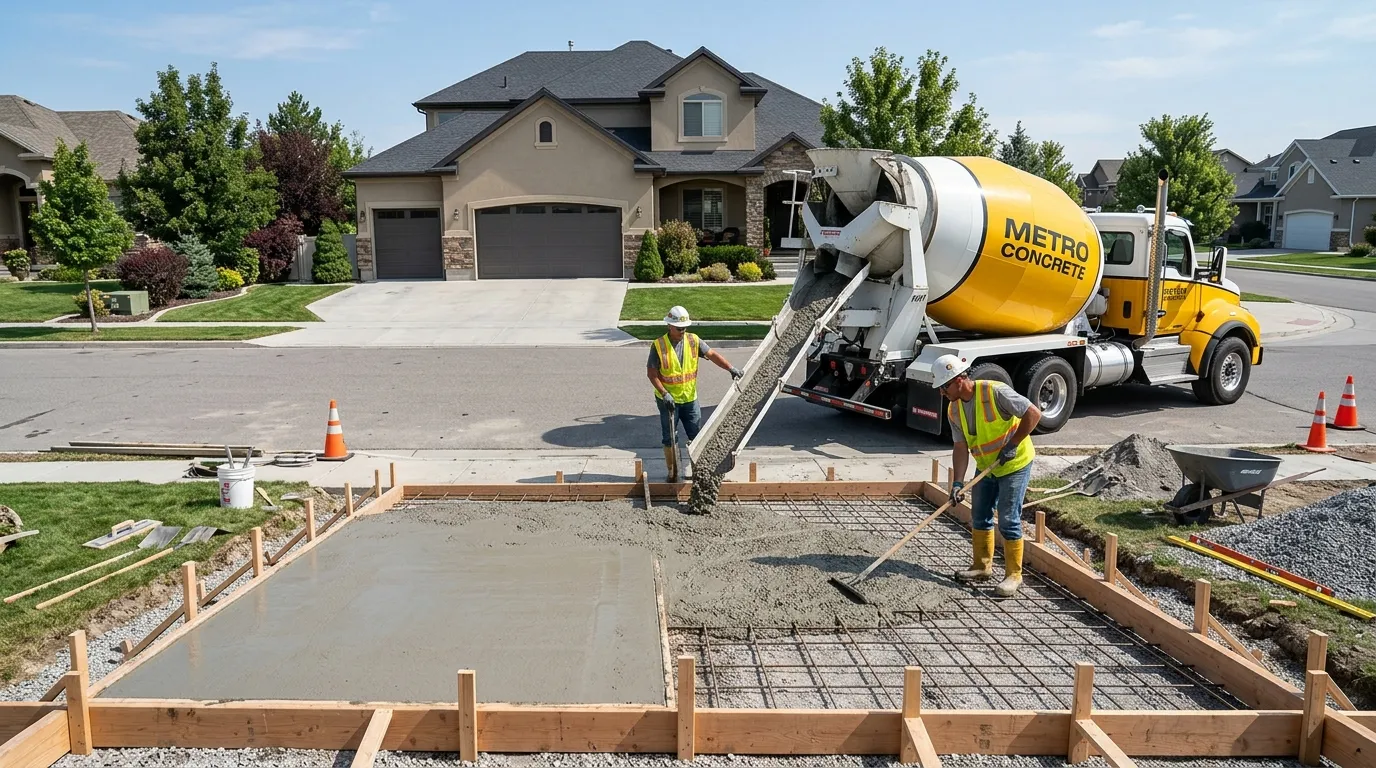
Source: ConcreteNetwork.com (updated July 14, 2026) reports a national range of $160 to $195 per cubic yard with a 2025 average of $179.95. AceCalc.com (August 2026) places the national midpoint at $165 per cubic yard using FRED PPI state adjustments.
Cost at a Glance
| Item | Low | Average | High | Notes |
|---|---|---|---|---|
| Ready-mix per cubic yard | $125 | $165 | $195 | Standard 3,000-4,000 PSI mix |
| Full truckload (10 cy) | $1,200 | $1,500 | $1,800 | No short-load fee at this volume |
| Delivery fee per load | $55 | $110 | $180 | Within 20 miles; higher for distance |
| Short-load fee | $50 | $100 | $200 | Applies under 5-8 cy minimum |
| Installed cost per sq ft | $6.50 | $8.50 | $10.50 | Material + labor + finishing |
Source: ConcreteNetwork.com (July 2026); ConcreteCalculator.pro (NRMCA 2024 benchmark: $179.89/cy); HomeGuide.com (May 2026) reports $125-$150/cy material + $55-$65 delivery.
Price by PSI Mix Strength
Concrete strength is measured in PSI (pounds per square inch). Higher PSI means more cement per cubic yard, and cement is the most expensive ingredient in the mix. Most residential projects use 3,000 to 4,000 PSI. Commercial and structural work uses 4,000 to 5,000 PSI.
| PSI | Sacks/CY | Price/CY | Premium vs 3,000 | Typical Use |
|---|---|---|---|---|
| 2,500 | 4.5 | $155-$175 | -$5 (discount) | Walkways, light patios, fills |
| 3,000 | 5 | $160-$180 | Base price | Standard slabs, patios, driveways |
| 3,500 | 5.5 | $166-$185 | +$6-$10 | Heavy residential, garage floors |
| 4,000 | 6 | $170-$195 | +$10-$15 | Driveways, commercial, structural |
| 4,500 | 6.5 | $174-$200 | +$14-$20 | Heavy commercial, load-bearing |
| 5,000 | 7 | $180-$210 | +$20-$30 | Industrial, high-traffic |
| 6,000 | 8 | $190-$230 | +$30-$50 | High-performance, bridges |
| 8,000 | 10 | $199-$250 | +$39-$70 | Specialty structural |
Source: Published ready-mix price list, Townsend Concrete, Vacaville, California (updated April 12, 2026). Retrieved July 31, 2026. PSI premium of +$8-$15/cy per 1,000 PSI confirmed by BuildCalchub.net and Hammerio.com.
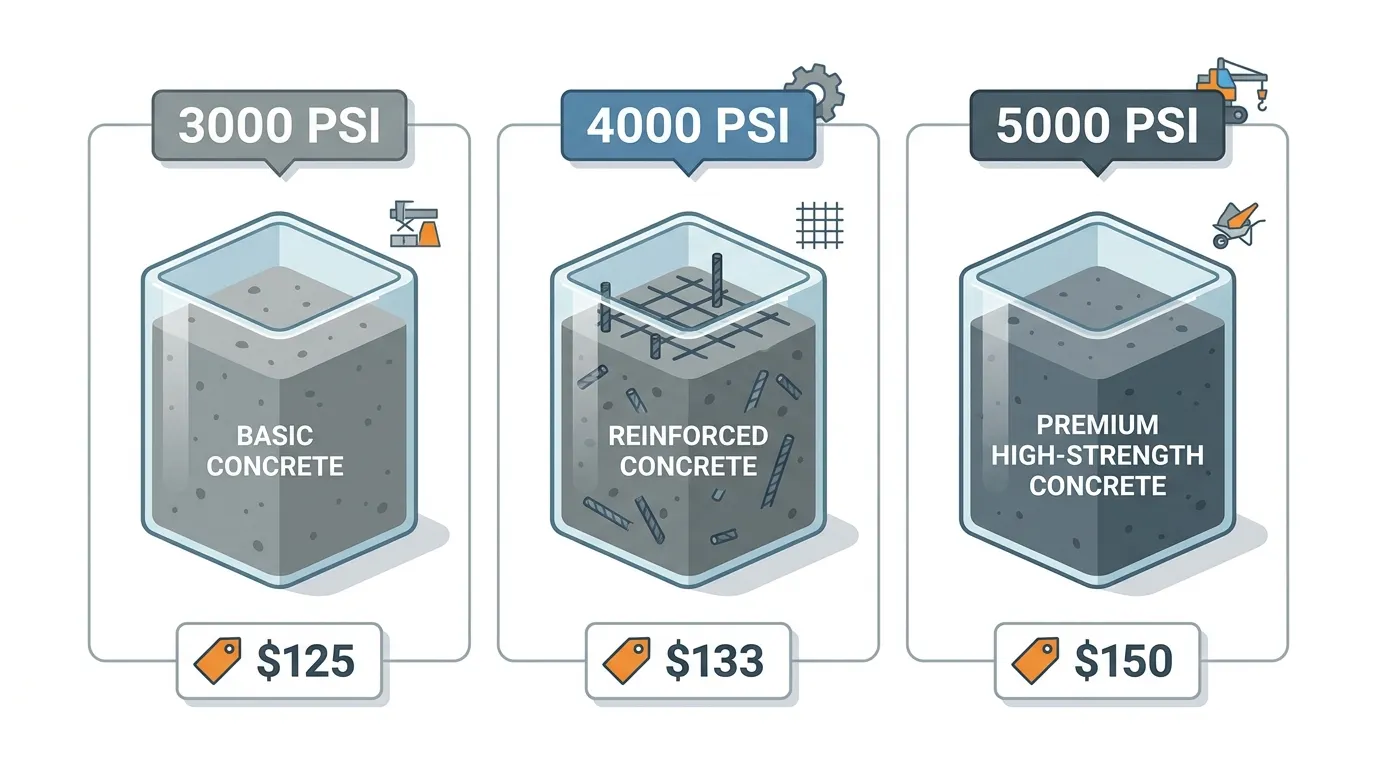
What this means for your project: A 20x20 patio at 4 inches needs about 5 cubic yards. Choosing 4,000 PSI over 3,000 PSI adds roughly $50 to $75 to your total. Worth it for driveways, probably overkill for a garden patio.
What Is in the Price: Cost Composition Breakdown
The per-yard price you are quoted is not pure profit for the supplier. Here is where the money actually goes, based on cost composition data for a typical $165/cy load of 3,000 PSI concrete:
| Component | Cost/CY | % of Total | What It Covers |
|---|---|---|---|
| Portland cement | $35-$45 | 22-28% | Most expensive raw ingredient |
| Aggregate (stone & sand) | $15-$22 | 10-14% | Locally sourced; quarry distance matters |
| Water & mixing | $3-$5 | 2-3% | Plant batching |
| Plant operations & overhead | $20-$30 | 13-18% | Equipment, staff, QC testing |
| Delivery truck & driver | $35-$55 | 22-33% | Largest single line item |
| Dispatch & admin | $10-$15 | 6-10% | Scheduling, ticketing |
| Total | $118-$172 | 100% |
Source: Hammerio.com cost composition analysis (May 2026). Portland cement price data from Buildermuse.com (April 2026): cement at $469.18/ton, up 3.3% YoY.
Cement alone is 22 to 28% of your concrete cost. When cement prices rise, ready-mix prices follow. This is also why higher-PSI mixes cost more: they require more cement sacks per cubic yard.
Short-Load Fees: The Hidden Cost Driver
Short-load fees are the single biggest surprise on a concrete invoice. Most homeowners budget for the per-yard price and get blindsided by this charge.
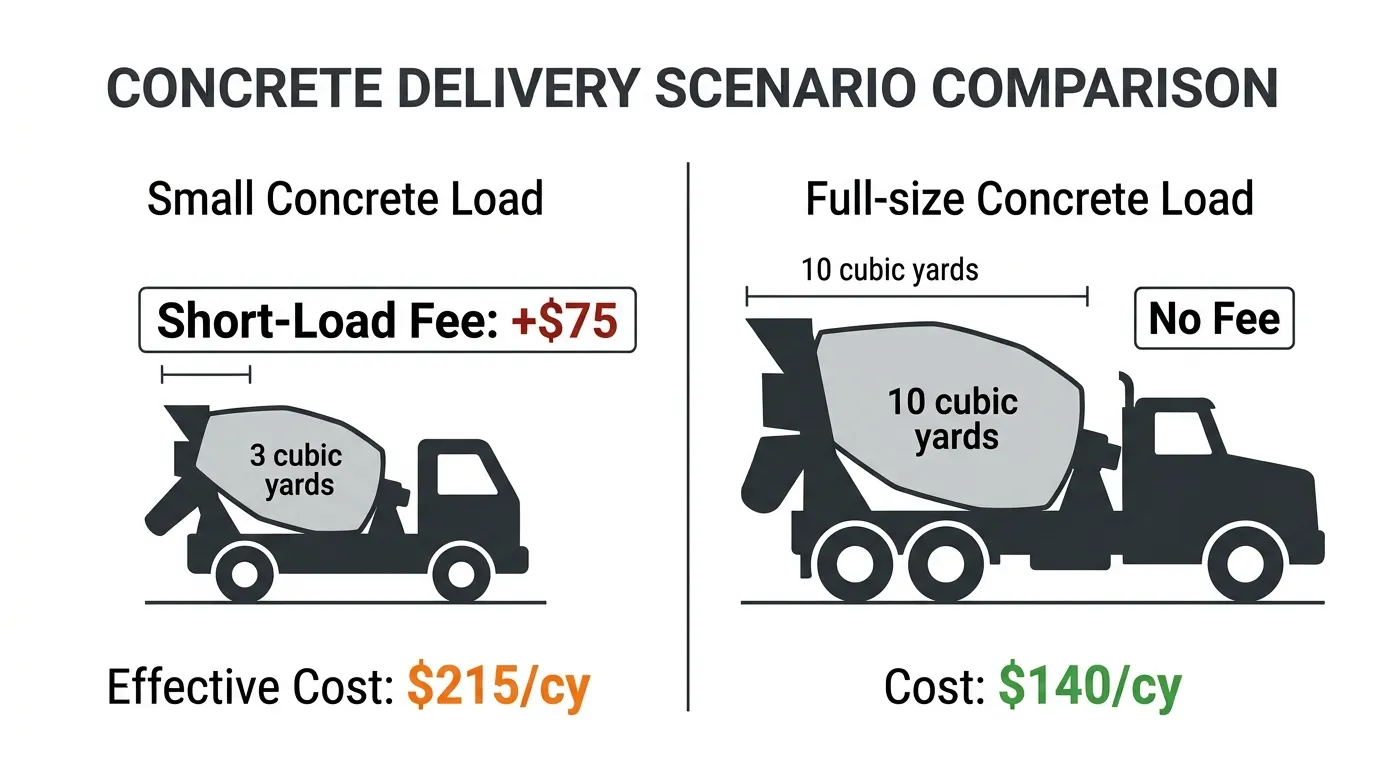
How it works: A ready-mix truck costs the same to dispatch whether it carries 3 yards or 10. The short-load fee compensates the supplier for the unused capacity.
| Your Order | Typical Minimum | Shortfall | Fee at $30/cy Short | Effective $/CY |
|---|---|---|---|---|
| 2 cy | 5 cy | 3 cy | $90 | $215/cy |
| 3 cy | 5 cy | 2 cy | $60 | $190/cy |
| 4 cy | 5 cy | 1 cy | $30 | $178/cy |
| 5 cy | 5 cy | 0 | $0 | $170/cy |
| 8 cy | 8 cy | 0 | $0 | $165/cy |
| 10 cy (full truck) | - | - | $0 | $160/cy |
Source: BuildCalchub.net (2026) reports typical short-load rate of $25-$45/cy short with thresholds of 7-9 cy. Allconcretecalculator.com (June 2026) confirms fees of $50-$250/cy under the minimum.
How to Avoid or Reduce Short-Load Fees
| Strategy | How It Works | Potential Savings |
|---|---|---|
| Round up to threshold | Order 5 cy instead of 3-4 cy | $60-$150 in fees |
| Combine with neighbor | Split a full truck load | $50-$100 each |
| Use volumetric truck | On-site mixing, pay for actual volume dispensed | No minimum, no fee |
| Ask for leftover mix | Plants sometimes sell partial loads at discount | $30-$80/cy off |
| Negotiate with contractor | Contractors often get waived short-load fees | Varies |
Source: Allconcretecalculator.com (June 2026); Stonarq.com (July 2026).
Delivery Fees: Distance and Timing
Delivery is almost always billed separately from the concrete material. The fee depends on distance, access difficulty, and timing.
| Fee Type | Typical Cost | When It Applies |
|---|---|---|
| Standard delivery (within 20 mi) | $0-$65/load | Most orders; often included in quote |
| Distance surcharge (20+ mi) | $9.50/mile over 20 mi | Rural sites far from batch plant |
| Short-load delivery | $60-$180/load | Orders under 5-8 cy |
| Weekend delivery (Saturday) | +$8-$25/cy | Weekend scheduling |
| Sunday/holiday delivery | +$15-$25/cy | Limited availability |
| Pump truck (if needed) | $200-$500 flat | Truck cannot reach pour site |
| Standby/demurrage | $75-$175/hr after 1st hr | Truck waits while you pour |
Source: Townsend Concrete published price list (April 2026): delivery zones from $120 (home zone) to $350 (edge of service area). BuildCalchub.net (2026) reports demurrage at $85 per half-hour after 60 minutes.
Bagged Concrete vs Ready-Mix: Full Comparison
The crossover point is 1 cubic yard. Below that, bags are usually cheaper. Above it, ready-mix wins on both cost and labor.
| Factor | Bagged (80 lb) | Ready-Mix |
|---|---|---|
| Cost per cubic yard | $225-$315 (material) | $125-$175 (material) |
| Bags per cubic yard | ~45 bags | N/A |
| Labor to place 1 cy | 3-5 hours (mixing) | 20-30 minutes (unloading) |
| Quality consistency | Variable (depends on mixing) | Plant-batched, uniform PSI |
| Best project size | Under 1 cy | Over 1 cy |
| Equipment needed | Mixer rental ($45-$65/day) | None |
| Best for | Post holes, small pads, repairs | Slabs, driveways, foundations |
Source: Stonarq.com (July 2026): 80 lb bags $5-$8 each; 1 cy = ~45 bags. BuildMaterialCalc.com confirms crossover at ~1 cy.
Real Cost Comparison by Project Size
| Project | Volume | Bagged Cost | Ready-Mix Cost | Winner |
|---|---|---|---|---|
| Small pad (4x4x4") | 0.2 cy | 10 bags x $6 = $60 | $170 + $100 short-load = $270 | Bags |
| Patio (10x10x4") | 1.2 cy | 56 bags x $6 = $336 + 4 hrs labor | $204 + $100 short-load = $304 | Ready-mix |
| Driveway (12x40x6") | 8.9 cy | 440 bags x $6 = $2,640 + 20 hrs labor | $1,513 + $60 delivery = $1,573 | Ready-mix |
Source: Bag pricing from Stonarq.com (July 2026); ready-mix pricing at national average of $170/cy for 3,000 PSI per ConcreteNetwork.com (July 2026). Volume formulas: L x W x (thickness/12) / 27 = cubic yards.
The hidden cost of bags: Mixing 45 bags by hand takes 3 to 5 hours of hard physical labor. At a contractor rate of $45 to $65 per hour, that is $135 to $325 in labor you are spending (or not counting if you are doing it yourself). Ready-mix eliminates this entirely.
Regional Pricing: Top US Regions
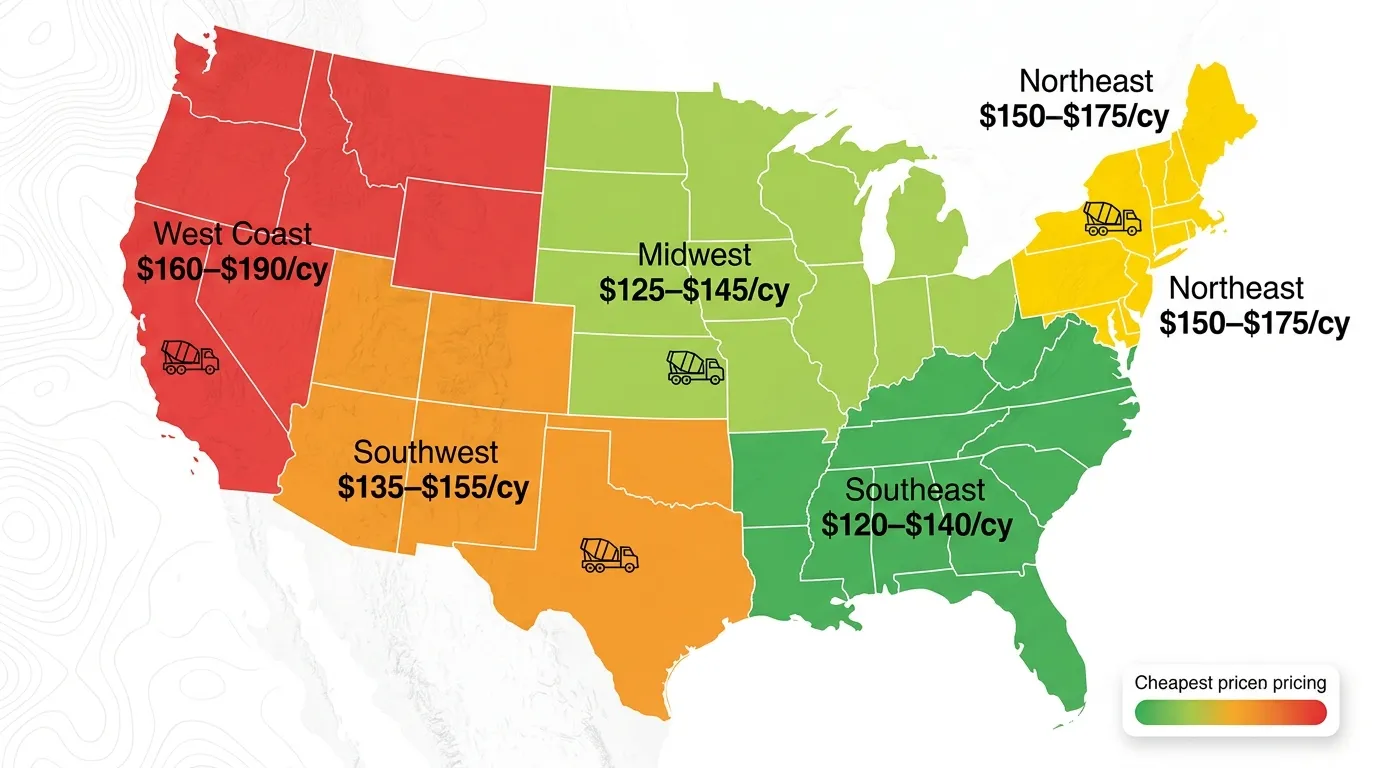
Concrete is a local product. It does not ship more than about 90 minutes from the batch plant before it starts setting. That means prices vary significantly by region.
| Region | Key States | Price/CY | vs National |
|---|---|---|---|
| Midwest (cheapest) | IA, IN, OH, NE, KS | $105-$122 | -25% to -15% |
| South | TX, FL, GA, NC, TN | $130-$165 | -10% to baseline |
| Mountain West | CO, AZ, NV, UT | $150-$190 | Baseline to +10% |
| Mid-Atlantic | PA, VA, MD, DE | $160-$200 | Baseline to +15% |
| West Coast | CA, WA, OR | $165-$215 | +10% to +25% |
| Northeast | NY, NJ, MA, CT | $185-$225 | +15% to +30% |
| Alaska/Hawaii | AK, HI | $175-$250 | +25% to +50% |
Source: AceCalc.com (August 2026) state-by-state data via FRED PPI adjustments. National midpoint: $165/cy. ConcreteCalculator.pro (2026) reports NRMCA national average of $179.89/cy.
Metro-Specific Pricing
| Metro | Avg Price/CY | Typical Range | Source |
|---|---|---|---|
| Houston, TX | $126 | $118-$140 | NRMCA 2026 / concretecalc.us |
| Chicago, IL | $183 | $170-$210 | ConcreteNetwork.com supplier survey |
| Los Angeles, CA | $182 | $170-$200 | ConcreteNetwork.com supplier survey |
| New York, NY | $185 | $170-$210 | ConcreteNetwork.com / AceCalc |
| Lynchburg, VA | $165 | $150-$180 | ConcreteNetwork.com contractor report |
Source: ConcreteNetwork.com (July 14, 2026): supplier quotes from 4 markets. Lynchburg figure from Tim Seay, owner of Decorative Concrete of Virginia.
Why the variation? Three drivers: (1) proximity to cement plants, the Midwest has abundant limestone deposits; (2) labor costs, Northeast and West Coast are unionized markets adding $15 to $30/cy; (3) code requirements, California seismic provisions and environmental regulations add compliance costs.
What Is Included vs Billed Separately
| Included in Per-Yard Price | Usually Billed Separately |
|---|---|
| Cement, aggregate, sand, water | Delivery ($60-$180/load) |
| Batching at the plant | Short-load fee ($50-$200) |
| Standard mixing | Weekend surcharge (+$8-$25/cy) |
| Pump truck ($200-$500) | |
| Air entrainment (+$5-$15/cy) | |
| Fiber reinforcement (+$8-$15/cy) | |
| Colored concrete (+$31-$170/cy) | |
| Demurrage ($75-$175/hr after 1st hr) | |
| Retarder (summer) (+$2.50-$3/cy) | |
| Accelerator (winter) (+$5-$6/cy) |
Source: American Concrete (effective April 1, 2026): fiber $4/cy residential, retarder $2.50/cy. Townsend Concrete price list (April 2026) for delivery zones and short-load terms.
Always request an itemized quote. Ask the plant to break out: (1) per-yard material price, (2) delivery fee, (3) short-load fee if applicable, (4) any admixture surcharges. This lets you compare quotes apples to apples.
Worked Examples With Real Math
Example 1: Small Patio (10x10x4")
10 ft x 10 ft x (4 in / 12) = 33.3 cubic feet. Divide by 27: 33.3 / 27 = 1.23 cubic yards.
1.23 x 1.10 = 1.35 cubic yards. Round to 1.5 cy for ordering.
Bags: 56 bags x $6 = $336 + 4 hours labor.
Ready-mix: 1.5 cy x $170 = $255 + $100 short-load + $65 delivery = $420.
Bags are $84 cheaper but take 4+ hours to mix. Ready-mix arrives in 30 minutes. If your time is worth more than $21/hour, go with ready-mix.
Example 2: Driveway (20x40x6")
20 ft x 40 ft x (6 in / 12) = 400 cubic feet. 400 / 27 = 14.8 cubic yards.
14.8 x 1.10 = 16.3 cubic yards. Order 17 cy (2 truckloads).
17 cy x $175 = $2,975 + $65 delivery = $3,040. No short-load fee (above threshold).
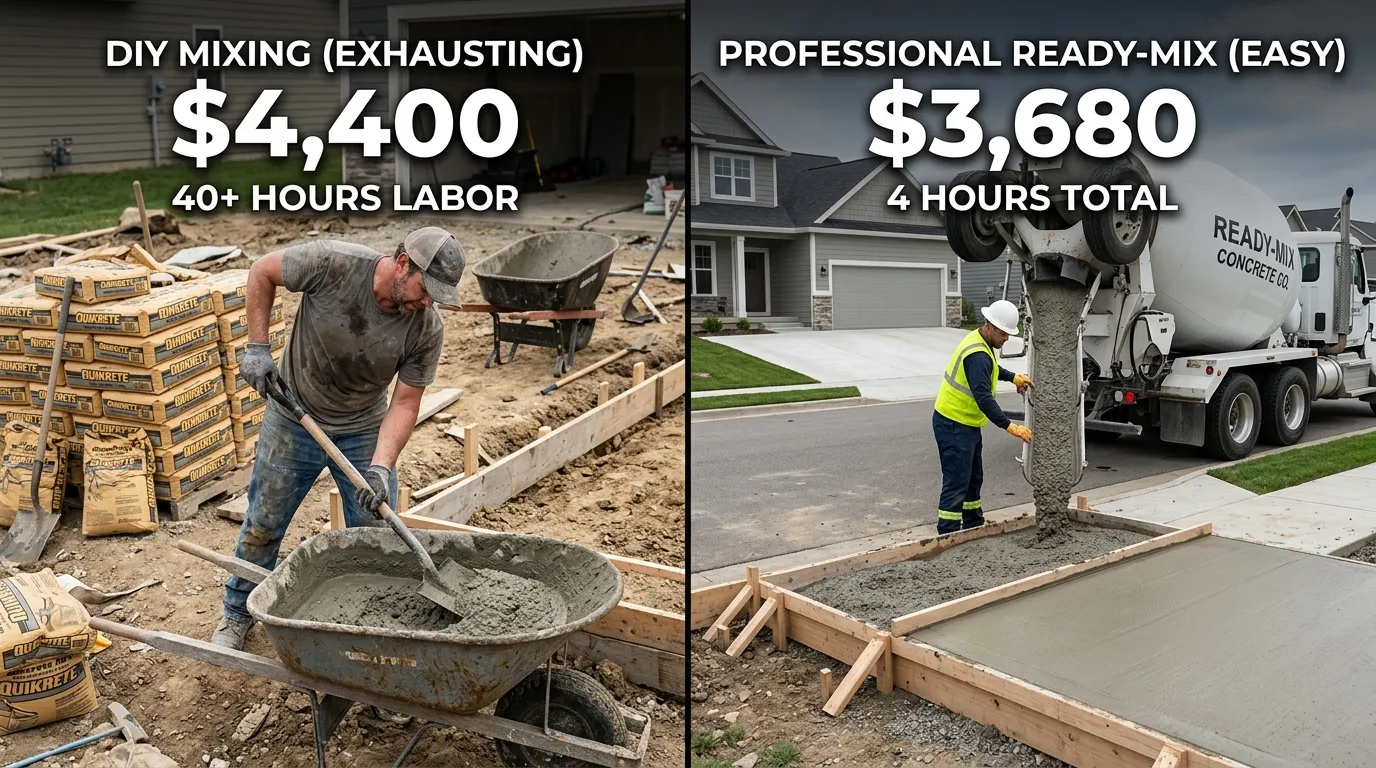
Ready-mix is the only practical option. Bags would cost $4,400 in material (733 bags x $6) plus 40+ hours of mixing and placing labor.
Example 3: Garage Floor (24x24x5")
24 ft x 24 ft x (5 in / 12) = 240 cubic feet. 240 / 27 = 8.89 cubic yards.
8.89 x 1.10 = 9.78 cubic yards. Round to 10 cy (one full truck).
10 cy x $180 = $1,800 + $60 delivery = $1,860. No short-load fee.
Ready-mix saves $780 in material and 20 hours of labor versus bags (440 bags x $6 = $2,640).
Example 4: House Foundation (1,000 sq ft x 8")
1,000 sq ft x (8 in / 12) = 667 cubic feet. 667 / 27 = 24.7 cubic yards.
Foundations need a larger buffer. 24.7 x 1.15 = 28.4 cubic yards. Order 29 cy (3 truckloads).
29 cy x $170 = $4,930 + 3 x $65 delivery = $5,125. Bulk discount likely applies at this volume.
Always hire a pro for structural work. Material alone is $4,500 to $5,200. Contractors typically negotiate $5 to $15 off per yard at this volume.
How to Get an Accurate Quote
Call your local ready-mix plant and ask these 5 questions:
"What is your per-yard price for [X] PSI mix?"
"What is your minimum order and short-load fee?"
"Is delivery included within [X] miles? What is the per-mile charge after that?"
"Do you charge for weekend or after-hours delivery?"
"What is the standby rate if the truck waits while we pour?"
Also ask: "Do you offer bulk discounts for orders over 10 yards?" and "What is your cancellation policy if the pour is delayed by weather?"
Frequently Asked Questions
How much is a yard of concrete?
Ready-mix concrete costs $125 to $195 per cubic yard in 2026 for standard 3,000 to 4,000 PSI mix delivered within 20 miles. The national average is approximately $160 to $180 per yard, with a reported 2025 average of $179.95 per yard per ConcreteNetwork.com. A full 10-yard truckload costs $1,200 to $1,800 before add-on fees.
Does higher PSI concrete cost more?
Yes. Each 1,000 PSI above 3,000 adds roughly $8 to $15 per cubic yard. A 4,000 PSI mix costs about $10 to $15 more per yard than 3,000 PSI. This is because higher-PSI mixes require more cement sacks per cubic yard, and cement is the most expensive ingredient. Published data from Townsend Concrete (April 2026) shows 3,000 PSI at $162/cy and 4,000 PSI at $170/cy.
What is a short-load fee?
A short-load fee is a surcharge of $50 to $200 applied when your order falls below the supplier's minimum (typically 5 to 8 cubic yards). It compensates the supplier for dispatching a truck that is not fully loaded. Fees range from $25 to $45 per cubic yard under the threshold. If you are close to the minimum, rounding up to avoid the fee is often cheaper.
Is bagged concrete cheaper than ready-mix?
For jobs under 1 cubic yard, bagged concrete is usually cheaper. Above 1 cubic yard, ready-mix is both cheaper per yard and requires far less labor. The crossover point is approximately 1 cubic yard: 45 bags of 80 lb mix cost $225 to $315 in materials, while 1 cubic yard of ready-mix costs $125 to $175. But mixing 45 bags takes 3 to 5 hours of hard labor.
How many bags of concrete are in a yard?
One cubic yard equals approximately 45 bags of 80 lb concrete mix, 60 bags of 60 lb, or 90 bags of 40 lb. Each 80 lb bag yields 0.6 cubic feet, and a cubic yard is 27 cubic feet.
Does concrete price change by region?
Yes, significantly. Midwest states (Iowa, Indiana, Ohio) average $105 to $122 per cubic yard. Northeast and West Coast run $185 to $225 per cubic yard. That is a 25 to 50% difference driven by labor costs, distance from cement plants, and local building code requirements.
What is the cheapest concrete mix?
Standard 2,500 to 3,000 PSI mix is the cheapest at $155 to $180 per cubic yard. Specialty mixes add to the cost: fiber reinforcement adds $8 to $15/cy, air entrainment adds $5 to $15/cy, colored concrete adds $31 to $170/cy, and high-early-strength mix adds $12 to $18/cy.
How far in advance should I schedule delivery?
Schedule 2 to 3 days in advance during peak season (spring and summer). Concrete starts setting within 90 minutes of batching at the plant, so coordinate your crew to be ready when the truck arrives. Most suppliers include 60 minutes of unloading time; after that, standby/demurrage charges of $75 to $175 per hour apply.
Data Sources
- ConcreteNetwork.com — Concrete Prices 2026 (updated July 14, 2026)
- National Ready Mixed Concrete Association (NRMCA) — Industry benchmarking data
- Ready-Mix-Concrete.com — Townsend Concrete published price list (April 12, 2026)
- FRED / BLS — Producer Price Index: Ready-Mix Concrete, series WPU133301 (Jul 2026: 394.468)
- Hammerio.com — Concrete Prices Per Yard (May 2026)
- BuildCalchub.net — Ready Mix Cost Calculator (2026)
- AceCalc.com — Concrete Prices by State (August 2026)
- Allconcretecalculator.com — Short-Load Fee Guide (June 2026)
- Stonarq.com — Concrete Bags vs Ready-Mix (July 2026)
- American Concrete — Published pricing (effective April 1, 2026)
Related Posts
- Cost to Pour Concrete Slab 2026: Per Sq Ft Pricing
- Concrete Slab Cost in 2026: What the Data Actually Says
- Slab Foundation Cost 2026: Per Sq Ft by House Size
- Concrete Driveway Installation Cost 2026
- How Much Firewood Do I Need? Calculator and Guide
Related Calculators
- Concrete Slab Cost Calculator — Get exact cubic yards, bag count, and total cost
- Firewood Cord Calculator — Estimate firewood for your outdoor space
- Mulch and Soil Calculator — Landscaping material estimates